
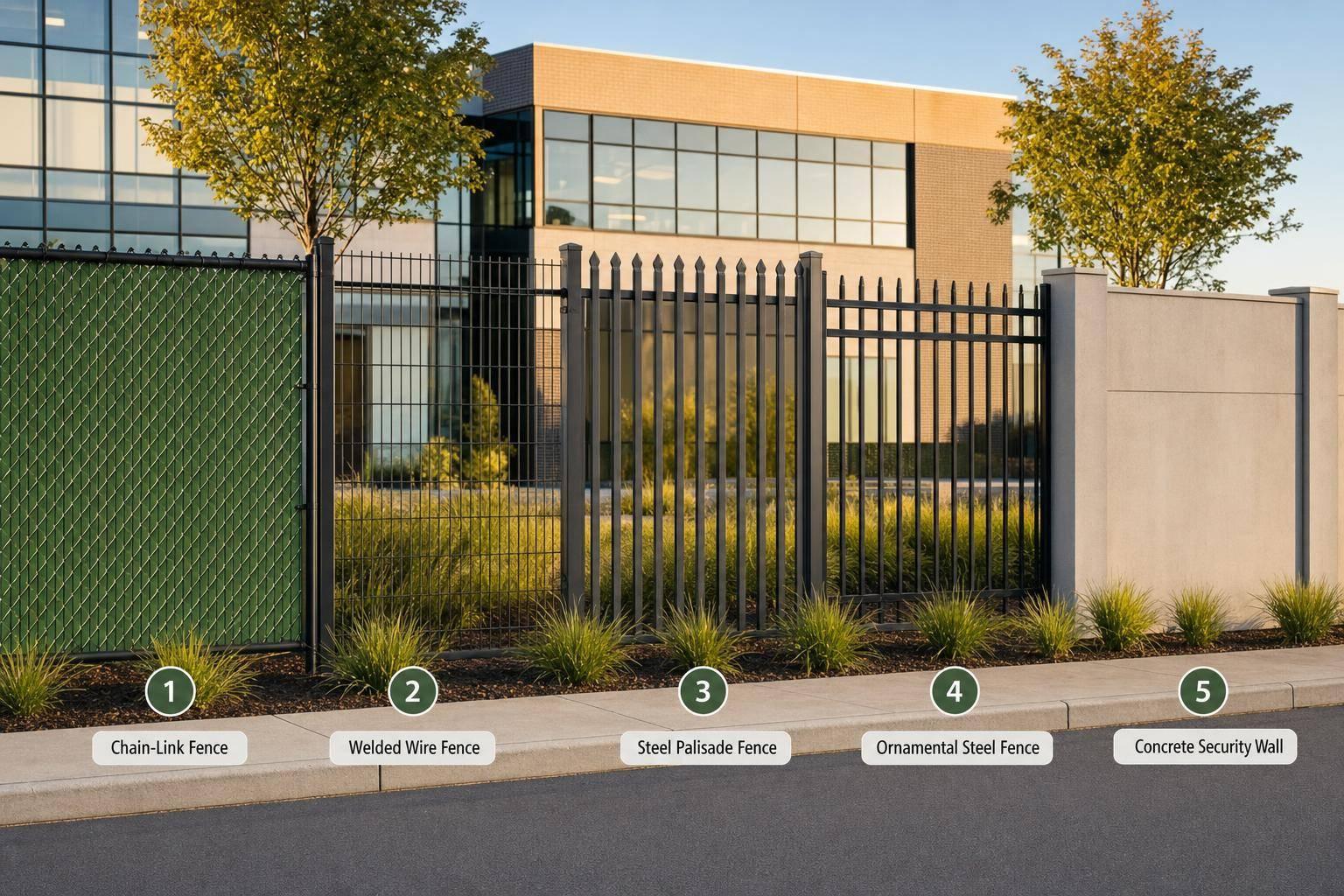
If I need to pick a commercial security fence fast, I’d narrow it down by risk level, visibility, upkeep, and cost. With 6.5 million+ U.S. property crimes reported in 2022 and property crime up 7.1%, the fence choice is not just about marking a line. It’s about making entry harder, keeping sightlines open where needed, and matching the barrier to the site.
Here’s the short version:
- Chain link: lower-cost perimeter control with high visibility
- Welded wire mesh: more rigid than chain link, still easy to see through
- Palisade / vertical steel: harder to climb, built for tighter perimeter control
- Ornamental iron: mixes security with a cleaner street-facing look
- High-security anti-climb systems: the top option for high-risk sites, often with electrified parts
If I were comparing them, I’d think about:
- Security level
- Camera and patrol visibility
- Site type
- Maintenance load
- Budget
Types of Security Fencing
sbb-itb-d1d0a96
Quick Comparison
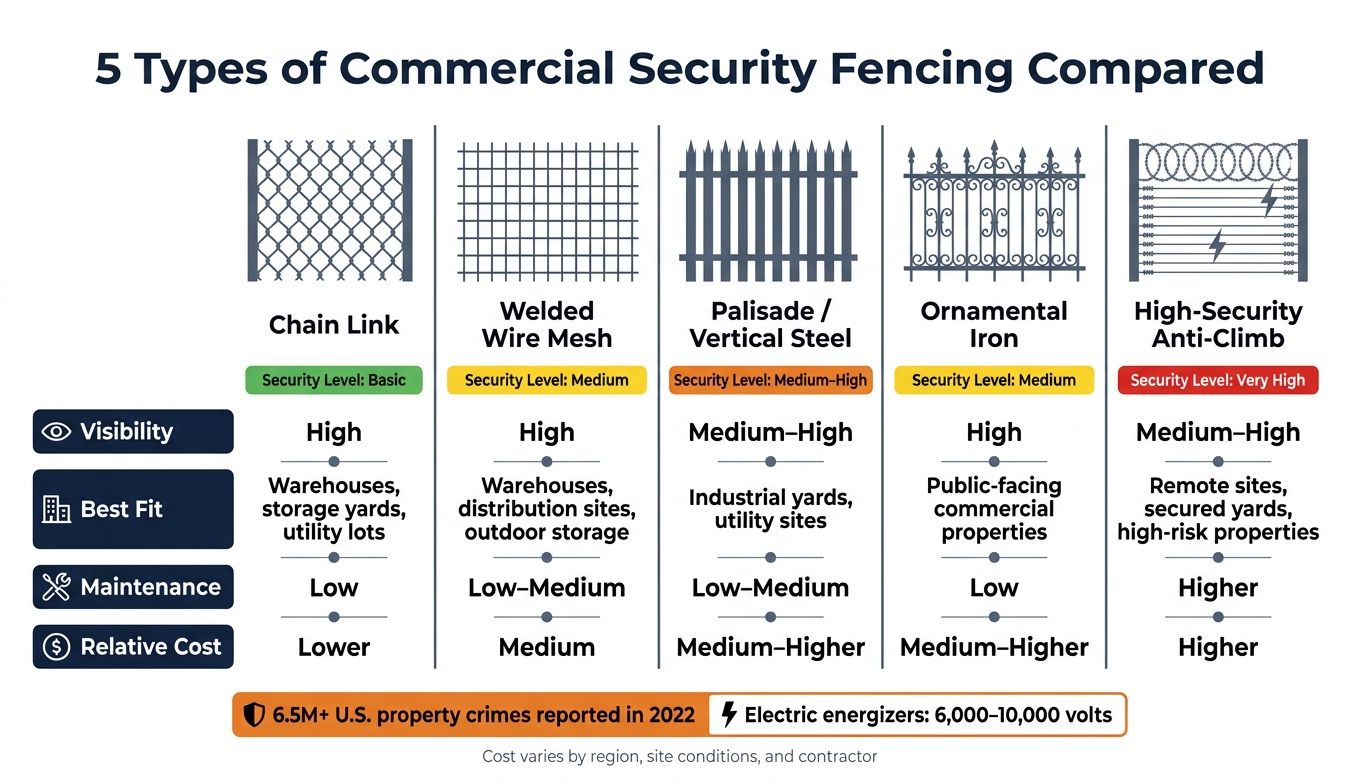
5 Types of Commercial Security Fencing Compared
| Fence Type | Security Level | Visibility | Best Fit | Upkeep | Cost Range |
|---|---|---|---|---|---|
| Chain Link | Basic | High | Warehouses, storage yards, utility lots | Low | Lower |
| Welded Wire Mesh | Medium | High | Warehouses, distribution sites, outdoor storage | Low to medium | Medium |
| Palisade / Vertical Steel | Medium to high | Medium to high | Industrial yards, utility sites | Low to medium | Medium to higher |
| Ornamental Iron | Medium | High | Public-facing commercial properties | Low | Medium to higher |
| High-Security Anti-Climb | Very high | Medium to high | Remote sites, secured yards, high-risk properties | Higher | Higher |
A few numbers stand out. Typical U.S. commercial fence installs often fall around $7,500 to $13,500, and electric fence energizers can run at 6,000 to 10,000 volts. That alone tells me not every site needs the same setup.
The main takeaway is simple: low-risk sites often do fine with open, lower-cost fencing, while high-risk sites need anti-climb features, stronger materials, and more frequent checks. I’d also pair any fence with locked gates, cameras, and motion sensors instead of treating the fence as the whole security plan.
1. Chain Link Security Fencing
Chain link is a good fit when visibility matters more than having a solid wall. It creates a clear perimeter that works well with cameras, patrols, and gated access. This makes it a strong match for low- to medium-risk sites where sightlines and budget carry the most weight. In simple terms, it gives you perimeter control without closing everything off from view.
Visibility and Surveillance Compatibility
The open mesh design helps cameras, motion sensors, and security patrols do their job without blocked sightlines. That matters more than people think. If your team or your cameras can see clearly, it’s easier to spot trouble before it turns into a bigger problem.
Locked gates and a clearly marked perimeter also send a message. They make entry less appealing to opportunistic intruders and show that the property is being watched, maintained, and secured.
Typical Commercial Use Cases
You’ll often see chain link around places like:
- Warehouses
- Storage yards
- Utility lots
- Other properties that need low-cost perimeter control with clear visibility
That setup works well for sites that need a defined boundary, but don’t need full visual screening.
Relative Cost and Maintenance
Price is a big reason chain link still shows up on so many commercial properties. It’s one of the lower-cost options for commercial security fencing, which makes it a practical first step for many businesses.
That said, low cost doesn’t mean no upkeep. To keep it doing its job, chain link needs regular inspections, gate checks, and rust control. Skip that maintenance, and small issues can pile up fast.
2. Welded Wire Mesh Security Fencing
Welded wire mesh gives you a more rigid perimeter than chain link while still keeping the area easy to see through. That extra stiffness adds more physical resistance, so it works well for sites that need more than a simple boundary line.
Visibility and Surveillance Compatibility
The open design keeps sightlines clear for cameras and patrols. That helps support deterrence without blocking the perimeter from view.
Typical Commercial Use Cases
Welded wire mesh is common on sites that need stronger perimeter control without giving up visibility. You’ll often see it around warehouses, distribution centers, and secured outdoor storage areas.
Relative Cost and Maintenance
Keep vegetation cleared back and inspect the fence on a regular basis to stop overgrowth from becoming a problem.
If a site needs more physical resistance and welded wire mesh still isn’t enough, palisade fencing is the next step up.
3. Palisade and Vertical Steel Fencing
For sites that need more resistance than welded wire mesh, palisade is the next step up. It uses vertical steel pales, often finished with spiked tops, to form a rigid barrier that’s hard to climb. You get stronger perimeter control without giving up visibility.
Security Level
Its height and pointed profile make it a strong deterrent at high-risk perimeters.
Visibility and Surveillance Compatibility
Its open design keeps sightlines clear for cameras and motion sensors.
Typical Commercial Use Cases
It works well for industrial yards, utility sites, and other properties that need tight perimeter control without blocking visibility.
Relative Cost and Maintenance
Palisade fencing is durable and needs routine inspections and prompt repairs to preserve its deterrent value.
4. Ornamental Iron Security Fencing
If palisade fencing is built around maximum deterrence, ornamental iron takes a different path. It blends perimeter security with a cleaner, more polished look. That’s why many property owners choose it not just for control, but also for how it looks from the street. It works well for sites that need security without giving off a harsh, industrial feel.
Security and Visibility
An ornamental iron fence makes unauthorized entry harder while keeping the property looking finished and well cared for. Its open design also helps in a practical way: sightlines stay clear for cameras and patrols. Cameras and motion sensors remain visible along the fence line, which adds to deterrence. Supplemental lighting can make the perimeter tougher to approach after dark.
Typical Commercial Use Cases
Ornamental iron is a good fit for public-facing commercial properties that need both security and a polished appearance.
Relative Cost and Maintenance
Regular upkeep helps preserve both appearance and deterrence. When maintenance slips, the site can look easier to target.
For sites that need more resistance than appearance-focused fencing can offer, anti-climb systems provide the highest level of perimeter control.
5. High-Security Anti-Climb Fencing Systems
For the highest-risk commercial sites, anti-climb systems do more than block access. They add hard-to-cross physical barriers and active deterrents at the same time. When standard fencing falls short, these systems offer the strongest perimeter control for high-risk or remote sites that protect expensive assets. This is the most secure option in the list.
Security Level
These systems pair reinforced fencing with electric deterrents. Electric fence energizers typically run at 6,000 to 10,000 volts. That kind of setup sends a clear message before anyone even tries to get over the fence.
Offset wires make climbing much harder. Some systems also use high-tensile wire or stainless steel rope mesh to improve cut resistance. Put simply, they’re built to slow intruders down and make forced entry far more difficult.
Visibility and Surveillance Compatibility
Visible cameras, sensors, and a clean fence line make these systems more intimidating. A clearly marked, well-maintained perimeter shows that the site is being watched and actively protected.
That visual signal matters. If the fence is damaged or covered by overgrowth, the deterrent effect drops fast. A messy perimeter can suggest weak monitoring, even when the hardware is still in place.
Typical Commercial Use Cases
High-security anti-climb systems are common at remote utility sites, secured storage yards, and other commercial properties where a breach could be costly. These are the kinds of locations where losing time, equipment, or inventory can turn into a major problem.
In remote areas, solar-powered energizers are a practical option when grid power isn’t available. That makes them a good fit for sites that still need strong perimeter defense but don’t have easy access to standard power.
Relative Cost and Maintenance
These systems need more attention than standard fencing. Electric fences should be checked weekly, and vegetation needs to be cleared on a regular basis to prevent grounding.
The comparison table below shows how these options differ in security, visibility, cost, and best use.
Side-by-Side Look at Commercial Security Fence Options
The table below compares the five fence types by security, visibility, cost, maintenance, and best use.
Comparison Table: Security, Visibility, Cost, and Best Use
Use this snapshot to compare the five options quickly.
| Fence Type | Security | Visibility | Best Use | Maintenance | Relative Cost |
|---|---|---|---|---|---|
| Chain Link | Basic perimeter control | High | General commercial perimeters | Low | Lower |
| Welded Wire Mesh | Moderate resistance | High | Industrial yards, utilities, and storage areas | Low–Moderate | Moderate |
| Palisade / Vertical Steel | Moderate–High deterrence | Moderate | Sites that need a stronger physical barrier | Low–Moderate | Moderate–Higher |
| Ornamental Iron | Moderate security | High | Customer-facing properties where appearance matters | Low | Moderate–Higher |
| High-Security Anti-Climb Systems | Very High | Moderate–High | High-risk or remote sites that need stronger access control | Higher | Higher |
Cost varies by region, site conditions, and contractor.
How to Narrow Down the Best Option
After you compare the basics, the short list usually comes down to four things: code, appearance, access, and upkeep.
Start with local fence codes. Height limits, material rules, and permit requirements can change from one municipality to the next. A fence that looks fine on paper can turn into a headache if it doesn’t meet local rules.
For customer-facing properties, appearance matters more than people sometimes think. A clean, well-kept fence can support security while also helping curb appeal. It sends a simple message: this property is watched and cared for.
Access control matters too. Even a strong fence does more when it’s paired with locked gates, cameras, motion sensors, and routine patrols. Think of the fence as the outer shell, not the whole system.
Upkeep is the other big filter. High-security and electrified systems need regular testing and vegetation control to keep working the way they should. If your team can’t stay on top of maintenance, a simpler option may make more sense.
Conclusion
After looking at the five fence types, the choice comes down to four things: risk, layout, cost, and upkeep. There isn’t one fence that works for every site. The right pick depends on your threat level, your property’s layout, your budget, and how much appearance matters.
A fence also works best as part of a bigger security setup. Pair it with locked gates, cameras, and motion sensors.
Key Takeaways for Commercial Property Owners
Before you commit to a fence type, run it through these four filters:
- Threat level – Higher-risk sites may need anti-climb or other high-security fencing systems.
- Site layout – Match the fence to the size and shape of the property, including entry and exit points.
- Budget – Compare both the upfront cost and the long-term maintenance needs.
- Local codes – Check height limits, permit rules, and access-control requirements before choosing materials.
For site-specific guidance, Tend Fencing installs commercial fencing and automatic gates in Plano, TX, and surrounding areas.
FAQs
Which fence type is best for my risk level?
The best fence comes down to the specific threats around your property. In higher-risk areas, you may need a tougher, force-resistant barrier like stainless steel cable mesh. It helps secure the perimeter without blocking visibility, which matters when you want both control and a clear line of sight.
For intrusion risks like climbing animals or unauthorized access, electric fencing can work well, especially with multi-strand setups and high-voltage energizers. Good visibility, regular maintenance, and added security features can also make the fence a stronger deterrent.
Do I need an anti-climb or electrified fence?
Whether you need an anti-climb or electrified fence comes down to your security needs and the kind of threats you’re dealing with.
Electric fencing can be a strong deterrent, but it also needs careful installation, solid grounding, and regular upkeep. If your main goal is to mark boundaries, stop unauthorized access, or tighten site security, ornamental iron, chain-link, or specialized mesh may be a better fit, depending on how your property needs to look and work.
What local codes should I check before installing a fence?
Before you install a fence on your commercial property, check local zoning ordinances and permit requirements first.
Those rules can cover things like fence height, approved materials, and how close the fence can sit to property lines or easements. In Plano, Texas, you can review city building and permit rules through the official eTRAKiT portal. You can also contact your local planning or building department to make sure your project complies.