

Chainlink fences are practical for marking boundaries, but they can be vulnerable to cutting, climbing, or being bypassed. With the right upgrades, you can turn a standard chainlink fence into a strong security barrier. Here’s how:
- Thicker Gauge Wire: Opt for 6-gauge wire for better resistance against cutting tools.
- Concrete Footings: Secure posts with concrete to prevent leaning or shifting.
- Barbed or Razor Wire: Add these to the top for anti-climb protection.
- Privacy Slats: Block up to 98% visibility to deter intruders.
- Smaller Mesh Apertures: Use tighter mesh (1 inch or less) to prevent climbing and cutting.
- Tension Wire: Reinforce the bottom to stop lifting or crawling underneath.
- Top Rail: Strengthen the structure and prevent sagging or pulling.
- Heavy-Duty Gate Hardware: Use secure locks and reinforced hinges for gates.
- Closer Post Spacing: Reduce post gaps to increase overall fence strength.
- Steel Fittings & Tack Welding: Secure connection points to resist tampering.
Each of these methods contributes to a more secure and durable fence. Combining multiple upgrades ensures better protection for your property.
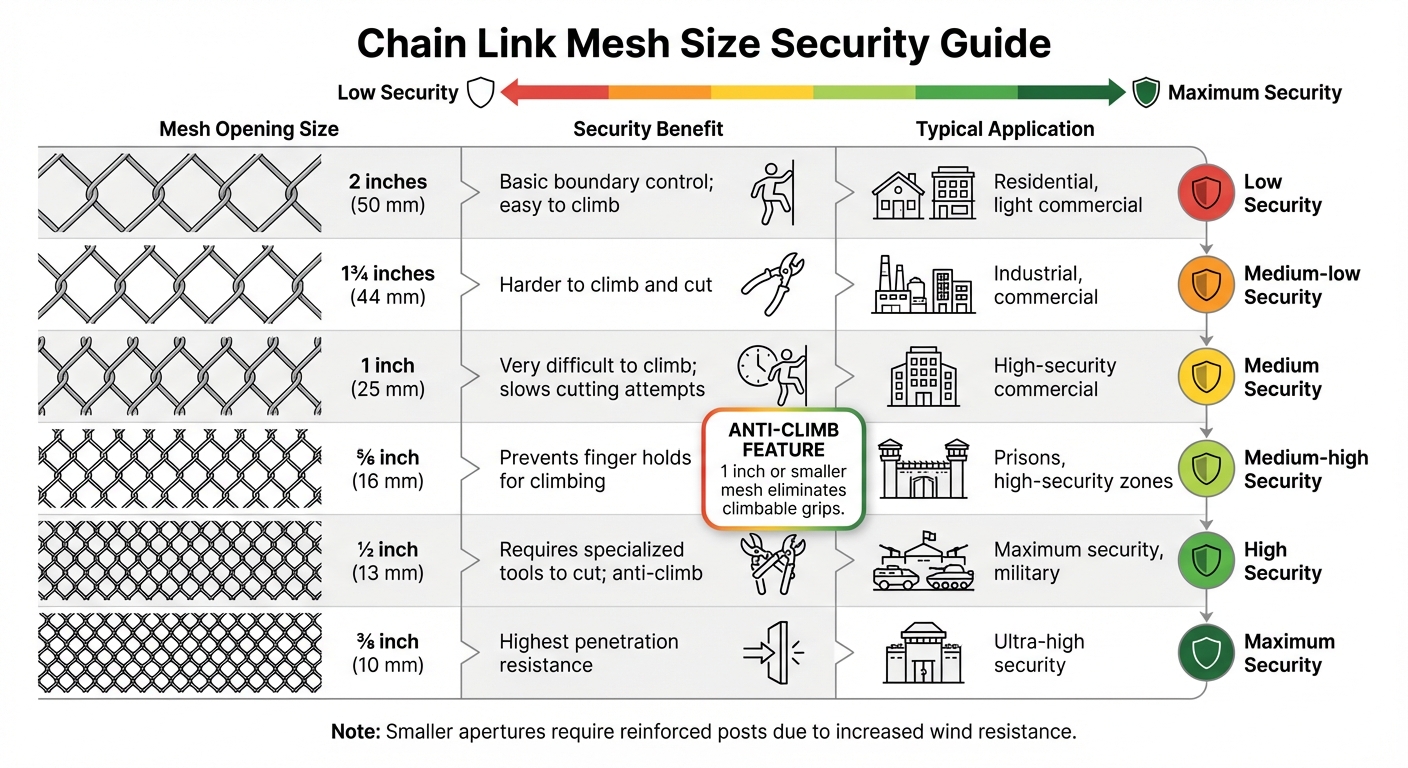
Chain Link Fence Mesh Size Security Comparison Guide
Simple Ways to Upgrade Your Old Chain-Link Fence
sbb-itb-d1d0a96
1. Upgrade to Thicker Gauge Wire
The thickness of the wire you choose directly affects how resistant your fence is to cutting and tampering. Here’s a quick tip: the lower the gauge number, the thicker and stronger the wire. For instance, a 6-gauge wire has a diameter of 0.192 inches, while an 11-gauge wire is only 0.120 inches thick.
Most residential fences use 11- or 12-gauge wire, which can be cut with basic wire cutters. Commercial fences often step it up to 9-gauge wire for added durability. But if you’re aiming for maximum security, 6-gauge wire is the way to go. Its thickness makes it tough enough to withstand bolt cutters and other heavy-duty tools, buying you more time to respond to any intrusion attempts.
"A standard residential chain link fence uses 9-gauge wire… But for serious security, you’ll want 6-gauge wire… It can withstand bolt cutters that would slice through thinner material." – BC Fence Austin
Upgrading to thicker wire does come with higher upfront costs because of the additional steel weight. However, the long-term advantages are worth the investment. Thicker wire holds its shape better, resists sagging, and stands up to harsh weather. It also supports added security measures like privacy slats or barbed wire.
For commercial properties in areas like Plano, 9-gauge wire strikes a good balance between cost and protection. Combine it with a smaller mesh size (covered in tip #5) for even better security. This upgrade sets a strong foundation for the other improvements discussed in the next sections.
2. Reinforce Posts with Concrete Footings
A sturdy fence starts with well-anchored posts. Even the toughest mesh can fail if the posts aren’t secured properly. Concrete footings provide that essential stability, locking posts in place and preventing them from shifting, leaning, or collapsing over time.
While thicker wires help deter cutting, it’s the secure posts that ensure the fence can withstand pressure. Concrete footings play a key role by distributing stress evenly across the soil, which is especially critical for terminal posts at corners, ends, and gates. These posts bear the most tension and are prone to loosening due to wind, soil movement, or even tampering if not properly anchored.
"Fence performance starts below ground. While fence panels, rails, and finishes often receive the most attention, the true foundation of a long-lasting fence lies in its posts and the footings that support them." – KKR Fencing & Outdoor Services
During professional chainlink fence installation, terminal post holes are dug about 30 inches deep and 8 inches wide, while line post holes should be 18–24 inches deep and 6 inches wide. Add 3–4 inches of gravel at the bottom for drainage. Use a level to ensure the post stays vertical as the concrete sets, which typically takes 24–48 hours. Properly anchored posts not only keep the fence stable but also enhance its ability to deter intrusion.
To protect the posts from water damage, slope the top of the concrete away from the post, directing rainwater outward. In colder climates, set the concrete top about 6 inches below ground level to prevent frost from heaving the posts. With securely anchored posts, your fence gains a solid foundation ready to handle added reinforcements.
3. Add Barbed Wire or Razor Wire at the Top
Adding barbed or razor wire to the top of your fence can make it much harder for intruders to climb over. Barbed wire is made of twisted wire strands with sharp points spaced along its length, while razor wire (also known as concertina wire) features sharp, blade-like edges. The choice between these two depends on your property type and local regulations.
"Adding barbed wire on angled arms isn’t just for show; it’s a proven method to significantly improve the anti-climb capabilities of your chain link security fence." – B.C. Fence
For residential properties, barbed wire is often the better option where allowed. However, many municipalities restrict or completely ban its use in residential areas for safety reasons. These rules often require a minimum fence height of 6 feet and mandate that any added wire must angle inward toward your property. Commercial and industrial properties typically have more leeway. Razor wire is commonly permitted in high-security areas like warehouses, industrial complexes, and government facilities.
Before you proceed, it’s crucial to check your local zoning laws and HOA guidelines. For instance, razor wire is banned in most areas of Canada and is heavily regulated in many parts of the U.S.. If you’re installing wire, use angled outriggers that force climbers to lean outward, making it nearly impossible to scale the fence without getting tangled. Secure these outriggers with tamper-resistant carriage bolts. Additionally, post clear warning signs to meet legal requirements and alert the public.
A typical barbed wire installation uses three to six strands, adding 1.5 to 2 feet of extra height to your fence. For sites that require maximum protection, such as high-risk areas, concertina razor wire coils are the strongest deterrent. However, due to the safety risks involved, professional gate and fence installation is highly recommended.
4. Install Privacy Slats for Obscured Visibility
Privacy slats can transform a basic chainlink fence into a more secure and private barrier. By blocking 75%–98% of visibility, these slats prevent outsiders from easily viewing your property, making it harder for potential intruders to identify valuable targets or plan unauthorized access.
"From a security perspective, slats make it harder for potential intruders to scope out property. When people can’t easily see behind fences, it removes temptation." – Rob Thibeault, Author
The most popular material for privacy slats is high-density polyethylene (HDPE), known for its durability. HDPE resists saltwater, road chemicals, and pollutants, and most options come with a 25-year warranty. For a more modern aesthetic, aluminum slats offer a sleek look and excellent rust resistance, especially beneficial in coastal areas.
There are several privacy levels to choose from:
- Bottom-locking slats: Provide 75% privacy at a lower cost.
- Winged slats: Offer 90–95% privacy and feature self-locking installation, requiring no additional tools.
- Four-wing "Ultimate" slats: Deliver the highest coverage, blocking up to 98% of visibility.
While these slats improve privacy, they also increase wind resistance by turning the fence into what’s essentially a sail. To maintain stability, consider upgrading to heavier-duty posts, such as "PF 20" light industrial grade or Schedule 40 pipe. Before purchasing, measure your fence’s diamond openings (commonly 2 inches or 2¼ inches) to ensure the slats fit correctly.
Installing privacy slats is relatively straightforward. You can cover about 10 feet of fencing in an hour, starting at a corner or end post for proper alignment. A plastic putty knife can help thread the slats without damaging the mesh. For fences taller than 8 feet, professionals often use two half-sized slats for better fit and improved wind resistance.
5. Use Smaller Mesh Aperture Chain Link
Switching from a 2-inch mesh to a 1-inch (or smaller) mesh can significantly boost fence security by eliminating climbable grips. When the mesh openings shrink to 1 inch or less, it becomes nearly impossible to climb because the reduced size prevents a secure handhold.
Smaller mesh also makes it harder for cutting tools to penetrate. Standard bolt cutters, for example, struggle to fit through the tighter wire spacing. For areas requiring the highest level of security – like correctional facilities or power plants – a 3/8-inch mesh provides the strongest resistance to cutting and penetration.
| Opening Size | Security Benefit | Typical Application |
|---|---|---|
| 2 in. (50 mm) | Basic boundary control; easy to climb | Residential, light commercial |
| 1 3/4 in. (44 mm) | Harder to climb and cut | Industrial, commercial |
| 1 in. (25 mm) | Very difficult to climb; slows cutting attempts | High-security commercial |
| 5/8 in. (16 mm) | Prevents finger holds for climbing | Prisons, high-security zones |
| 1/2 in. (13 mm) | Requires specialized tools to cut; anti-climb | Maximum security, military |
| 3/8 in. (10 mm) | Highest penetration resistance | Ultra-high security |
This variety of mesh apertures allows you to customize your fence’s security based on your specific needs. Smaller apertures work well alongside other security measures, strengthening the overall barrier.
For most commercial properties, a 1 3/4-inch mesh is a common choice. However, for high-risk locations, smaller apertures – 1 inch or less – are recommended. Keep in mind that tighter mesh openings increase wind resistance, so reinforced posts are essential to maintain stability. Pairing smaller mesh with heavy 9-gauge wire and reinforced posts creates a more robust security solution.
6. Add Tension Wire Along the Bottom
Reinforcing the base of a chain-link fence is essential for residential fence security and durability. Adding tension wire creates a sturdy horizontal barrier that stops animals or intruders from lifting or pushing the fence fabric to crawl underneath. This is especially useful for older fences that may have weakened over time due to snow loads or other environmental factors. By reinforcing the bottom, this method strengthens the entire fence structure and complements any previous upgrades.
To install, position the tension wire no more than 6 inches from the bottom of the mesh. For new fences, sandwich the wire between the posts and the fabric. For existing fences, stretch the wire externally, tuck it between the posts and fabric, and secure it with hog rings.
"This wire reinforces the bottom of a chain link fence and helps prevent the bottom from ‘pulling’ up if an animal tries to push the fabric out and away from the fence line." – Hoover Fence
Use 7-gauge galvanized or 6-gauge vinyl-coated spiral tension wire for added strength and resistance to weather. When stretching the wire, maintain its natural crimp pattern to accommodate thermal expansion and prevent misalignment of terminal posts. Secure the wire with hog rings spaced every 24 inches for standard security. For added protection against smaller animals, reduce the spacing to 12 inches.
If animals persist in pushing under the fence, you can add U-shaped stakes to anchor the wire securely to the ground. This extra step ensures a tighter, more secure barrier.
7. Install a Sturdy Top Rail
A top rail transforms your chainlink fence into a more rigid and secure barrier. This horizontal rail runs along the entire length of the fence, connecting all posts. It helps prevent the chainlink fabric from sagging over time or being pulled down by intruders, which is key for long-term durability and security.
For better strength and resistance against bending or tampering, choose materials like Schedule 40 or SS40 pipe. These options have thicker walls, making them far tougher than standard pipes.
"Industrial and security chain link fences are made from much heavier pipe, up to Schedule 40 or SS40 in some cases. It may look the same from outside, but it’s a whole lot tougher on the inside!" – Rite-Way Fencing
Steel fittings can also boost security. Unlike standard aluminum components, steel fittings are tougher and can be tack welded after installation, making them more resistant to tampering. Attach the chainlink fabric to the top rail using fence ties, spaced no more than 24 inches apart, to ensure the fabric stays tight and secure.
If you’re worried about climbing, consider installing the top rail 12 inches below the top of the mesh. This placement eliminates easy handholds for climbers while still providing the structural support your fence needs.
8. Secure Gates with Heavy-Duty Hardware and Locks
Your gate is often the most vulnerable part of a chainlink fence, and if it’s not secure, it can compromise the entire system. Strengthening your gate with heavy-duty hardware and reliable locks is a smart way to protect your property.
According to Acme Locksmith, standard welders can’t bond effectively with galvanized chainlink, so specialized mounting kits are a must. Additionally, wide gaps and loose tolerances can make self-latching mechanisms unreliable. To address these issues, opt for heavy-duty padlocks – either combination or keyed – that resist bypass attempts and can be keyed to match your existing locks. If using keys isn’t practical, especially in high-traffic areas, mechanical keypad systems like the Lockey GB2900 gate box (compatible with Lockey 2900 or 2985 locks) are a solid, non-welded alternative. Just make sure the gap between the gate rail and fence post is less than ½ inch to ensure the latch engages properly.
For added durability, reinforce gate hinges by installing hinge straps or bolts and upgrading to stainless steel or galvanized hinges. Secure these with carriage bolts (smooth head facing outward, nuts on the inside, and ends peened to prevent removal). Adding a bottom rail can also help deter prying attempts.
If you want to take it a step further, consider upgrading to an automatic gate system. Options like keypad entry, magnetic locks, or smart locks with biometric scanners provide both convenience and security. Ensure the ground is graded properly for smooth operation, and cover all hardware with hardened covers to prevent tampering. These upgrades not only enhance security but also improve the overall functionality of your gate.
9. Space Posts Closer Together
When combined with reinforced posts and tension wires, reducing the distance between fence posts creates a sturdier framework. Shrinking the standard spacing from 8–10 feet to 7 or 8 feet significantly boosts the fence’s strength and reduces weak points, such as those exploited by a drive-through tactic.
At 10 feet apart, a cut in the mesh could allow a vehicle to pass through. As Rite-Way Fencing explains, “Post spacing of seven feet or eight feet will make it a lot harder to access any site using this sneaky trick [cutting the fence and driving through].” The closer spacing distributes force across more concrete-anchored posts, making it harder for intruders to bend the frame or lift the fence fabric.
| Fence Height | Recommended Spacing | Primary Security Benefit |
|---|---|---|
| 4 feet | 10 feet | Cost-effective boundary marking |
| 6 feet | 8 feet | Better wind load and weight support |
| 8 feet | 6 feet | Stronger structure for taller perimeters |
While tighter spacing means more posts, concrete, hardware, and labor, it results in a fence far better equipped to resist breaches—you can request a quote to estimate these upgrades. If you’re adding privacy slats or windscreens, closer spacing (6 to 8 feet) is crucial to handle the added wind load. For taller fences, Liam Cope, Founder of Engineer Fix, advises that “increasing the fence height from four feet to six or eight feet requires reducing the post spacing by at least 25% to manage the increased leverage and bending moment at the base”.
To plan your layout, divide the total fence length by your target spacing to ensure uniform and sturdy intervals. Although the upfront costs are higher, the payoff is a much more secure fence. This adjustment, combined with earlier reinforcements, strengthens the overall security of your fencing system.
10. Use Steel Fittings and Tack Welding
To strengthen your chainlink fence even more, upgrading the connection points is key. Incorporating steel fittings and tack welding can transform your fence into a nearly tamper-proof barrier. Steel fittings make it possible to apply tack welds, turning vulnerable spots into secure joints that only heavy-duty cutting tools can penetrate.
"The reason high security fencing like prison fencing uses steel fittings is that they can be tack welded in place after the installation is complete – making it much harder for people to tamper with the fence." – Rite-Way Fencing
Tack welding works by creating short, permanent welds that fuse metal components together. Once the fence is installed and aligned, a welder applies weld beads to the screw heads, locking the brackets in place. This approach makes tampering nearly impossible without specialized cutting equipment, effectively countering common intrusion methods. It’s a technique often seen in high-security settings like prisons, military bases, and government facilities.
Before welding, sand off any powder coating or galvanization to ensure a clean bond between the metal components. Afterward, apply a galvanizing primer and rust-inhibiting paint to protect the welded areas from corrosion. For gates, weld the hinge pins to prevent unauthorized removal.
While tack welding might make future maintenance more challenging, the added security it provides is well worth the trade-off. Incorporating steel fittings and tack welding significantly increases the difficulty for intruders to breach your fence.
Conclusion
Improving the security of your chainlink fence requires a multi-layered approach. Instead of focusing on a single upgrade, combining several methods creates a system where each enhancement supports the others, turning a standard fence into a robust protective barrier.
Structural upgrades play a key role in this process. Features like closer post spacing, concrete footings, and secure bottom rails provide a sturdy framework that resists tampering, vehicle impact, and other physical threats. Additions such as privacy slats and barbed wire not only act as visual deterrents but also increase the physical challenge for intruders. Using galvanized materials and ensuring proper tension during installation helps guard against weather-related wear and extends the fence’s lifespan. These combined measures create a comprehensive security system.
When planning your upgrades, consider local regulations, environmental conditions, and your budget. For example, residential properties may focus on privacy and keeping pets secure, while commercial sites often require stronger defenses against forced entry.
To maximize the effectiveness of these enhancements, professional installation is highly recommended. Skilled installers use high-quality materials, such as Schedule 40 pipe and heavy-duty wire mesh, and apply specialized techniques like driving posts 4 to 5 feet into the ground. For tailored chainlink fencing solutions in Plano, TX, and nearby areas, Tend Fencing combines premium materials with expert craftsmanship to meet your specific security needs.
FAQs
Which upgrade gives the best security boost for the cost?
A durable, self-closing, key-lockable chain link fence latch is one of the most effective ways to enhance security without breaking the bank. This simple upgrade helps prevent unwanted access, can be installed or replaced with ease, and doesn’t require any specialized tools. While measures like raising the fence height or adding barbed wire can also boost security, they tend to be more costly and time-consuming. A secure latch strikes the perfect balance between practicality and affordability.
Are barbed wire or razor wire legal where I live?
The use of barbed wire or razor wire is subject to local laws and zoning rules. In some places, these types of fencing are permitted as long as they adhere to specific guidelines. However, they are often banned in residential areas. It’s essential to consult with your local authorities to make sure you’re following the regulations in your location.
Should I upgrade the fence fabric first or the posts and footings?
When improving a fence, start by upgrading the posts and footings. A solid foundation is key to ensuring the fence remains stable and long-lasting. Once the base is sturdy, you can focus on reinforcing or replacing the fence fabric to boost security effectively.