

Vinyl-coated chain link fences offer a durable and low-maintenance alternative to standard galvanized options. They address common issues like rust, sharp edges, and poor aesthetics while lasting longer and requiring less upkeep. Here’s why they stand out:
- Rust Protection: The vinyl coating creates a barrier against moisture and UV rays, preventing rust and corrosion.
- Longevity: These fences last 20–30+ years, compared to 15–25 years for standard fences.
- Low Maintenance: Cleaning requires just a quick rinse, with no need for painting or sealing.
- Safety: The smooth surface eliminates sharp edges, making it safer for kids and pets.
- Improved Appearance: Available in colors like black, green, brown, and white, they blend well with landscaping and reduce glare.
While they cost about 20–40% more upfront ($13–$20 per linear foot vs. $10–$17), their extended lifespan and reduced maintenance make them a smart long-term investment. Perfect for residential, commercial, and coastal areas, vinyl-coated fences combine functionality with style.
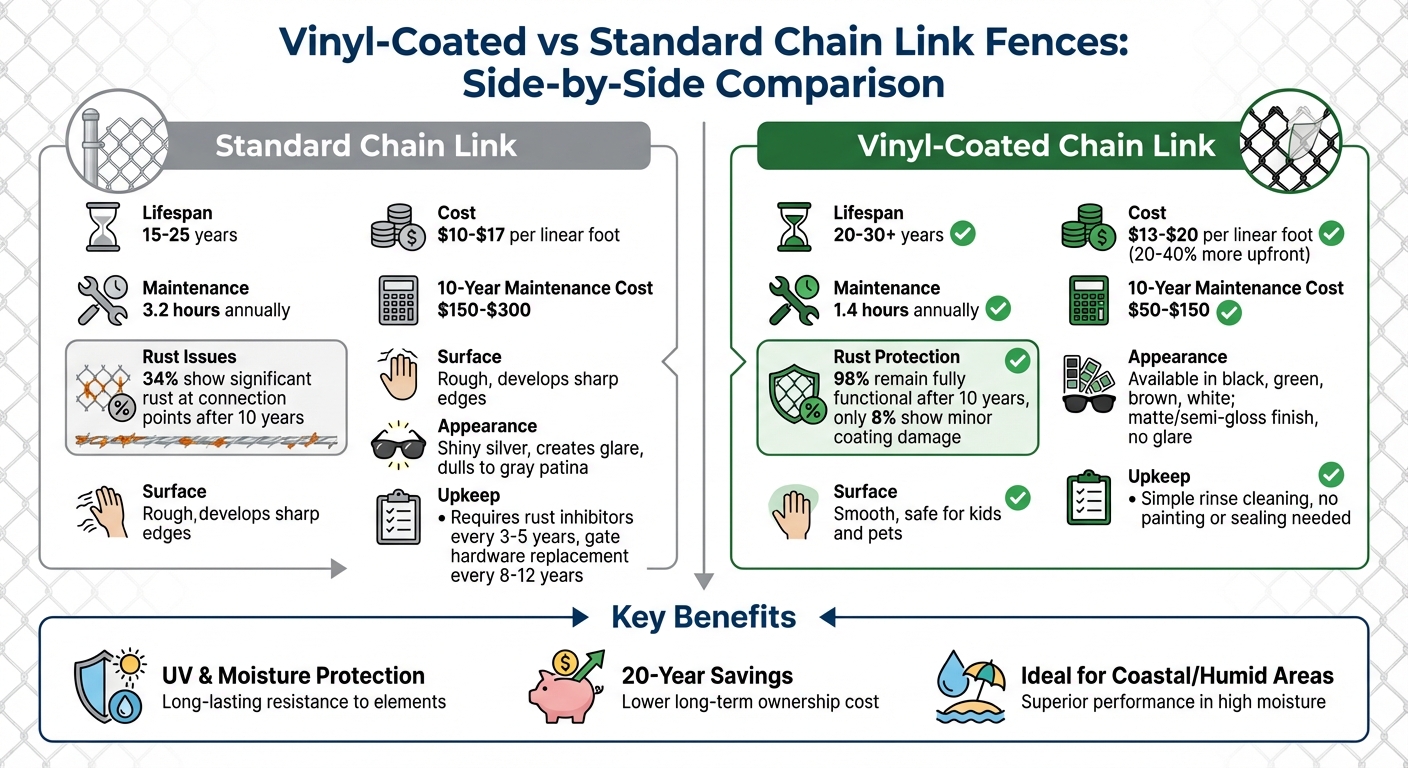
Vinyl-Coated vs Standard Chain Link Fence Comparison
Problems with Standard Chain Link Fences
Rust and Corrosion
Standard chain link fences rely on a protective zinc coating, a process called galvanization, to shield the steel from rust. Over time, this zinc layer wears away, especially in areas exposed to high stress and moisture – like post bases, tension bands, bottom rails, and gate hinges. Once the zinc is gone, the steel underneath begins to rust. This rust, or iron oxide, weakens the fence and makes it brittle. In humid regions or places with moisture-heavy soils, such as red clay, this process speeds up significantly. These factors not only reduce the fence’s durability but also harm its overall appearance and value.
Poor Appearance
The shiny silver finish of a standard galvanized chain link fence often clashes with residential landscaping. Its reflective surface can create an unpleasant glare in sunlight, and within a few years, it dulls into a gray patina that detracts from the property’s curb appeal. In areas with red clay soil, rain can splash mud onto the fence’s bottom rails, leaving stains that are nearly impossible to clean. Beyond these aesthetic concerns, chain link fences are often viewed as inexpensive and utilitarian, which can negatively impact a home’s resale value .
These visual drawbacks are only part of the problem, as safety and maintenance issues further complicate their use.
Safety Concerns and Upkeep Requirements
As chain link fences age, their surfaces become rough and worn. Damaged wires can create sharp edges, which pose risks like snagging clothing or scratching skin – hazards that are particularly concerning for children and pets. Security Fence Minneapolis highlights this issue:
Everyone is familiar with the texture of an old chain link fence. Breaks in the wire and finish roughened by weather cause old chain links to become sharp.
Maintaining these fences can also be a significant burden. Rust treatment is one of the most labor-intensive tasks, requiring the application of rust inhibitors every three to five years, particularly at connection points. Gate hardware, which loses its protective coating over time, often needs replacement every eight to 12 years. Additionally, the roughened surface of aging fences provides an easy grip for invasive plants like kudzu or poison ivy, making upkeep even more challenging.
These issues highlight why vinyl-coated chain link fences are increasingly seen as a more durable and visually appealing option.
sbb-itb-d1d0a96
How Vinyl Coating Solves These Problems
Better Durability and Rust Protection
Vinyl-coated fences offer a dual-layer defense that outperforms standard fencing options. This additional layer of vinyl acts as a protective shield over the galvanized steel, creating a barrier that blocks moisture, oxygen, and corrosive elements. Plus, it includes UV inhibitors to protect against sun damage, ensuring the fence holds up in various weather conditions.
The method of applying the vinyl coating also impacts its effectiveness. For residential use, extruded vinyl creates a loose sleeve around the wire. In commercial settings, extruded and bonded vinyl adds adhesive for extra security. For industrial applications, fused and bonded vinyl is thermally fused to provide maximum durability. Typically, the vinyl layer is about 0.010 to 0.016 inches thick, offering tailored protection depending on the specific needs.
A long-term study conducted by Precision Fenceworks in Metro Atlanta reviewed 50 fence installations from 2010 to 2025. The findings were striking: 98% of vinyl-coated fences remained fully functional after 10 years, with only 8% showing minor coating damage. In contrast, 34% of standard galvanized fences had significant rust at key connection points. Zack Goekjian, Owner of Precision Fenceworks, summed it up perfectly:
"Vinyl coating extends fence life by shielding the galvanized core from moisture and oxygen." – Zack Goekjian, Precision Fenceworks
Longer Service Life
Thanks to its superior protection, vinyl coating significantly increases the lifespan of fences. This is especially important in coastal and humid areas where salt and moisture accelerate wear and tear. The enhanced durability means fewer repairs and replacements over time, making it a cost-effective choice for property owners in these challenging environments.
Smooth and Safer Surface
Vinyl-coated fences don’t just last longer – they also provide a smoother, safer surface. Unlike standard chain link fences that develop sharp edges and barbs as they age, vinyl-coated options maintain a smooth finish throughout their life.
This smooth surface reduces the risk of snagging clothing or skin, making it a safer choice for families with kids or pets. The cushioned coating is particularly ideal for areas like playgrounds, daycares, and dog kennels where people or animals frequently come into contact with the fence. It’s a practical solution for creating a secure and user-friendly environment.
Chain Link Fence Tour: 9-Gauge Vinyl-Coated, Black (from Menards)
Appearance and Design Options
Vinyl-coated fences don’t just excel in durability – they also provide versatile design choices that work seamlessly with a variety of property aesthetics.
Multiple Color Choices
These fences come in a range of colors to match different styles and settings. Popular options include black, green, brown, and white, with custom colors available for specific needs. Black is a favorite for residential properties because it offers a subtle, elegant look that blends into shadows and landscaping. Green works well with natural settings like gardens or lawns, while brown adds an earthy tone that complements rustic designs. White, on the other hand, delivers a crisp, modern vibe, making it a great option for schools, healthcare facilities, or contemporary homes. With such a wide palette, these fences not only perform their function but also enhance the overall look of your property. If you’re ready to upgrade your curb appeal, you can request a free quote for your project.
Blends with Property Design
The metallic shine of standard galvanized steel fences can feel harsh and uninviting. In contrast, vinyl coatings allow fences to blend naturally into their surroundings. Black vinyl, in particular, is excellent at making the fence seem almost invisible when placed near trees, shrubs, or wooded areas. As Pacific Fence & Wire Co. explains:
A black vinyl coating, for example, helps the wire disappear into the landscape.
This subtle integration makes vinyl-coated fences a popular choice for residential spaces, upscale commercial properties, and recreational areas. The understated design ensures the fence complements the environment rather than dominating it.
Reduced Shine and Glare
Traditional galvanized fences often feature a bright, reflective silver finish. Vinyl-coated options, however, offer a matte or semi-gloss finish that reduces glare. This muted finish helps the fence visually recede into the background, making it a better fit for various architectural styles. Even over time, the matte or semi-gloss appearance remains intact, keeping the fence looking polished and cohesive throughout its lifespan.
Low Maintenance and Long-Term Savings
Vinyl coatings do more than just protect against corrosion – they significantly reduce the time and effort needed to maintain a fence compared to traditional galvanized options. This lower upkeep translates into notable long-term savings. Over a decade, vinyl-coated fences require just 1.4 hours of maintenance and cost between $50 and $150, while standard fences demand 3.2 hours and $150–$300. These savings stem from reduced labor and material costs, as outlined below.
Resists Chipping and Color Loss
Vinyl coatings are built to endure harsh weather conditions without compromising their appearance. Unlike bare metal, which often shows rust spots or fades to a dull gray, the synthetic resin layer resists fading and deterioration. Even after years of exposure to sunlight, rain, or fluctuating temperatures, the color remains intact. If the coating gets scratched or chipped, a quick application of plastic paint can reseal the barrier, preventing moisture from reaching the underlying metal.
Simple Cleaning Process
Cleaning a vinyl-coated fence couldn’t be easier. For regular upkeep, a garden hose is usually sufficient to rinse off dirt and debris. For more stubborn grime, such as bird droppings or caked-on mud, a soft-bristled brush paired with mild soap – or natural options like vinegar or borax – works well. Thanks to the smooth surface, dirt doesn’t stick easily, making cleanup quicker. Harsh chemicals like bleach should be avoided; plain water or gentle cleaning solutions are all you need. This simplicity in maintenance further reduces long-term effort and costs.
No Painting or Sealing Needed
Unlike wood fences that require regular staining or repainting, vinyl-coated chain link fences are virtually maintenance-free in this regard. The protective vinyl layer shields the steel from moisture and oxygen, eliminating the need for periodic painting, staining, or sealing. With a lifespan of 15 to 20 years – and often exceeding 20 years with minimal care – these fences deliver durability without constant upkeep.
Best Uses for Vinyl-Coated Chain Link Fences
Residential Applications
Vinyl-coated chain link fences are a popular choice for backyards, offering a mix of safety, functionality, and aesthetic appeal. The smooth vinyl coating helps prevent scratches and snags, making it safer for both children and pets. It’s especially suited for pet enclosures and dog runs, where the barb-free surface keeps animals secure and protected while creating a safe play area for families.
For pool areas, vinyl-coated fences provide a moisture-resistant barrier that stands up to pool chemicals like chlorine. This protective coating prevents rust, even with constant exposure to water and humidity, ensuring the fence remains secure and durable for 15 to 20 years or more. Gardeners also benefit from the open-weave design, which allows sunlight and airflow to reach plants, while color options like green and brown help the fence blend into natural surroundings.
Homeowners looking to enhance curb appeal can choose black or bronze vinyl-coated fences, which offer a more polished look compared to the industrial appearance of silver galvanized fences. These options not only improve aesthetics but may also add to property value, showcasing the dual benefits of style and durability in residential settings.
Commercial and Public Properties
Vinyl-coated chain link fences are equally effective in commercial and public spaces where security and aesthetics are both priorities. Parks, schools, and sports facilities benefit from the smooth vinyl surface, which makes high-traffic areas safer for public use. The open mesh design ensures clear visibility, allowing parents and supervisors to monitor activities without obstructing views.
For businesses, the advanced bonding methods used in vinyl coatings enhance durability, making these fences ideal for industrial or government properties. Commercial installations often use thicker 9-gauge wire, compared to the lighter 11.5-gauge wire in residential settings, making the fences tougher to cut with standard tools. Black vinyl coatings further enhance functionality by reducing glare, which improves visibility for security cameras and surveillance systems compared to reflective galvanized wire. These features combine to create a secure, professional appearance while minimizing maintenance over time.
Coastal and Humid Climates
Vinyl-coated chain link fences shine in areas with harsh, moisture-heavy conditions. In environments prone to salt air, humidity, and frequent rainfall, standard galvanized fences can corrode quickly. Vinyl coating acts as a protective layer, shielding the steel from these elements and extending the fence’s lifespan. As noted by Good Neighbor Fence:
The vinyl coating helps protect the steel wire from rust, corrosion, and wear. This makes it perfect for areas with high moisture levels, such as coastal regions or places with heavy rainfall.
The coating also prevents water damage to fence posts, maintaining structural integrity and security. In these conditions, routine rinsing is enough to keep the fence in good shape. While traditional galvanized fences may lose their finish and rust over time, vinyl-coated options retain their color and protective qualities for 15 to 20 years or more. This durability and low-maintenance design make vinyl-coated fences a smart choice for challenging climates.
Conclusion: The Value of Vinyl-Coated Fences
Vinyl-coated chain link fences bring clear benefits compared to standard galvanized options. Built with a galvanized steel core and a protective vinyl coating, these fences typically last 20 to 30+ years – outperforming the 15 to 25 years of standard chain link fences. They also require much less maintenance, averaging just 1.4 hours annually compared to 3.2 hours for their galvanized counterparts. The smooth, rust-resistant surface enhances safety for kids and pets, while the vinyl coating resists chipping and fading, eliminating the need for frequent painting or sealing.
While the upfront cost is 20% to 40% higher, the long-term savings make vinyl-coated fences a smart investment. Over a 20-year period, annual service costs average $115, slightly above the $113 for galvanized fences, but with fewer repairs and less maintenance required. As Zack Goekjian, Owner of Precision Fenceworks, points out, these fences offer durability and cost efficiency over time.
Vinyl-coated fences are versatile, performing well in residential, commercial, and coastal environments. Homeowners value the added curb appeal from color options like black or green, which blend naturally with landscaping. In coastal and commercial settings, the vinyl layer provides strong protection against salt air and humidity, guarding the metal against corrosion.
To fully enjoy these advantages, professional installation is key. Expert installers ensure the fence is properly tensioned and positioned for maximum durability. For those in Plano, TX, and nearby areas, Tend Fencing offers professional chain link fence installation services. Their licensed team manages everything from layout planning to utility checks, ensuring your vinyl-coated fence delivers decades of dependable performance.
FAQs
Is vinyl-coated chain link worth the higher upfront cost?
Vinyl-coated chain link fences are a smart choice, even with their higher initial cost. Why? They’re safer to handle, resist rust and corrosion effectively, and last longer, cutting down on maintenance costs in the long run. Plus, they offer a clean, polished look that boosts both practicality and visual appeal.
What vinyl coating type is best for my fence?
The best vinyl coating for your chain link fence depends on what you’re looking for. Extruded vinyl is a flexible and temporary option, great if you need something easier to install. On the other hand, bonded or fused vinyl delivers a tougher, more durable finish, ideal for long-term use. Deciding between the two comes down to whether you value convenience or longevity.
Can a damaged vinyl coating be repaired?
Yes, you can fix damaged vinyl coating on a fence. The process typically involves a few straightforward steps:
- Remove loose vinyl: Start by carefully peeling away any loose or damaged vinyl coating.
- Sand the exposed metal: Use sandpaper to smooth out the exposed metal and remove any rust or debris.
- Apply rust-proof paint: Coat the exposed area with a rust-resistant paint to protect the metal from further corrosion.
- Seal with epoxy: Finish the repair by applying an epoxy sealant to restore the coating and improve durability.
Following these steps can help bring back the fence’s original look while extending its lifespan.