
Fence disputes are more common than you think. They often stem from unclear property lines, encroachments, disagreements over maintenance costs, or violations of local rules. Resolving these issues early can save money, time, and stress. Here’s how to handle them effectively:
- Confirm Property Lines: Use property deeds, plat maps, or hire a licensed surveyor.
- Clarify Fence Ownership: Ownership depends on location, construction records, and agreements.
- Understand Local Rules: Zoning laws and HOA guidelines often regulate fence placement, height, and materials.
- Resolve Disputes Early: Talk to your neighbor calmly, share evidence, and consider written agreements.
- Avoid Court if Possible: Mediation or arbitration is faster and cheaper than lawsuits.
- Hire Professionals: Surveyors, attorneys, and licensed fence installers can prevent future problems.
Taking these steps ensures clear boundaries, avoids legal trouble, and helps maintain good neighborly relationships.
Neighbor Fence on My Property – Ask A Real Estate Attorney!
Finding Property Lines and Fence Ownership
To determine your property lines and confirm fence ownership, start by examining your deed, title documents, and plat maps from your county recorder’s office. These documents include the legal description (such as metes and bounds or lot-and-block) that outlines your property boundaries, lot dimensions, and any easements. Compare these records to the physical layout of your property to ensure everything matches. If you have closing documents from when you purchased your home, they may include a prior survey that highlights your property boundaries. Having accurate documentation is crucial when verifying a survey or determining who owns a fence.
How to Find Your Property Lines
Hiring a licensed land surveyor is one of the most reliable ways to confirm your property boundaries. Surveyors will review historical records like your deed, plat map, and previous surveys, then visit your property to locate or re-establish boundary markers. These markers might include iron pins, rebar, concrete monuments, or survey caps stamped with the surveyor’s license number. After taking precise measurements, the surveyor will create a signed and sealed drawing showing your lot lines and any structures like fences. Depending on the size and complexity of your property, a survey can cost anywhere from a few hundred to several thousand dollars. In some cases, neighbors may choose to split the cost of a joint survey, reducing expenses and fostering cooperation.
While physical markers like iron pins or concrete monuments can provide clues, they should always be verified against official surveys. Features like fences, retaining walls, or tree lines may have been placed for convenience and are not definitive proof of boundary lines. Courts and surveyors rely on legal descriptions and professional measurements, so it’s wise to avoid moving a fence or confronting a neighbor until you’ve confirmed the boundary with proper documentation or a survey.
Who Owns the Fence
Fence ownership typically depends on its location in relation to the property line, who paid for its construction, and whether there are any written agreements between neighbors. If a survey shows the fence is entirely on one side of the boundary, it usually belongs to that property owner. However, if the fence is built directly on the boundary line, many states and Homeowners Associations (HOAs) consider it a shared or "partition" fence, with both neighbors responsible for its maintenance. To determine ownership, check for permits, installation contracts, receipts, or HOA approvals that document who originally built the fence. If disputes arise, combining this evidence with a professional survey can clarify ownership and resolve questions about encroachment or repair responsibilities.
For shared fences, neighbors often negotiate agreements that outline maintenance responsibilities, cost-sharing for major repairs or replacements, acceptable materials, and fence height. For example, if one neighbor wants a taller or more decorative fence, they may agree to cover the additional expense, while both parties share the cost of a standard, code-compliant structure. Recording these agreements with your county land records can ensure future property owners honor the terms and help avoid similar disputes in the future. Understanding fence ownership and local regulations is key to resolving conflicts and maintaining compliance.
Local Laws and HOA Rules
Local zoning laws and HOA rules often regulate fence height, setbacks, and sightline requirements. Before making any changes, check with your local planning department and review your HOA guidelines. Many areas also enforce "sight triangle" rules near driveways and intersections to ensure clear visibility for drivers and pedestrians.
In planned communities, your HOA’s Covenants, Conditions, and Restrictions (CC&Rs) may specify additional rules about fence location, height, style, and even which side must have the "finished" appearance. Some HOAs also define when a fence is considered shared and outline maintenance responsibilities. Typically, they require prior approval for any new installations, replacements, or relocations – even if the fence is entirely within your property. Ignoring these regulations can result in fines, orders to alter or remove the fence, and added challenges in resolving disputes with neighbors. Always review your CC&Rs, architectural guidelines, and any past HOA approvals before making changes, and follow the required application process.
For homeowners in areas like Plano, TX, working with a professional fence installer, such as Tend Fencing, can simplify the process. Once you’ve confirmed your property lines and reviewed local regulations, a professional can help design and install a wood, ornamental iron, chain-link, or gate system that meets local codes, clearly marks your property, and helps prevent future conflicts.
Solutions for Common Fence Disputes
Property Line and Encroachment Issues
Once property lines are verified, the next challenge is addressing encroachment. Encroachment happens when a fence crosses into a neighbor’s property – or vice versa. This can range from minor cases, like a fence extending a few inches over the boundary, to more significant issues, such as an improperly placed replacement fence or retaining walls and gates that go beyond the property line. After a professional survey confirms encroachment, the solution should match the severity of the issue and your relationship with your neighbor.
Start by talking directly with your neighbor and sharing the survey results. For minor encroachments – say, a fence that extends six inches over the line – you might agree to move it or create a written agreement. A boundary line agreement is a formal document where both parties agree to treat the current fence as the legal boundary. This agreement is recorded with county land records, ensuring clarity for future property owners.
For larger encroachments, you might need a more formal solution. A written easement or a revocable license can be documented and recorded with your county. An easement allows the fence to stay while confirming you still own the land underneath, while a license gives temporary permission that you can revoke later. Significant encroachments – like a five-foot strip – may require legal action. This could include a formal demand letter from an attorney or legal steps like an ejectment (to remove the fence), a quiet title action (to settle ownership of the disputed area), or an injunction (to stop further construction or enforce setback rules). Tackling disputes early can help avoid costly legal battles down the road.
Maintenance and Safety Problems
Fences in poor condition often lead to disputes, especially when they’re shared or near property lines. Common issues include rotting wood, unstable posts, or rusted panels that could pose safety risks. The first step is figuring out who owns the fence. If it’s entirely on one side of the property line, the owner is typically responsible for upkeep. However, some states have laws treating fences on the boundary as a shared responsibility, requiring neighbors to share repair costs.
Check local ordinances and HOA rules to clarify maintenance obligations. If the fence is unsafe or violates local codes, contacting code enforcement or building officials can sometimes prompt repairs. For less urgent situations, start with a polite written request to your neighbor. Offering to split repair costs or providing estimates from local contractors can help move the conversation forward. Be sure to document the condition of the fence with photos and notes. If the issue persists and the fence poses a real safety risk, you may need to escalate with formal notices, mediation, or even a court order to enforce repairs. Addressing these problems quickly not only ensures safety but also minimizes long-term expenses.
Adverse Possession Claims
A less obvious but important concern is the risk of adverse possession – a legal principle that can transfer property rights if someone openly and continuously occupies another’s land without permission for a set period (usually 10 to 20 years, depending on the state). In fence disputes, this can happen if a fence has been misplaced for years and one neighbor treats the enclosed area as their own.
To avoid adverse possession claims, act quickly when you discover a long-standing encroachment. Document that any use of your land by a neighbor is with your permission. A written license or use agreement can clarify that the neighbor does not claim ownership. Recording a boundary or easement agreement that reserves your ownership rights while allowing the fence to remain provides additional protection. For instance, include language stating that the neighbor’s use of the area is conditional and can be revoked. If a neighbor claims long-term use, update your survey and consult a real estate attorney to evaluate the situation and explore legal options. Taking steps early can save you from expensive and drawn-out legal disputes later on.
Resolving Disputes Without Going to Court
Many fence disputes can be resolved without stepping into a courtroom, saving time and money. The best way to handle these situations is to approach them thoughtfully – gathering the right information, communicating clearly, and documenting everything. Simple disagreements often take just 2 to 6 weeks to resolve through direct communication, while mediation might extend the timeline to 2 to 4 months. Both options are quicker and far less expensive than legal proceedings. Below are steps to help you prepare and negotiate effectively.
Collecting Evidence
The first step in resolving a dispute is gathering all the evidence you’ll need to support your position. Start with key property documents like your deed, title report, plat map, and any previous surveys. If you have a recent survey, check for markers or monuments that define the boundaries. If not, make note of any visible markers on your property. Collect any fence-related records, such as receipts, contracts, permits, or messages from contractors. These should show who ordered and paid for the fence, as well as its location and materials.
Take date-stamped photos and videos of the fence, boundary markers, and any encroachments. Include nearby features like driveways, sheds, or any visible damage or safety concerns. Document how the area has been used over time – whether through photos or notes about who has been mowing, maintaining, or otherwise using the space. Finally, save all communications with your neighbor – emails, texts, letters, and notes from conversations. Organize everything digitally for easy access.
Talking with Your Neighbor
Once your evidence is ready, plan a calm and constructive conversation with your neighbor. Before you meet, set clear goals and think about what compromises you’d be willing to make – such as splitting costs for a replacement fence or adjusting its placement. Bring only the most relevant surveys and photos to keep things simple. Choose a neutral time and place for the discussion, like a weekend afternoon near the property line.
Start the conversation by focusing on shared goals, like maintaining privacy, ensuring safety, preserving property value, and avoiding legal fees. Walk the property line together, review any markers or surveys in straightforward terms, and ask for your neighbor’s perspective. Listen carefully, and repeat back their concerns to show you understand. Instead of issuing ultimatums, suggest practical solutions – such as hiring a surveyor together, splitting repair costs, adjusting a fence section, or agreeing to shared maintenance. Keep the discussion focused on finding a resolution, and end with clear next steps, like getting survey estimates or scheduling a follow-up meeting.
Creating Written Agreements
Once you’ve reached a verbal agreement, it’s crucial to put everything in writing. A well-crafted neighbor agreement should include the names of both property owners and the legal descriptions or street addresses of the properties involved. Clearly outline the agreed-upon fence location, referencing the survey, plat map, or a simple sketch. Specify whether the fence sits on the boundary line or entirely on one side of the property.
Define ownership and maintenance responsibilities, detailing who will handle routine upkeep, repairs, or replacements, and include specifics about materials or quality standards. Address any encroachments by noting whether a small intrusion is allowed under a license, easement, or adjusted boundary, and clarify if either party waives trespass claims. Include a basic process for approving future changes, such as modifying the fence height, adding gates, or switching materials. Finally, add a clause requiring future disputes to be resolved through discussion or mediation before considering legal action.
Both property owners should sign the agreement, ideally in the presence of a notary, to ensure it’s legally valid and recordable if required by state law. Even a brief one- or two-page document can provide clarity, prevent future conflicts, and protect both parties – especially when the properties are sold.
sbb-itb-d1d0a96
Legal Options and Professional Help
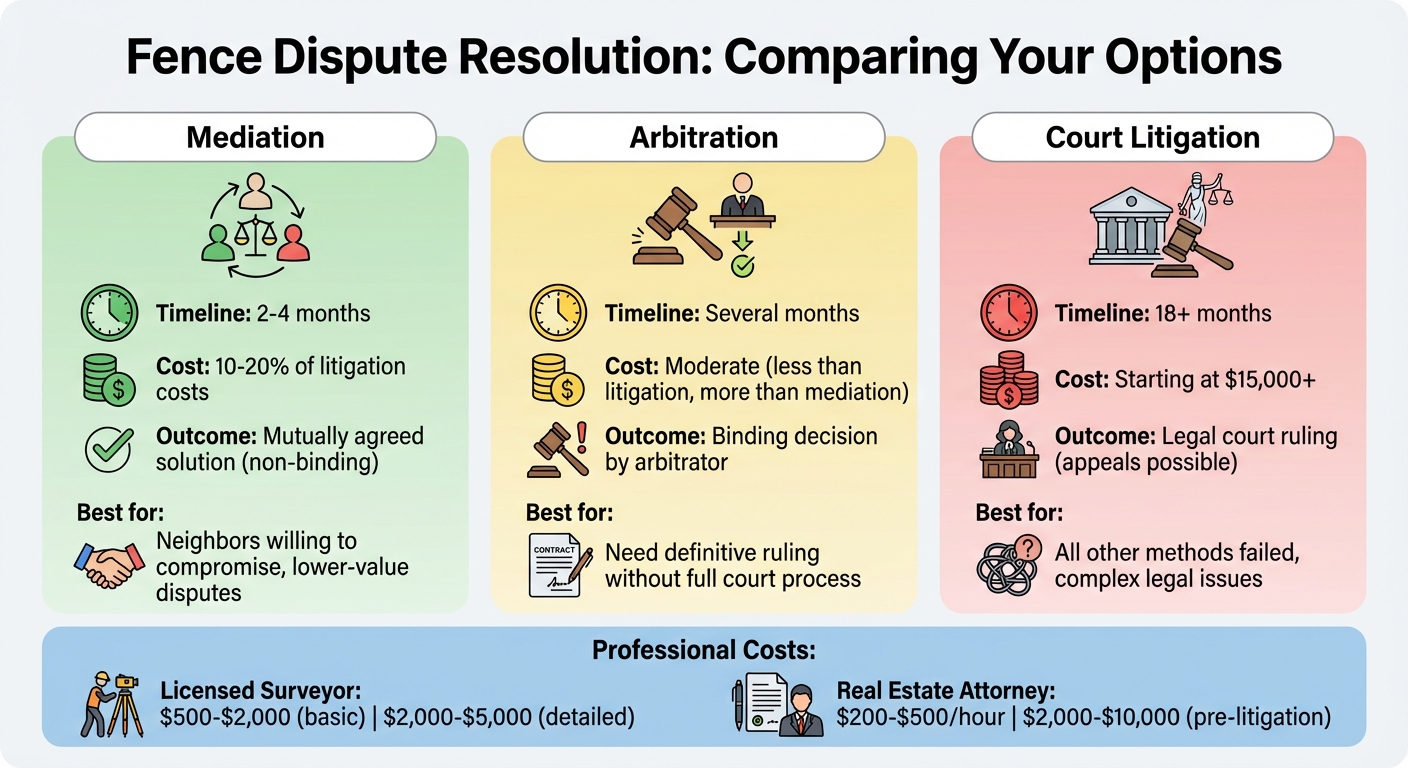
Fence Dispute Resolution Methods: Timeline and Cost Comparison
When direct negotiations don’t resolve the issue, it’s time to explore more formal solutions. These structured approaches build on the groundwork you’ve already laid, such as collecting evidence and having discussions with your neighbor.
Mediation involves a neutral third party who helps both sides work toward a mutually acceptable solution. The mediator doesn’t make decisions but instead facilitates productive conversations. Mediation works best when both parties are willing to compromise. It’s a faster and significantly cheaper option compared to litigation, often costing just 10-20% of what a court case might cost. Plus, disputes are typically resolved in weeks rather than dragging on for months or years. This approach is particularly useful for disputes involving lower-value property areas or when maintaining a good relationship with your neighbor is important.
Arbitration is a step up in formality. In this process, a neutral arbitrator reviews evidence from both sides and issues a binding decision. Think of it as a streamlined version of a court trial – quicker and less costly than full litigation. Arbitration usually wraps up in a matter of months, though it’s more expensive than mediation. The main downside? The arbitrator’s ruling is final in most cases, leaving little room for appeal.
If mediation or arbitration doesn’t resolve the conflict, you may need to turn to the courts. Court actions provide a definitive legal ruling when all else fails. For example, a quiet title action can legally establish your property line. If a neighbor’s structure crosses onto your land, an ejectment action can force its removal. You can also pursue damage claims for issues like unauthorized fence removal or property damage caused by neglect. While lawsuits provide clarity, they come with steep costs – often starting at $15,000 – and can take 18 months or longer to conclude.
Seeking professional help can make a significant difference, no matter which path you choose. A licensed surveyor is essential for providing reliable boundary evidence. Courts and mediators heavily rely on signed and sealed surveys, which typically cost $500 to $2,000 for basic checks and $2,000 to $5,000 for more detailed surveys. Splitting the survey cost with your neighbor can foster trust and ensure both parties are working from the same set of facts.
A real estate lawyer is another key resource. They can review your deed, draft demand letters, represent you in mediation or arbitration, and handle litigation if needed. Hourly rates for real estate lawyers generally range from $200 to $500, with pre-litigation work often costing between $2,000 and $10,000. Look for attorneys who specialize in property disputes and are well-versed in local boundary laws to ensure you’re getting the best guidance.
Installing or Replacing a Fence After a Dispute
Choosing a Fence That Works for Both Neighbors
Once your dispute is resolved, the next step is selecting a fence that works for everyone involved. Start by reviewing local zoning laws and HOA guidelines, as these often dictate height, design, and even material choices. Some HOAs may also require specific colors or mandate that the more polished side of the fence faces outward.
Before making any decisions, have an open conversation with your neighbor. Talk about privacy, security, and how you’d like the fence to look. The goal is to find materials that strike a balance between durability, aesthetics, and ease of maintenance, while also addressing both parties’ needs.
Put your agreement in writing to avoid future misunderstandings. Include details like the exact location of the fence (based on your property survey), the materials to be used, the height, and whether the fence will sit entirely on one property or straddle the boundary. Clarify ownership and determine how repair or replacement costs will be shared. To make the agreement legally binding and protect against future disputes, consider recording it with your county land records.
Hiring Professional Fence Installers
After a boundary dispute, hiring a professional installer can save you from future headaches. Licensed contractors, like Tend Fencing in Plano, TX, have the expertise to read property surveys, follow boundary lines accurately, and adhere to local building codes and HOA regulations. They ensure the fence is built to last, with posts set at the proper depth (typically 24 to 36 inches, depending on soil and fence height) and using high-quality materials to minimize maintenance down the road.
When choosing an installer, look for professionals who are licensed, insured, and offer written contracts that include warranties on both materials and workmanship. Tend Fencing, with over 15 years of experience, specializes in various fence types, including wood, ornamental iron, chain link, and automatic gates. They handle all the details – from permit applications to verifying survey markers – to ensure everything is done correctly. One customer, Gunnar Thompson, shared his experience:
The team was incredibly professional and communicative throughout the entire process and the craftsmanship on the fence was outstanding.
To ensure a smooth installation process, provide your contractor with all necessary documents, such as the property survey, any boundary agreements, HOA guidelines, and dispute settlement records. Schedule a walkthrough to mark the agreed boundary with stakes or flags, and keep copies of permits, invoices, and inspection approvals. Taking photos of the finished fence can also be helpful if questions arise later about its placement or compliance.
Environmental Benefits of Professional Installation
Professional installation doesn’t just ensure a sturdy fence – it can also have environmental perks. Experts recommend materials and finishes suited to your area, which can extend the life of your fence and reduce the need for frequent replacements. Proper techniques, like correct post spacing and depth, help prevent issues like rot or soil erosion, which can impact neighboring properties over time.
Tend Fencing goes a step further by planting a tree for every fence they build through their partnership with One Tree Planted. This initiative helps offset the environmental impact of using wood or metal by contributing to urban and suburban tree canopies. These trees provide shade, aid in stormwater management, and support local wildlife habitats. Additionally, professional installers can protect root zones and maintain natural buffers between properties, promoting healthier outdoor spaces while clearly defining boundaries.
Preventing Future Fence Disputes
Steps Property Owners Should Take
Avoiding fence disputes starts with keeping your property records organized and up to date. Make sure to maintain an updated survey, especially after major changes like additions or re-platting your lot [2,8]. Take the time to inspect your property line every year, comparing the physical markers – like fences, walls, or hedges – with what’s outlined in your deed and plat map [2,5]. If you spot any discrepancies or notice shifted markers, address them as soon as possible [2,5].
It’s also a good idea to clearly mark your boundaries using survey stakes, concrete monuments, or metal pins placed exactly where your surveyor confirms the line. Capture these markers in dated photos and store them with your property records. This visual evidence can be a lifesaver if a neighbor ever questions the fence’s location [1,7]. Keep all your fence-related documents – such as surveys, building permits, HOA approvals, contractor invoices, and any agreements with neighbors – in one organized file for easy access. Staying proactive with record-keeping creates a strong foundation to prevent future conflicts.
Before making any modifications, double-check local regulations about fence height, setbacks, materials, and which side of the fence must face outward. If you’re performing maintenance – like replacing posts, repairing panels, or trimming vegetation near the boundary – document the work with photos and receipts [1,2]. This kind of paper trail not only shows consistent care but can also help clarify ownership if questions arise during a property sale or when neighbors change.
Keeping Good Relationships with Neighbors
Accurate records are essential, but maintaining good communication with your neighbors is just as important. If you’re planning work near the property line, give your neighbor a heads-up and invite them to walk the boundary with you. Bring copies of deeds or plat maps to help clarify any concerns, such as leaning posts or encroaching roots, before they escalate into bigger issues. Keeping the conversation calm and respectful, and focusing on shared goals like privacy, safety, or property value, can go a long way toward avoiding unnecessary tension.
After significant discussions, follow up with a short email summarizing the conversation. This creates a simple record without coming across as confrontational [1,6]. For major decisions – like installing a new fence, splitting repair costs, or clarifying the property line – put everything in writing. Agreements like boundary line or fence maintenance agreements can outline responsibilities for repairs, approved materials, and how to handle future disputes. Recording these agreements with your county land records ensures they remain binding for future property owners and can protect against adverse possession claims [1,5]. Treating neighbors as long-term partners and backing that relationship with clear documentation is a reliable way to prevent conflicts [1,3].
FAQs
How can I find my property lines to prevent fence disputes?
Before installing or repairing a fence, it’s crucial to confirm your property boundaries to avoid future disputes. Start by checking your property deed and survey plat – these documents outline where your property lines are. For added precision, you might want to hire a licensed surveyor to clearly mark the boundaries. Taking this step upfront can help you avoid unnecessary costs, wasted time, and potential disagreements with neighbors.
What should I do if my neighbor’s fence crosses onto my property?
If your neighbor’s fence crosses onto your property, the first step is to verify your property boundaries. Hiring a professional surveyor can help clarify the exact lines if there’s any confusion. Once you have the facts, have a direct conversation with your neighbor. Approach the topic calmly and explain the situation to work toward a friendly resolution.
If talking it out doesn’t lead to a solution, you might need to consider legal actions, such as filing a formal complaint or pursuing a court order. To better understand your rights and what options are available, it’s a good idea to consult with a property or real estate attorney. They can provide the guidance you need to handle the situation effectively.
How does mediation help settle fence disputes without going to court?
Mediation offers a practical approach to resolving fence disputes by bringing in a neutral third party to guide open communication and help both sides reach a fair resolution. This method promotes cooperation and mutual understanding, often resulting in outcomes that work well for everyone involved.
Compared to taking the matter to court, mediation is usually quicker, more affordable, and provides greater flexibility. Plus, it gives you the chance to address the issue in a constructive way while preserving a good relationship with your neighbor.