
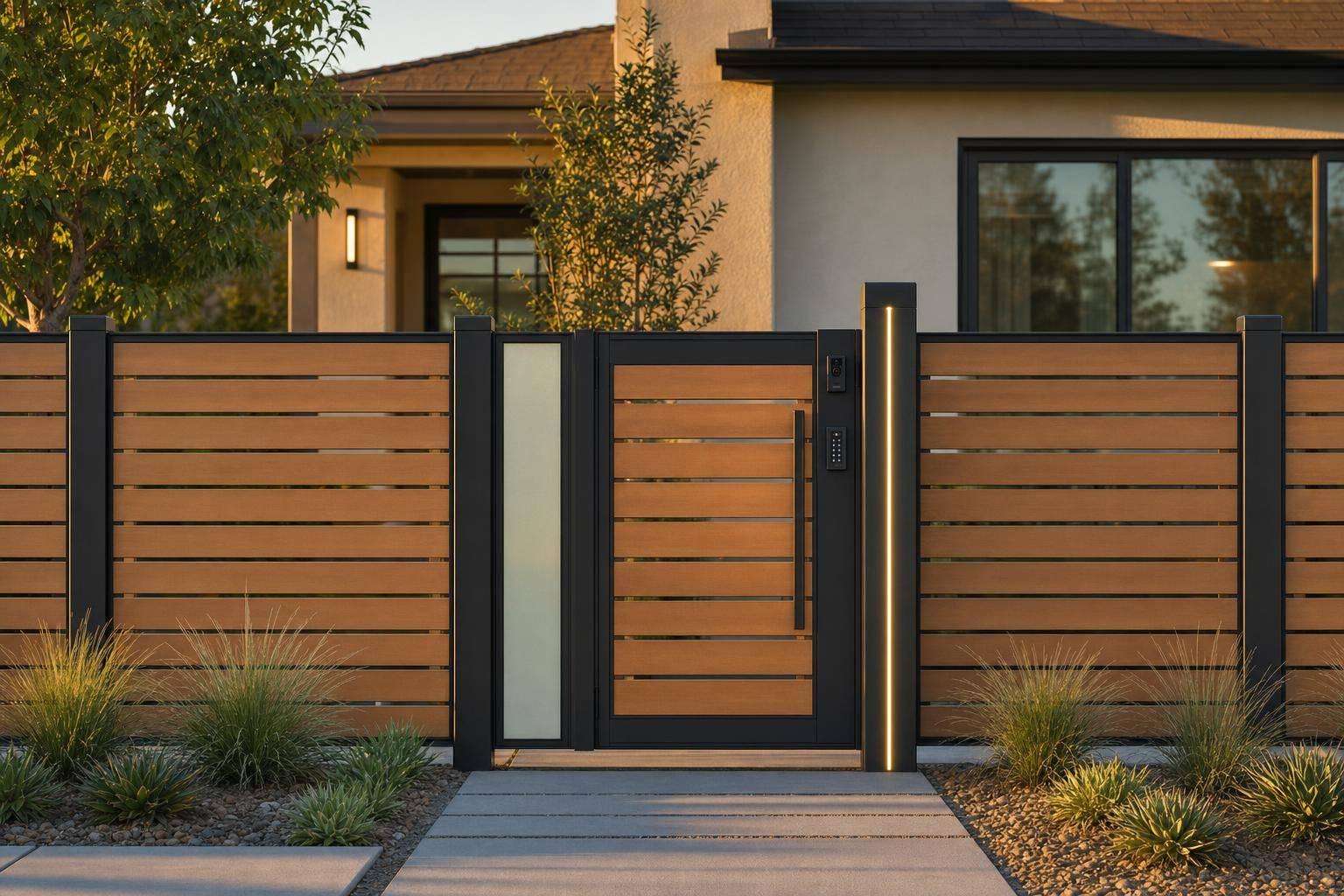
If I had to sum up 2026 fence design in one line, it’s this: people want fences that look clean, give more privacy, need less upkeep, and add smarter gate access.
Here’s the short version:
- Clean-lined styles are leading, especially horizontal slats and tall vertical panels.
- Mixed materials like wood + metal are popular because they balance looks, privacy, and strength.
- Smart gates now often include keypad entry, remote control, app access, and solar-powered parts.
- Low-upkeep materials are getting more attention as owners compare install cost with long-term repairs.
- Weather fit matters more than ever, especially in high-UV, wet, and snowy parts of the U.S.
- Living borders and eco-minded options are showing up more, but they usually need more yard work.
A few details stand out right away. Some electric fence setups run at 6,000–10,000 volts. Many outdoor lighting and gate parts now use IP65 to IP68 ratings for dust and water protection. And common privacy fence heights still land around 6 to 8 feet, while simpler containment setups are often 4 feet.
100+ Modern Front Yard Fence Ideas 2026 🌿 Curb Appeal, Luxury & Budget Fence Designs
sbb-itb-d1d0a96
Quick Comparison
| Trend | Best For | Privacy | Upkeep | Cost |
|---|---|---|---|---|
| Custom wood and iron | Homes, businesses | Medium to High | Medium | Moderate to High |
| Horizontal slats | Modern homes, businesses | High | Low to Medium | Moderate |
| Mixed materials | Custom design projects | Medium to High | Low | Moderate |
| Bold colors and finishes | Style-focused projects | Varies | Medium | Moderate |
| Privacy-first styles | Backyards, side yards | High | Low to Medium | Moderate |
| Smart fences and gates | Driveways, entries, business sites | Medium | Medium | Moderate to High |
| Eco-minded materials | Long-life builds | Low to Medium | Medium | Moderate |
| Living fences | Natural-looking borders | High after growth | High | Lower upfront |
What this means for you is simple: the best fence in 2026 is not just about material. It’s about matching style, climate, privacy needs, gate access, and upkeep before you spend $1.00 on the build.
What Is Driving Fence Design in 2026?
Four forces are shaping custom fence design in 2026: modern architecture, lower maintenance, smart access, and weather-ready performance. You can see all four in the trends below.
Modern Home and Commercial Building Styles
Modern architecture, especially the International Style, is pushing fence design toward clean lines, simple profiles, and visible frames. Mixed-material systems with metal frames and rope mesh or synthetic panels fit that look while still balancing openness and security.
For new builds and renovation work, fences are now treated more like part of the overall design plan, not just a border or barrier. That shift shows up most clearly in horizontal slats, mixed materials, and custom gates.
Low-Maintenance Material Preferences
Property owners are leaning toward stainless steel rope mesh, ABS plastic, and polycarbonate because they need less upkeep and hold up well outdoors. These materials are also chosen for UV stability and impact resistance.
The draw is pretty simple: stronger long-term performance in outdoor settings.
Smart Access and Perimeter Control
Keypad entry, remote gate control, and app-based monitoring are becoming standard in both residential and commercial projects. In many cases, these systems also work alongside gate operators, solar-powered lighting, and energizers.
Sustainability and Weather Performance
Electronic gate hardware and lighting are often specified with IP65 or IP68 ratings for dust and water resistance. At the same time, HOA rules, permits, and local climate still decide which designs make sense.
In heavy-snow regions, raised wire lines help keep fences above the snowpack and reduce grounding or animal escape. Those code and climate pressures help shape the fence styles that follow.
1. Tend Fencing‘s Custom Wood, Iron, and Gate Designs
Tend Fencing builds custom wood fences, ornamental iron fences, and automatic gate systems for both homes and commercial properties. That fits what many property owners want in 2026: privacy, security, and a clean look that feels made for the space. You can see that same custom-first mindset across several fence styles this year.
Privacy and Security Value
A well-built wood or iron fence does more than mark a property line. It changes how a space feels and functions. Solid privacy panels work well in high-traffic areas because they help reduce visibility and noise. That can make a yard, entry, or shared edge feel more private and less exposed.
Ornamental iron takes a different path. It creates a more open, architectural look while still helping with perimeter security. So the choice often comes down to what the property needs most: more screening, more openness, or a mix of both.
Wood Durability and Climate Fit
Wood fences need the right species and treatment for local weather and day-to-day use. A fence that looks good on day one still has to deal with sun, rain, moisture, and wear over time.
The main goal is simple: pick a wood option that balances appearance and durability. That choice can affect how long the fence holds up and how much upkeep it needs.
Custom Design Impact
The 2026 shift toward vertical lines is showing up in architecture, especially when clean lines complement surrounding landscapes. That style can make a fence feel current without looking forced.
Custom design helps tie everything together. It lets the fence match the property’s style, height, and finish, instead of feeling like an off-the-shelf add-on. And that more tailored look connects naturally to the simpler, streamlined layouts showing up in horizontal slat fences.
Maintenance and Long-Term Upkeep
Wood fences need resealing from time to time, and gate hardware should be serviced on a routine basis. If the property has an automatic gate system, there are also moving parts and electronics to check.
A little routine care goes a long way:
- Reseal wood as needed
- Inspect gate hardware for wear
- Check automatic gate components and electronics
Regular maintenance helps keep the fence and gate working as intended over time. From here, the bigger shift moves toward simpler profiles and mixed materials.
2. Horizontal Slat Fences
Building on the shift toward simpler profiles, horizontal slat fences line up with the 2026 move to clean, simple design in both residential fences and commercial spaces.
Custom Design Impact
Horizontal slats stand out in 2026 because of their clean lines and site-matched finishes. Many designs use color palettes pulled from local bark, soil, and rock tones, which helps the fence sit naturally within the setting.
Privacy and Security Value
The horizontal layout creates a clear boundary that cuts down on unwanted views while keeping the perimeter easy to read.
Material Durability in U.S. Climates
Material choice matters, especially in areas with strong sun exposure, where UV radiation and heavy snow buildup can affect long-term performance. Stainless steel and high-performance woods are durable options for modern fences.
Maintenance and Long-Term Upkeep
Maintenance plays a big part here. Fast-spreading vines like Virginia Creeper can weaken posts or panels if left unchecked, so it’s better to remove invasive growth at the root instead of just trimming it back. In snowy parts of the U.S., keeping the lowest slat above the snowpack level helps prevent burial and protects the fence’s structure. That visual flexibility leads naturally into mixed-material fence designs.
3. Mixed-Material Fence Designs
After the clean lines of horizontal slats, mixed materials bring in contrast and extra function. They make a fence feel custom by mixing texture, structure, and finish. Common pairings include wood with metal, stone with wood, and cable mesh with clean framing. Stainless steel cable mesh systems can also give the fence an open, modern look. And once you add that kind of contrast, bolder color and finish choices start to make more sense.
Custom Design Impact
Choose colors and textures that match the surrounding architecture and landscape.
Material Durability in U.S. Climates
How a material holds up depends a lot on the climate. In high-UV or high-altitude areas, pick materials that resist fading and chipping better. ABS and polycarbonate components offer strong impact resistance and UV stability for accessories and lighting. If you’re adding solar lighting, look for an IP65+ weather rating to help protect against dust and water.
Maintenance and Long-Term Upkeep
A little upkeep goes a long way. Check lighting and wiring, clean solar panels, and stop plants from growing into posts or panels. That makes finish selection the next design decision.
4. Bold Colors and Custom Finishes
Once the materials are set, color and finish do the next big job: they tie the whole fence together. In 2026, those choices aren’t made at the end. They’re part of the design from day one.
The shift is pretty clear. Bold finishes now do less “look at me” work and more “this was made for this property” work. The look comes first, sure, but the finish still needs to handle life outside.
Custom Design Impact
Pull tones from the site itself – bark, soil, stone, or nearby structures – so the fence feels built into the setting.
Material Durability in U.S. Climates
A bold finish still has to last. In high-altitude, high-UV parts of the U.S., use UV-resistant coatings to limit fading and surface wear. That also means routine inspection should be part of the plan, not something you deal with later.
Maintenance and Long-Term Upkeep
Check the fence line on a regular basis, and clear away growth before it traps moisture or damages the finish.
5. Privacy-First Fence Styles
After mixed-material and bold-finish trends, privacy fences in 2026 are moving in a slightly different direction. The goal is still privacy, but without that boxed-in feel. In practice, that means fences that screen views while still feeling open and easy on the eyes.
Privacy and Security Value
Privacy and security don’t have to make a fence look heavy. Downward-facing solar lights can mark the fence line at night without harsh glare. If a property needs a perimeter that feels more open but still secure, stainless steel mesh systems can offer strong security while letting light and visibility pass through.
That mix of screening and openness also fits well with the move toward taller, more vertical fence panels.
Custom Design Impact
Tall, narrow panels create a stronger vertical profile. They also lean into the vertical look showing up across 2026 privacy fence designs.
Shape isn’t the whole story, though. Finish matters too, especially when a fence has to deal with rough weather year after year.
Material Durability in U.S. Climates
In mountain areas and high-UV regions, it makes sense to choose UV-rated finishes and weather-sealed hardware. For fences with built-in lighting or electronic parts, use at least an IP65 rating.
Once those durability details are handled, upkeep becomes the next piece of the puzzle.
Maintenance and Long-Term Upkeep
Inspect the fence line each season and remove invasive vines at the root before they damage panels or posts.
6. Smart Fences and Automatic Gates
In 2026, smart fences blend access control, lighting, and automatic gates into one clean setup. You get more control over who comes and goes, without turning the yard into something that looks cold or overbuilt.
Privacy and Security Value
Once privacy is handled, access becomes the next big piece. New fence and gate hardware now fits into the layout more neatly, so the perimeter can stay secure without looking industrial.
For higher-security setups, electric fence energizers can deliver 6,000–10,000 volts. That’s enough to deter intrusion from wildlife and unauthorized entry. On remote properties, solar-powered gate operators make a lot of sense because they avoid trenching and cut down on wiring. High-efficiency solar units can also support overnight operation after a full day of sun.
Custom Design Impact
A clean look comes down to where the hardware goes. Operators, conduits, and control parts can be hidden inside posts or gate frames, which helps the fence line look consistent instead of pieced together.
Automatic gates can also be built right into the fence design, so the entry point matches the rest of the property. When this is done well, the system blends into the fence line rather than shouting, “Here’s the gate.”
Maintenance and Long-Term Upkeep
Upkeep still matters. Vegetation should stay clear so it doesn’t block sensors, short wiring, or interfere with electric flow. In snowy climates, wires may need to be raised, or hardware adjusted above the snowpack so the system keeps working.
For exposed hardware, use IP65. For parts near grade or in wet areas, use IP68.
7. Eco-Conscious Fencing Materials
After smart access, 2026 fence design leans toward materials that last and sit well in the landscape. Eco-conscious fencing in 2026 puts the focus on long life, a good site match, and less upkeep.
Material Durability in U.S. Climates
Climate should guide your material choice. Stainless steel cable mesh brings durability and visibility for modern builds. Tropical woods such as Tatajuba add natural strength and visual appeal.
In high-altitude or high-UV parts of the U.S., materials and finishes need to stand up to harsh weather and heavy sun exposure. A fence might look great on day one, but if it can’t handle the local climate, that good look won’t last.
Durability also needs to fit the property’s natural setting. A fence shouldn’t feel dropped in from somewhere else.
Custom Design Impact
Eco-conscious fencing doesn’t mean one-size-fits-all. You can still tailor the design to the site.
For example, these fences can use:
- Wildlife-friendly layouts
- Site-matched tones
That helps cut visual impact while keeping the fence aligned with the property.
Maintenance and Long-Term Upkeep
Some eco-friendly materials ask for more attention over time. Living fences, for instance, need plant species that match the soil well. If they don’t, survival rates can be low.
Upkeep methods are shifting too. More property owners are skipping harsh chemicals and using fire, water, and vinegar to keep fence lines clear.
That trade-off between appearance and upkeep leads into landscape-integrated borders.
8. Living Fences and Landscape-Integrated Borders
Building on eco-conscious fencing, 2026 leans toward borders that mix structure with planting. Living fences make the property line feel like part of the landscape, not a hard cutoff. Instead of a fixed edge, you get a perimeter that grows, changes with the seasons, and sits more naturally on the land. Many property owners are pairing plantings with mesh, wire, or posts to shape boundary lines that look like they belong.
Privacy and Security Value
Dense vegetation, like native trees or shrubs, can screen a property from public roads and create a natural edge that works with the site. It feels softer than a standard fence, but it still does a lot of work.
That softer look doesn’t take care of itself, though. It depends on regular upkeep. On rural properties, some owners add electric wire for deterrence, while low-glare solar lights help mark the edge after dark.
Maintenance and Long-Term Upkeep
Living borders need steady care over time. Fast-growing native vines like Virginia Creeper can reach 90 feet if they’re left alone. That may sound great at first, but unchecked growth can turn into a problem fast. Vines can damage panels and even nearby masonry if they aren’t clipped back on a regular schedule.
Integrated electric systems need attention too. Voltage should be checked weekly, since weeds pushing into the line can bleed voltage and weaken performance. In snowy climates, wires may also need to be lifted by hand on posts as snowpack builds, so the system keeps working through winter.
Custom Design Impact
When structural parts match the site, the whole border feels more at home. Tones pulled from bark, soil, and dark accent colors can be used on fence components so they blend into planted edges instead of standing apart.
Solar-integrated lighting and wildlife-friendly mesh layouts also give property owners room to shape the border to fit the land, while keeping that natural look in place. This keeps the fence tied to the site instead of fighting against it.
Quick Trend Comparison Table
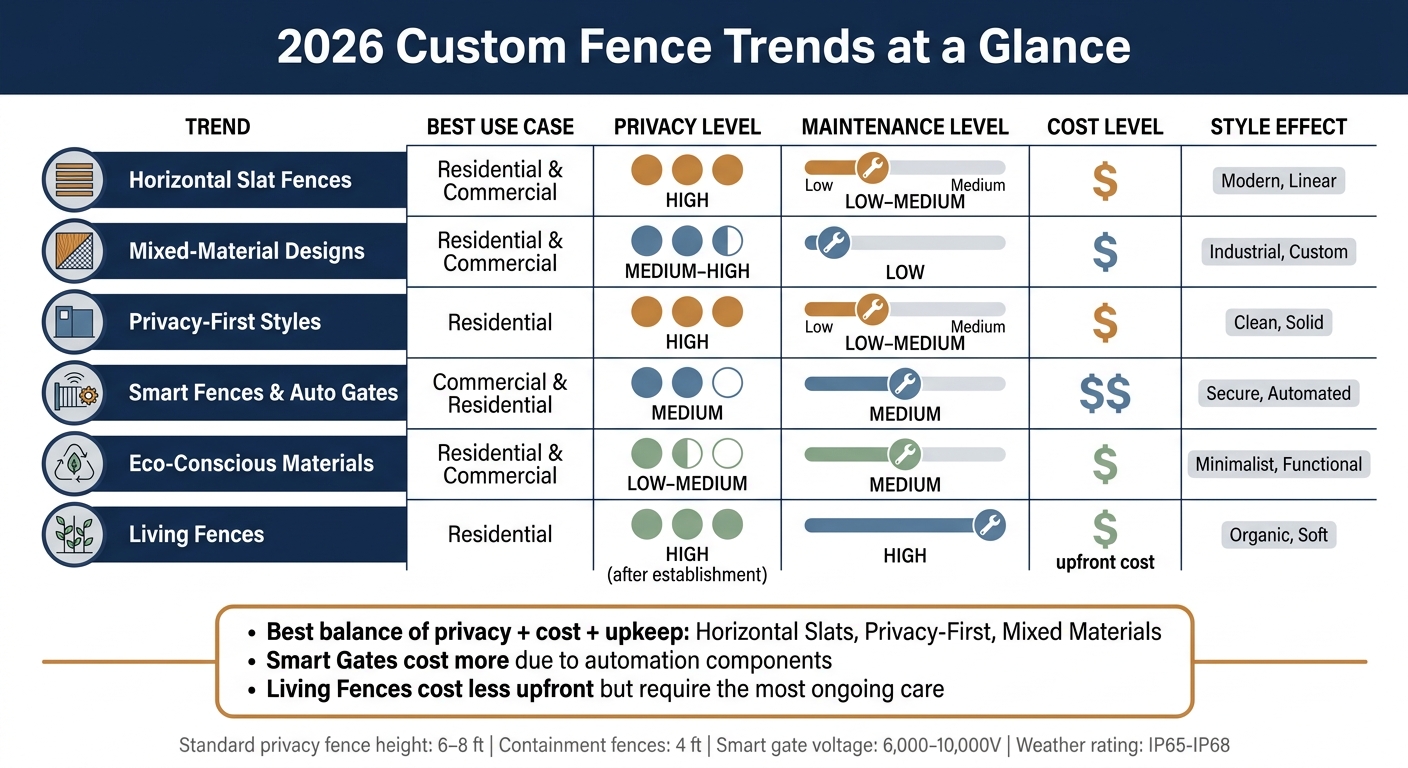
2026 Custom Fence Trends: Privacy, Upkeep & Cost Compared
Here’s a fast side-by-side comparison. Use this summary to compare privacy, upkeep, and cost at a glance. In 2026, the right custom fence comes down to balancing style, security, maintenance, and cost.
| Trend | Best Use Case | Privacy Level | Maintenance Level | Cost Level | Style Effect |
|---|---|---|---|---|---|
| Horizontal Slat Fences | Residential and commercial | High | Low–Medium | Moderate | Modern, Linear |
| Mixed-Material Fence Designs | Residential and commercial | Medium–High | Low | Moderate | Industrial, Custom |
| Privacy-First Fence Styles | Residential | High | Low–Medium | Moderate | Clean, Solid |
| Smart Fences and Automatic Gates | Commercial and residential | Medium | Medium | Moderate to high | Secure, Automated |
| Eco-Conscious Materials | Residential and commercial | Low–Medium | Medium | Moderate | Minimalist, Functional |
| Living Fences | Residential | High after establishment | High | Lower upfront | Organic, Soft |
A few patterns stand out right away. Smart gates cost more because automation adds extra parts and setup. Living fences cost less upfront, but they ask for more hands-on care over time.
If you want the best middle ground, horizontal slats, privacy-first styles, and mixed materials usually give you the strongest mix of privacy, cost, and upkeep. Once you’ve compared the look and function of each option, check local site rules, your climate, and the maintenance you’re willing to handle before you build.
Key Design Points to Review Before You Build
After you pick a style, pause before you build. This is the stage where a good-looking idea turns into a plan that can actually get approved, priced, and installed without headaches. Look at height, local rules, weather, cost, and whether your installer can pull it off cleanly.
Fence Height, Layout, and Intended Use
Fence height shapes privacy, security, sightlines, and code compliance. Use 4 feet for simpler containment needs. Use 6 to 8 feet for privacy and security. Once you settle on height, confirm the exact property boundary and check local rules before moving ahead.
Property Lines, Permits, and HOA Rules
Don’t assume an old fence line marks the true property edge. Always verify exact property lines and setback rules through municipal records or a professional survey before building. It’s also smart to check HOA rules on height, color, and material before work starts. A fence can look perfect on paper and still hit a wall with paperwork if these details get skipped.
Climate Fit and Long-Term Performance
Your local weather matters more than many people expect. Match materials and coatings to local UV exposure, and keep vines off the fence line. That step can help the fence hold up better over time and reduce wear that sneaks up on you.
Installation Cost vs. Maintenance Cost
Don’t look at install price alone. Compare lifetime cost, including upkeep, repairs, and parts. Solar gate systems can cut wiring and trenching costs. Sometimes the lower upfront bid ends up costing more once maintenance enters the picture.
Working With a Custom Fence Installer
Tend Fencing can help turn your chosen style into a code-compliant wood, iron, chainlink, or automatic-gate installation for residential and commercial properties in Plano, TX, and surrounding areas.
Conclusion
Put it all together, and the 2026 fence trends point in one direction: more function, less fuss. The styles leading the way lean toward clean lines, strong performance, and low upkeep. No matter the material, the pattern is pretty clear: simpler forms, smarter access, and fences built to last.
A fence should work with the landscape, not fight it. That idea sits at the heart of 2026 fencing. The best options balance privacy, durability, and the look of the yard around them.
When it’s time to choose, focus on what fits your site, climate, budget, and tolerance for maintenance. Match the material to local conditions, confirm your property lines, and compare installation costs with long-term upkeep. A good fence should ask for very little after it’s in the ground.
If you want a custom build that lines up with those goals, work with a local installer that knows design and gate systems. Tend Fencing designs and installs custom wood, ornamental iron, chainlink, and automatic gate systems in Plano, TX, and surrounding areas.
FAQs
Which fence trend offers the best mix of privacy and low upkeep?
For homeowners who want more privacy without piling on yard work, adding natural elements like nasturtium is a simple move. It acts as a natural weed barrier and border, asks for very little upkeep, and brings extra color and charm to the space.
Pair it with high-quality fencing from Tend Fencing, and you get a clear, attractive outdoor boundary that stays easy to maintain over time.
How do I choose a fence that fits my local climate?
Think about how heat, cold, wind, and snow will affect both your fence material and its long-term stability.
If you live in an area with heavy snow, plan for extra upkeep. For example, you may need to lift fence wires above the snowpack so the fence keeps working through winter.
In places with strong wind or ice, pick materials that can stand up to added pressure and tension. Stainless steel mesh is a solid option here because it handles harsh conditions well.
For arid regions, grounding is a big deal for electric fencing. Dry, rocky soil can weaken system performance, so the grounding setup needs extra care.
Are smart gates worth the extra cost?
It comes down to what matters most to you: security, day-to-day ease, and property value.
An automatic gate can give you better control over who comes and goes, add another layer of security, and fit smoothly with your fencing when it’s built for your space.
Smart gates do cost more than manual options. But for many home and business owners, the extra convenience, solid build quality, and strong curb appeal make the upgrade worth it.