
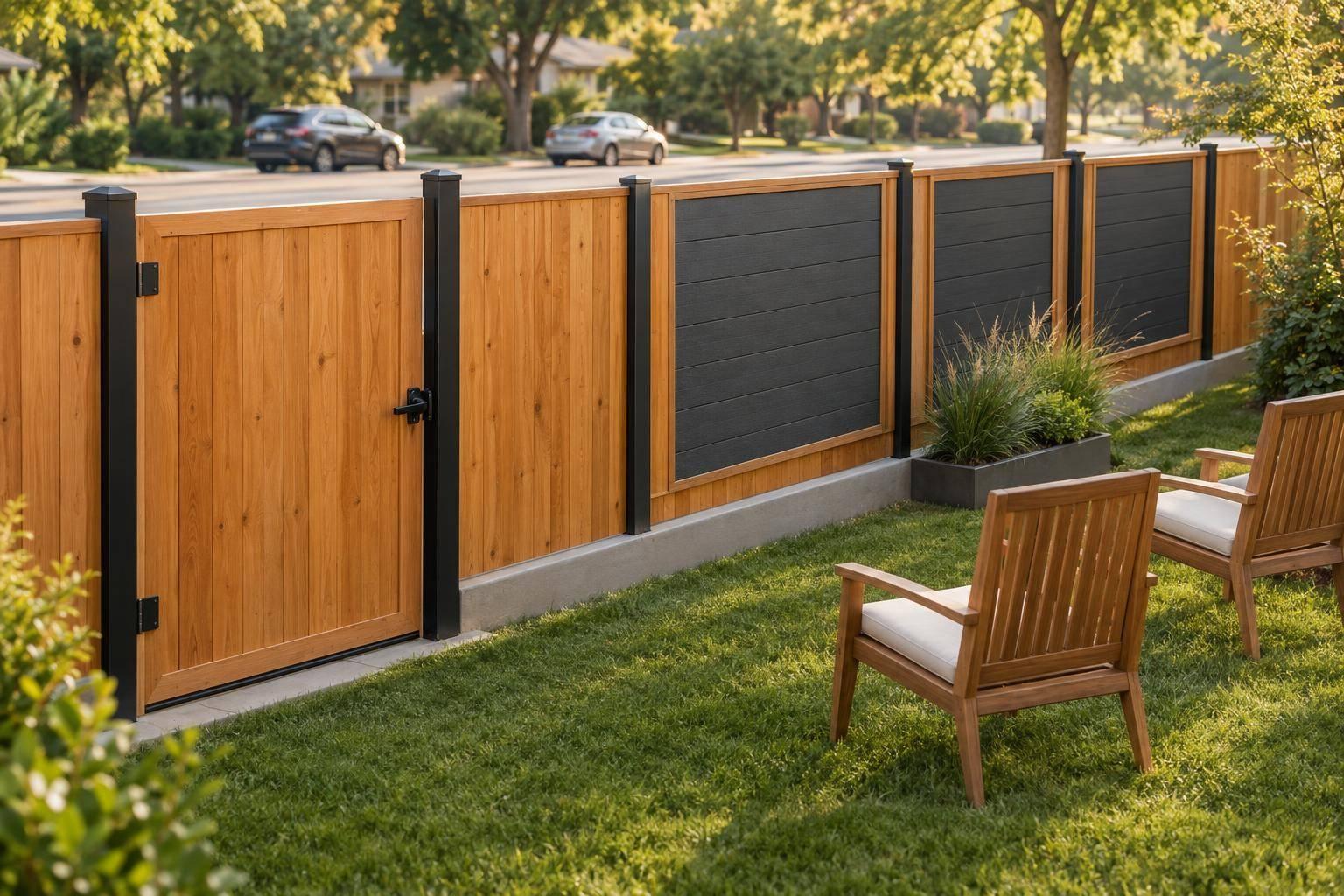
I’d close fence gaps before paying for more height or a new fence. Start with missing boards, open joints, gaps underneath, and a gate that won’t close squarely. A solid fence can reduce direct traffic noise, but it won’t make your yard silent.
Here’s how I’d choose the next step:
- Repair isolated gaps when posts and rails are sound.
- Add a solid layer only after a professional checks the fence’s weight and wind limits.
- Replace the fence when rot or failing supports would mean rebuilding most of it.
I’d also check height, length, drainage, and gate safety – not just panel thickness. In Plano, the general residential height limit is 8 feet, with stricter rules in some areas. <u>Check current city and HOA rules before work starts.</u>
Then I’d compare the same listening spots under similar traffic conditions. The goal is less street noise, not a promise of silence.
Privacy Fence Noise Reduction: Repair, Reassess, Upgrade
DIY Acoustic Fence
sbb-itb-d1d0a96
Inspect the Fence Before Making Changes
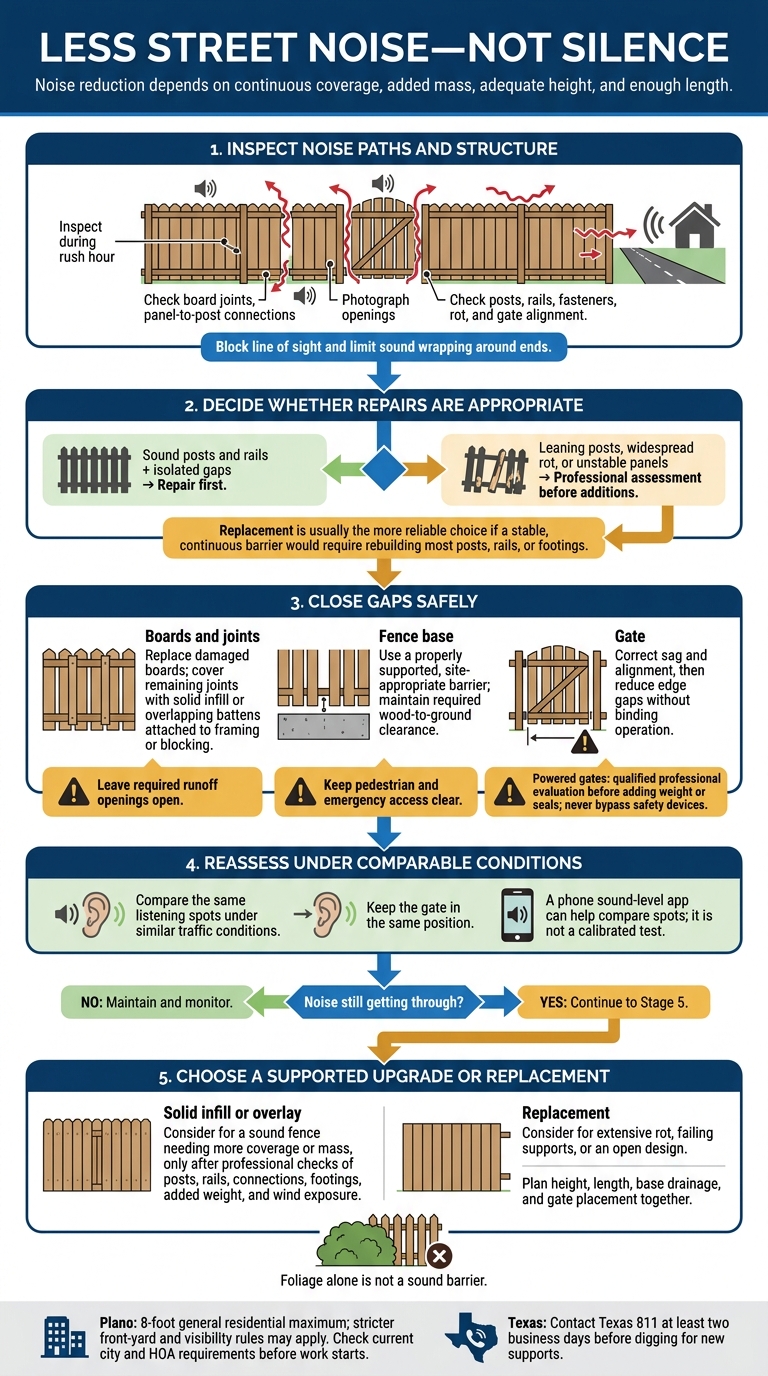
Start in the area you want to protect during rush hour. Trace where traffic noise comes through, around, and under the fence, then check the street-facing side where access is allowed. If traffic patterns change, repeat the inspection during another busy period.
Find Gaps and Areas the Fence Does Not Block
Check board joints, panel-to-post connections, the bottom edge, gate edges, and fence ends. Follow slopes and grade changes, where triangular gaps can form beneath panels. Photograph each opening and record its approximate width and length in inches.
Before planning a bottom closure, note any erosion or drainage channels. Repairs must leave room for water to drain.
From your usual seat, check whether you can see traffic through, above, or beside the fence.
Effective barriers should block line of sight to the noise source and extend far enough to reduce sound wrapping around the ends.
A phone sound-level app can help you compare spots, but it isn’t a calibrated test.
Check Posts, Rails, and Fasteners
Once you’ve mapped the openings, check whether the fence can support repairs. Look along the posts for leaning, then check accessible boards and rails for movement. Look for warped boards, detached rails, missing or corroded fasteners, and rotted wood near post bases.
Lightly probe suspect wood with a screwdriver. Don’t climb or lean hard on unstable sections. Check for insect damage, too, and see whether gate hinges or frames have shifted.
Separate small hardware problems from structural failure. A few damaged boards or loose fasteners in sound wood may only need repairs in those spots. Leaning posts, rot across large areas, or panels that move under light pressure need a professional assessment before you add heavier materials or extra layers.
In the Plano, TX, area, Tend Fencing can assess whether repair, reinforcement, or replacement makes sense. Mark each weak point so the next step targets the right repair.
Repair Gaps in Boards, Fence Bases, and Gates
If your inspection found sound framing but open joints, make repairs before adding new layers.
Replace Damaged Boards and Cover Open Joints
Secure loose rails to solid framing and swap rusted fasteners for corrosion-resistant exterior hardware. Replace cracked, missing, or warped boards with boards of the same width and thickness. Leave the manufacturer-recommended expansion gap so the boards can move without splitting.
Cover remaining joints with solid infill or overlapping battens attached to framing or blocking – not just board edges. Keep the overlap continuous from top to bottom. Skip lattice, spaced slats, and alternating-board patterns; sound still passes through them. Use sealant only for small cracks that don’t move.
Close Gaps Beneath the Fence
Gaps at the base let sound pass under the fence. Close them with a barrier that blocks sound without trapping water, such as a properly supported, rot-resistant kickboard, a permitted masonry curb, or another ground-contact barrier suited to your site.
Maintain the required wood-to-ground clearance. Don’t bury boards or pile soil against them.
Leave required runoff openings open, even if that means blocking less sound. During the next rain, check for pooling, washout, or water flowing toward neighboring property.
Fix Gate Sag and Edge Gaps
Finish with the gate. Even a well-built fence can leak noise around its opening.
Start with alignment: repair worn hinges, rollers, or frame supports so the gate closes squarely. Then reduce remaining gaps with solid infill, a stop strip, an overlapping edge, or an exterior-rated seal. Nothing should bind the gate. Check that it opens fully, latches reliably, and keeps pedestrian and emergency access clear.
Have a qualified gate professional evaluate powered gates before adding weight or seals. Added material can change wind load, balance, and pinch points. The professional should check the structure, operator capacity, and entrapment devices, then test operation in both directions. Never bypass sensors or alter safety devices to make a tighter seal fit.
Choose Between an Added Barrier and Replacement
Retest the same listening spots under similar traffic conditions. If noise still comes through the remaining paths, add a barrier only if the fence can safely support it.
Add a Solid, Supported Barrier Layer
If repairs close the gaps but noise remains, consider a solid overlay or added barrier.
Solid wood boards, rigid panels, or purpose-built acoustic barriers can add coverage when installed to specifications. Added mass helps only when seams stay closed. Foliage alone is not a sound barrier.
Before installation, have a qualified contractor or engineer check post spacing, rails, connections, footing size and depth, and the fence’s ability to handle added weight and wind exposure. Check the property line and keep drainage paths open. Contact Texas 811 at least two business days before digging for new supports.
Compare Repairs, Added Layers, and Replacement
Compare each option against the fence’s condition and the work it needs.
| Option | Typical use | Main benefit | Structural needs | Likely disruption | Main limits |
|---|---|---|---|---|---|
| Gap repairs | Isolated openings in an otherwise sound fence | Smallest repair scope for restoring continuous coverage | Existing posts and rails must be stable | Low; usually localized work | Does not fix extensive decay or a design with built-in openings |
| Solid infill or overlay | Sound fence that needs more coverage or mass | Improves privacy and reduces direct sound paths without removing the entire fence | Posts, rails, connections, and footings need checking; drainage and fastening details matter | Moderate; may require reinforcement and careful attachment | Can overload weak framing, increase wind exposure, or fail to help if gaps remain |
| Full replacement | Extensive rot, failing supports, or an open design | Creates a stable, continuous barrier and lets you redesign height, length, and gate placement | New posts, footings, panels, gates, and a layout that meets local rules | Highest; demolition, digging, and possible permit review | Requires more materials, labor, property-line checks, and construction planning |
Request separate scopes for repairs, reinforcement, an added layer, and replacement. Replacement is usually the more reliable choice if a stable, continuous barrier would require rebuilding most posts, rails, or footings.
Before approving work, check current permit, height, front-yard, visibility, and HOA requirements with the City of Plano and your HOA. Plano’s residential requirements list an 8-foot general maximum, with stricter front-yard and visibility rules.
Plan Fence Height, Length, and Gate Placement
Plan solid coverage around the street-facing noise path, nearby grade changes, and the listening area – not just fence height. Include a base that allows drainage and carefully fitted gates while keeping access safe and sight lines clear. Use this layout to decide which work the fence needs.
Conclusion: Repair First, Then Reassess the Noise
After repairs, check noise levels at the same listening spots under similar traffic conditions. Keep the gate in the same position, too.
Limit DIY work to minor board, fastener, and latch repairs. Leave structural additions, major post repairs, and powered-gate work to qualified professionals.
If noise still gets through, let the fence’s condition guide your choice of a supported overlay, reinforcement, or replacement. Noise reduction depends on continuous coverage, added mass, adequate height, and enough length.
FAQs
Will fence upgrades reduce truck noise?
Yes – fence upgrades can reduce truck noise, but they won’t eliminate it. According to Tend Fencing guidance, effective traffic barriers typically cut noise by about 5–10 decibels.
The key is blocking the direct path of sound and sealing gaps under and around boards and gates. A solid, continuous barrier, along with repairs to loose boards and gates, matters more than the fence type alone.
How can I compare fence repair and replacement costs?
Repairs usually cost less when damage is limited to one area. Replacement is typically the better financial choice when damage affects more than 20–30% of the fence or repeated problems point to structural failure.
Compare itemized quotes for the same fence height, length, and materials. Each quote should include demolition, grading, permits, and gate hardware. Repairs can cost up to 80% less than a full rebuild, but repeated fixes may eventually cost more than replacement.
How do I keep repaired fence gaps from reopening?
Check for gaps after the first wet-dry cycle, then check annually. Replace boards rather than filling gaps with sealant, and follow the manufacturer’s requirements for expansion spacing. Tighten loose fasteners, replace corroded ones, and check that gate hinges line up.
Fill gaps caused by erosion with soil and reseed, or add gravel to reduce further movement. Reset unstable or leaning posts in concrete to keep the fence from shifting and pulling boards apart.