

Choosing the right fence depends on your budget, maintenance preferences, and how long you want it to last. Here’s a quick breakdown:
- Wood: Cheapest upfront ($10–$30/ft), but high maintenance and shorter lifespan (10–20 years). Expect long-term costs of $5,500–$10,000+ for a 100-ft fence.
- Vinyl: Mid-range cost ($18–$40/ft) with low maintenance. Lasts 20–30 years and costs less over time compared to wood.
- Metal: Highest upfront cost ($15–$80+/ft) but minimal upkeep and longest lifespan (30–50+ years). Long-term costs are $4,500–$7,500 for a 100-ft fence.
Quick Tip: If you want low hassle and durability, vinyl or metal are better choices. For a tight budget, wood works but requires regular upkeep.
Quick Comparison:
| Factor | Wood | Vinyl | Metal |
|---|---|---|---|
| Initial Cost | $10–$30/ft | $18–$40/ft | $15–$80+/ft |
| Maintenance | High | Low | Minimal |
| Lifespan | 10–20 years | 20–30 years | 30–50+ years |
| 20-Year Cost | $5,500–$10,000+ | Moderate | $4,500–$7,500 |
Pick the option that fits your needs and climate. For humid or coastal areas, metal or vinyl outlast wood due to better resistance to rot and rust.
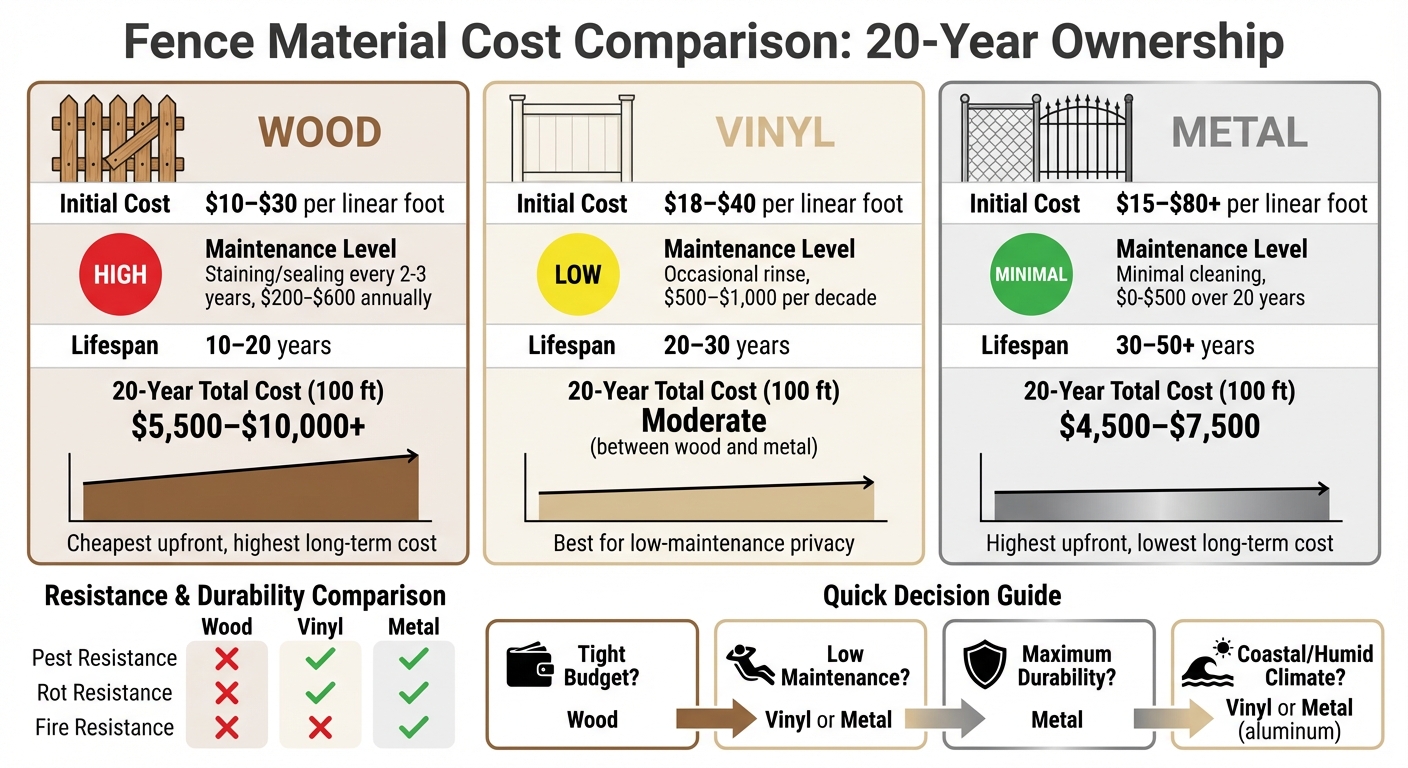
Wood vs Vinyl vs Metal Fence Cost Comparison: Initial Price, Maintenance, and 20-Year Total Cost
1. Wood Fencing
Initial Cost
Wood fencing often stands out as the most affordable option upfront among fencing materials. Installation costs typically range from $1,920 to $5,000, translating to about $11 to $45 per linear foot, depending on factors like the type of wood, design, and terrain. If you’re on a tight budget, pressure-treated pine is your go-to, costing around $18 to $28 per linear foot installed. On the other hand, premium choices like cedar range from $35 to $42 per linear foot, while redwood can cost anywhere from $35 to $120 per linear foot.
Labor costs represent a significant portion – 40% to 60% – of the total installation expense, typically running between $8 and $25 per linear foot. Keep in mind, though, that these costs can climb by 20% to 50% if your property has sloped terrain or rocky soil. Additionally, permit fees can range widely, from $25 to $500, depending on your location.
It’s worth noting that material costs have seen a 4% to 6% increase in 2026, driven by supply chain challenges and the rising demand for eco-friendly lumber. These upfront costs are just the starting point – maintenance expenses will play a big role in the long-term cost of owning a wood fence.
Maintenance Expenses
Maintenance is a key factor when it comes to wood fencing. To keep its appearance and durability, wood requires consistent upkeep. Staining or sealing every 2 to 3 years will cost around $2 to $5 per linear foot, and occasional repairs can add $250 to $750 per incident. On average, you could be spending $200 to $600 annually on maintenance.
"Wood rarely stays ‘cheap’ if you own it long enough." – TheSiteMath Editorial Team
In humid climates, untreated posts that come into contact with the ground may decay within 5 to 8 years, leading to costly replacements. Over a 20-year span, the upkeep for a 100-foot wood fence could total $5,500 to $10,000 or more, potentially surpassing the lifetime costs of metal or vinyl alternatives.
Lifespan
The lifespan of wood fencing depends heavily on maintenance and the type of wood used. With proper care, a wood fence typically lasts 15 to 20 years, though premium options like cedar or redwood can endure for 20 to 40 years. Pressure-treated pine usually falls on the shorter end of the spectrum, lasting 15 to 20 years. Without regular maintenance, however, the lifespan can shrink dramatically to as little as 5 years. Climate also plays a big role – humid areas can speed up rot, while drier climates help extend the life of the wood.
Long-Term Value
Weighing upfront costs against long-term expenses is essential for understanding the overall value of wood fencing. While maintenance can be a consistent expense, wood fences often deliver solid financial returns. A well-maintained wood fence can increase property value by 5% to 10% and offer a return on investment (ROI) of about 60%, which is significantly higher than vinyl’s estimated 30% to 40% ROI.
To maximize value, opt for rot-resistant woods like cedar or redwood, or ensure pressure-treated lumber meets AWPA UC4B or UC4C standards for ground contact. If you’re looking to save on installation, consider scheduling the project during late fall or winter, when contractors may offer 5% to 15% discounts during their off-peak season.
sbb-itb-d1d0a96
2. Vinyl Fencing
Initial Cost
Vinyl fencing strikes a balance between affordability and durability. It’s not the cheapest option, but it offers great value for its near-zero maintenance requirements. The installed cost ranges from $20 to $40 per linear foot, with materials alone typically costing $18 to $35 per linear foot. For standard privacy fences, expect to pay $25 to $40 per linear foot, which is pricier than basic pressure-treated wood but still more affordable than ornamental wrought iron.
On average, homeowners spend about $4,155 for a vinyl fencing project, though the total cost can vary between $2,341 and $5,991, depending on the size of the property and the design. Labor fees typically add $5 to $10 per linear foot, and gates can cost an extra $300 to $1,500 each. Since vinyl often comes in pre-fabricated panels, installation is generally quicker and easier compared to wood fences that require individual board assembly. This upfront investment sets the foundation for vinyl’s long-term cost advantages.
Maintenance Expenses
One of vinyl’s standout features is its low maintenance. Forget about frequent staining or sealing – vinyl only needs an occasional rinse with a garden hose or a wipe-down with mild detergent. Over a decade, maintenance costs typically range from $500 to $1,000, far less than the $1,500 to $3,000 you’d spend on wood fences.
"While the upfront investment is greater, vinyl offers several advantages that can offset the higher price over the lifespan of the fence." – HomeSidekick
Repairs are also less expensive, averaging $100 to $500 per incident, compared to $250 to $750 for wood. Professional pressure washing, if needed, costs about $225. Vinyl’s resistance to rot, warping, and pests like termites further reduces upkeep headaches. However, avoid hitting the fence with weed whackers, as this can cause cracking or other damage.
Lifespan
Vinyl fences are built to last, with most lasting 20 to 30 years – and premium installations often exceeding the 30-year mark. That’s about double the lifespan of standard wood fences, which usually need replacing every 10 to 15 years. Modern vinyl includes UV stabilizers like titanium dioxide (TiO₂), which protect against yellowing, fading, and cracking from sun exposure.
Vinyl’s flexibility is another key advantage. It bends rather than breaks during high winds or storms, withstanding gusts over 70 mph and temperatures as low as –20°F without cracking. However, low-quality vinyl can become brittle in extreme cold, so investing in high-grade materials is crucial. Keep in mind that damaged vinyl panels often require full replacement, unlike wood, where individual boards can be swapped out.
Long-Term Value
When you consider its minimal upkeep and long lifespan, vinyl fencing is a smart choice for long-term ownership. A well-maintained vinyl fence typically delivers an ROI of 30% to 40%, and the low maintenance costs make it even more appealing over time.
For a 200-foot vinyl fence, the initial cost might range from $5,000 to $10,000, but the durability and ease of care make it a cost-effective option in the long run. To get the most value, opt for "virgin" vinyl rather than recycled versions, as recycled materials are more prone to brittleness and quicker deterioration. Professional installation with solid concrete footings is also essential to ensure the fence remains sturdy and reliable for decades.
3. Metal Fencing
Initial Cost
Metal fencing offers a range of options, from budget-friendly chain-link to high-end wrought iron. Installed costs usually fall between $15 and $80+ per linear foot. For instance, chain-link fencing costs around $10 to $25 per linear foot, while wrought iron starts at $50 and can exceed $80 per linear foot. Material-only prices for 2026 are expected to range from $7 to $15 per linear foot for chain-link and $30 to $55 per linear foot for wrought iron or steel horizontal slat panels. Labor typically adds another $10 to $30 per linear foot, but opting for DIY installation kits can reduce overall costs by 40% to 60% compared to hiring a contractor. Additionally, set aside 10% to 15% of your budget for permits, surveys, and any necessary site grading. If your project requires a new entrance, factor in fence gate installation costs as well.
Next, let’s take a closer look at the maintenance costs to understand why metal fencing often offers long-term savings.
Maintenance Expenses
One of the biggest perks of metal fencing is its low maintenance requirements. Most of the time, all it needs is a quick rinse with a garden hose. Over 20 years, maintaining a 100-foot metal fence could cost anywhere from $0 to $500, a stark contrast to the $4,000 to $12,000 you might spend on upkeep and replacement for a wood fence. Plus, metal is resistant to pests like termites and carpenter ants, and it won’t rot.
For regions with coastal or humid climates, aluminum is an excellent choice since it doesn’t rust. Steel, on the other hand, works best when treated with galvanization or powder coating to prevent oxidation. Modern hot-dip galvanized steel can resist corrosion for 50 years or more in moderate climates, making it a durable option for the long haul.
Lifespan
Metal fences are built to last, with typical lifespans ranging from 30 to 50+ years. That’s roughly three to five times longer than wood fences, which generally last 8 to 15 years, and nearly double the lifespan of vinyl fences, which hold up for about 15 to 25 years. Properly installed hot-dip galvanized steel and wrought iron fences can even surpass the 50-year mark.
Beyond longevity, metal fencing is also non-combustible and fire-resistant, making it far more durable in extreme weather. By comparison, wood fences are highly flammable, and vinyl fences can melt under intense heat.
Long-Term Value
Thanks to its durability and minimal upkeep, metal fencing offers an excellent return on investment. While the initial installation cost may be higher, the long-term ownership costs are significantly lower. For example, a $2,500 corrugated metal fence with a 40-year lifespan averages out to about $62.50 per year. Meanwhile, a $2,000 wood fence lasting 12 years costs approximately $166.67 per year. As the BarrierBoss Team puts it:
"Metal beats wood and vinyl on longevity, fire resistance, and total cost of ownership over 15+ years."
Over a 20-year period, a 100-foot metal privacy fence may cost between $4,500 and $8,000 in total, including minimal maintenance. In contrast, a comparable wood fence could run anywhere from $6,500 to $17,500 or more when factoring in upkeep and replacement. If you plan to stay in your home for many years, the upfront investment in metal fencing pays off significantly over time.
2025 Fence Cost Guide: Real Prices & What to Expect
Pros and Cons
Here’s a quick rundown of the advantages and disadvantages of wood, vinyl, and metal fences, based on the earlier breakdown.
Wood is the budget-friendly option, with an initial cost of $10 to $30 per linear foot. This makes it a great choice for cost-conscious projects. However, it does come with a catch – expect to stain or seal it every 2 to 3 years to avoid issues like rot and warping. Over time, maintenance and replacement costs can add up, as shown in the comparison table below.
Vinyl sits in the middle, costing $18 to $40 per linear foot installed. One of its biggest perks? It’s virtually maintenance-free – just an occasional rinse with a hose will do the trick. With a lifespan of 20 to 30 years, vinyl offers excellent value for those who want privacy without constant upkeep. That said, it’s not perfect – extreme cold can cause it to crack.
Metal fencing spans a wide price range, from $15 per linear foot for chain-link5 per linear foot for chain-link fence installation to over $80 for wrought iron. While it demands a higher upfront investment, metal fences last the longest – 30 to 50+ years – with minimal upkeep. They’re also pest-proof, non-combustible, and highly durable. Aluminum, in particular, is a great option for coastal or humid areas since it won’t rust.
Here’s a side-by-side comparison to make things clearer:
| Factor | Wood | Vinyl | Metal |
|---|---|---|---|
| Initial Cost | $10–$30/ft | $18–$40/ft | $15–$80+/ft |
| Maintenance | High (needs staining/sealing) | Minimal (occasional wash) | Low (minor cleaning) |
| Lifespan | 10–20 years | 20–30 years | 30–50+ years |
| Pest/Rot Resistance | Vulnerable | Immune | Immune |
| 20-Year Total Cost | $5,500–$10,000+ | Moderate | $4,500–$7,500 |
A few additional points to consider: wood fences are easier and cheaper to repair since individual boards can be replaced. In contrast, damaged vinyl or metal panels often require full replacement. If sustainability matters to you, metal’s recyclability and long-term durability make it a strong contender.
This comparison lays out the key trade-offs, helping you choose based on your budget, maintenance preferences, and how long you want your fence to last.
Conclusion
When deciding on the right fence, it all comes down to balancing upfront cost, maintenance needs, and lifespan.
Wood fences are an affordable option, starting at around $10 to $30 per linear foot. However, they come with ongoing maintenance costs, averaging $200–$600 annually for upkeep. On the other hand, vinyl fences cost more upfront – between $18 and $40 per linear foot – but require minimal maintenance, making them a convenient choice for homeowners who want a hassle-free option.
Metal fences offer a wide range of pricing, from $10–$25 per foot for chain-link to over $75 per foot for ornamental wrought iron. With a lifespan of 30 to 50+ years, they provide excellent long-term value. Over two decades, a 100-foot wood fence could cost $5,500–$10,000, while a metal fence might range from $4,500–$7,500.
For those working with a budget under $3,000 per 100 feet, wood can be a practical choice, provided you’re ready to handle regular maintenance every couple of years. If you’re looking for a low-maintenance option that also enhances privacy, vinyl is worth the investment. For maximum durability, security, or use in coastal environments, aluminum or steel fences stand out due to their rust-resistance and longevity.
Professional installation is key to avoiding alignment or anchoring issues, particularly with vinyl and metal fences. In Plano, TX, Tend Fencing offers expert installation for wood, ornamental iron, and chain-link fences, tailoring designs to suit both your budget and long-term needs. This ensures your fence not only looks great but also performs well over time.
The best fence is the one that fits your budget, matches your maintenance preferences, and delivers lasting value.
FAQs
Which fence type is cheapest over 20 years for my yard size?
Over a span of 20 years, steel fences often prove to be the most cost-effective option because of their durability and minimal upkeep. While wood fences come with a lower initial price tag – ranging between $13 and $25 per linear foot – they demand regular maintenance and typically last 15 to 40 years. On the other hand, steel fences, though more expensive upfront at $30 to $55 per linear foot, boast a lifespan of 30 to 50+ years with little to no maintenance. This makes them a smarter long-term investment despite the higher initial cost.
What hidden costs can raise my fence price?
When planning for a new fence, it’s easy to overlook certain expenses that can sneak up on you. Here are a few hidden costs to keep in mind:
- Site Preparation: If your property has uneven terrain, clearing, grading, or leveling may be required. These tasks often involve extra labor, which can drive up the overall cost.
- Permits and Inspections: In some areas, you’ll need to secure permits or schedule inspections before installing a fence. These requirements can add to your expenses, especially in highly regulated locations.
- Ongoing Maintenance: Fences aren’t a one-and-done deal. Over time, you might need to invest in staining, sealing, or repairing your fence to keep it looking good and functioning well.
- Unexpected Issues: Sometimes, surprises like underground utilities, poor soil conditions, or accidental installation damage can crop up. These situations often lead to additional charges, so it’s smart to set aside a little extra in your budget just in case.
By being aware of these potential costs, you can plan more effectively and avoid unpleasant surprises during or after your fence project.
Which fence holds up best in Texas heat and storms?
Metal fences tend to hold up much better in Texas’s intense heat and unpredictable storms thanks to their strength and durability. Unlike wood fences, which can warp, rot, or even fall victim to insect damage in humid or stormy weather, metal fences are built to withstand these harsh conditions. While wood may provide a certain visual charm, metal stands out as the better option for those seeking long-lasting resilience in tough climates.