
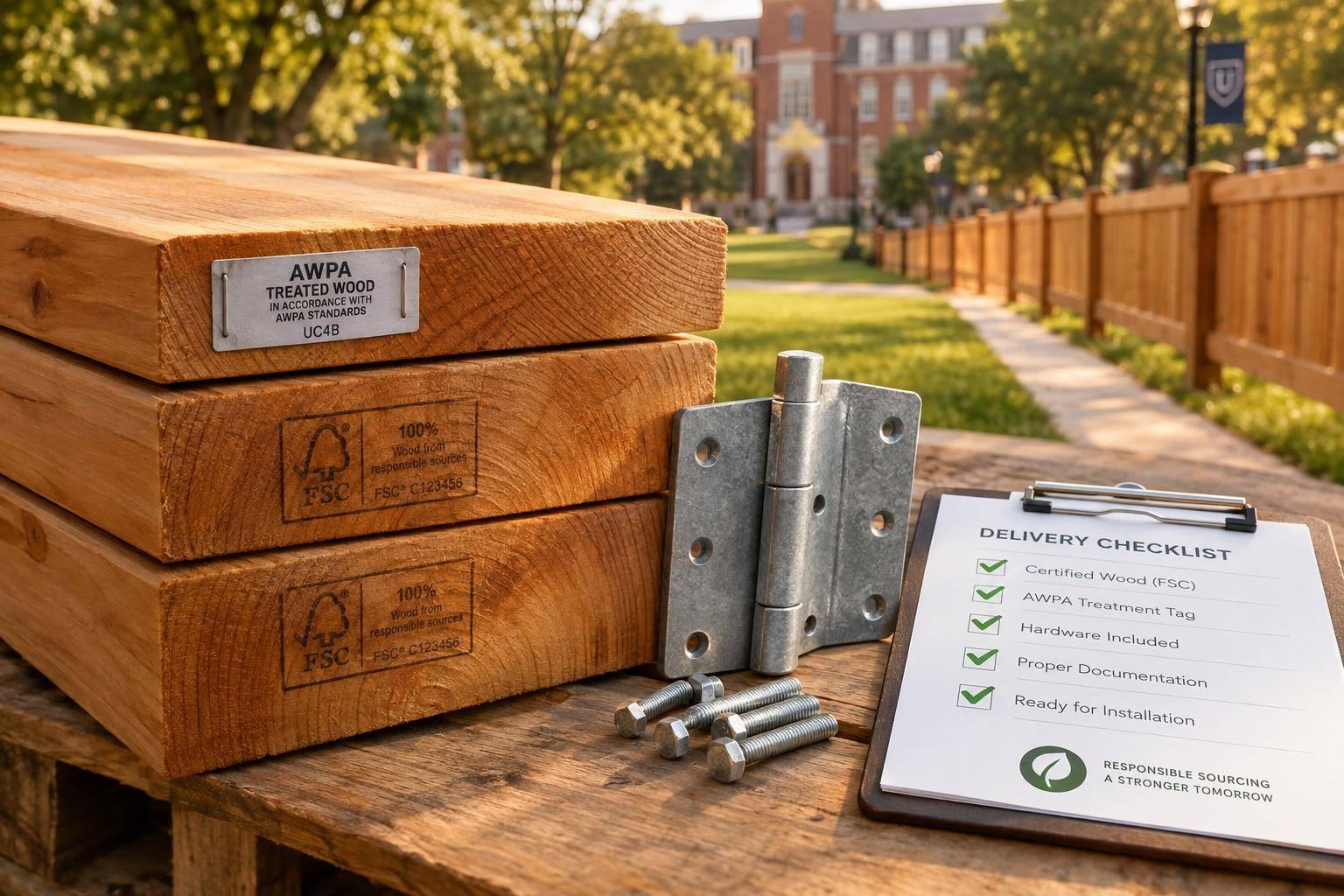
I recommend approving the exact lumber order before scheduling campus fence installation – not relying on a supplier’s general claims. Check certification records, wood specifications, treatment, hardware, and delivered costs first. For example, soil-contact posts commonly need AWPA UC4A treatment; above-ground-only lumber won’t do.
Here’s the checklist I use to frame the purchase:
- Define each fence section’s purpose, site conditions, and campus purchasing rules.
- Verify product-specific certification claims, source records, and any substitutions.
- Compare local availability, lead times, and total delivered prices.
- Confirm component treatment, compatible hardware, and field-cut protection.
- Get written approval, inspect deliveries, and keep records for maintenance and audits.
My rule: <u>approve the materials first, then release the schedule</u>. For Plano-area projects, that includes getting written material and delivery details from Tend Fencing – not assuming availability or approval.
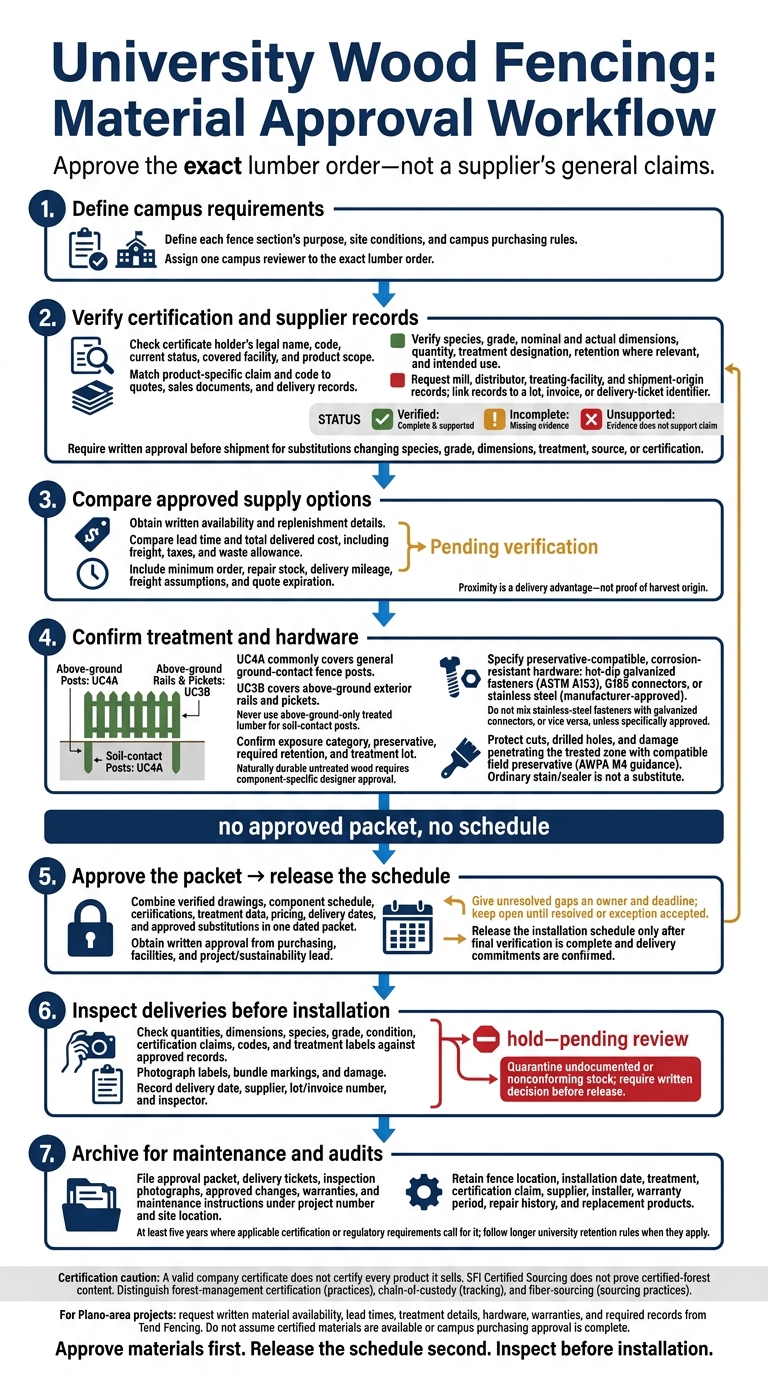
University Wood Fencing: Material Approval Workflow
Verify Wood Certifications and Supplier Records
Once purchasing requirements are set, assign one campus reviewer to check the exact lumber order before release – not the supplier’s general sustainability statement. Log each discrepancy, who must resolve it, and the deadline. Hold approval until the evidence is complete or an exception is accepted.
Check Certification and Chain-of-Custody Claims
These certifications cover different things. Forest-management certification addresses forest practices. Chain-of-custody tracks eligible material through processing and distribution. Fiber-sourcing covers sourcing practices. SFI Certified Sourcing does not prove certified-forest content.
Check the certificate holder’s legal name, code, current status, covered facility, and product scope in the program database or with the certification body. Use FSC’s public database. For ATFS-origin material, ask the supplier, mill, or an authorized procurement participant to obtain verification through the ATFS system.
Match the applicable claim and code to the quote and sales documents, then require matching delivery records. A valid company certificate does not certify every product that company sells.
Match Lumber Details to Supplier Records
Require line-item details for species, grade, nominal and actual dimensions, quantity, treatment designation, retention where relevant, and intended use. Request records for the mill, distributor, treating facility, and shipment origin. A local shipping address is not proof of harvest origin.
Use the table as a checklist, marking one status per row. Incomplete means evidence is missing; unsupported means the supplied evidence does not support the claim. Require written approval before shipment for substitutions that change species, grade, dimensions, treatment, source, or certification.
| Required record | Provider | What it verifies | Status |
|---|---|---|---|
| Certificate, code, scope, and covered facility | Supplier or certification body | Current holder and covered products/facility | Verified / incomplete / unsupported |
| Product-specific claim on quote or sales document | Supplier | Claim tied to the ordered lumber | Verified / incomplete / unsupported |
| Species, grade, dimensions, and quantity | Mill or supplier | Matches purchase specifications | Verified / incomplete / unsupported |
| Treatment and intended-use records | Treating facility or supplier | Treatment, retention, and exposure suitability | Verified / incomplete / unsupported |
| Mill, distributor, treatment facility, and shipment-origin records | Supplier | Handling locations and origin gaps | Verified / incomplete / unsupported |
| Lot, invoice, or delivery-ticket identifier | Supplier or carrier | Links records to delivered lumber | Verified / incomplete / unsupported |
| Written substitution approval, if needed | Campus reviewer | Authorization for changes to approved materials | Verified / incomplete / unsupported |
Use the verified records to compare local supply, lead times, and treatment options.
sbb-itb-d1d0a96
Check Local Supply and Treatment Options
Compare Materials, Lead Times, and Delivered Costs
Once records are verified, compare approved materials by cost and timing. Treat proximity only as a delivery advantage. Get written quotes that include species, grade, dimensions, quantity, minimum order, waste allowance, repair stock, delivery mileage, lead time, freight assumptions, taxes, and quote expiration. Ask about current inventory and future replenishment. Mark missing fields Pending verification.
Use the sheet below to compare supplier responses and narrow the purchase order. These fields do not approve materials or substitutions.
| Approved material | Certification claim | Source location | Treatment availability | Lead time | Delivered cost (USD) | Documentation status |
|---|---|---|---|---|---|---|
| Soil-contact posts | Required certification claim | Harvest, processing, treatment, and stocking locations | Required ground-contact category, preservative, and retention | Supplier-stated lead time | Quote including freight, taxes, and waste allowance | Pending verification |
| Above-ground rails and pickets | Required certification claim | Harvest, processing, and stocking locations | Required above-ground treatment or permitted naturally durable species | Supplier-stated lead time | Quote including freight, taxes, and waste allowance | Pending verification |
| Matching repair stock | Same required claim as installed material | Replenishment source | Matches component specification | Replenishment lead time | Quote including delivery and repair-stock terms | Pending verification |
Specify Treatment for Each Fence Component
Never use above-ground-only treated lumber for soil-contact posts. Match posts, rails, and pickets to the applicable American Wood Protection Association (AWPA) use category – not just a “pressure treated” label. UC4A commonly covers general ground-contact fence posts, while UC3B covers above-ground exterior rails and pickets. Confirm the exposure category before buying, and require treating records that identify the preservative, required retention, and treatment lot.
Untreated, naturally durable wood needs designer approval based on species, heartwood content, moisture exposure, drainage, irrigation exposure, and campus service-life requirements. Approval must be specific to each component.
Specify Hardware and Field-Cut Protection
Before crews start, specify preservative-compatible, corrosion-resistant fasteners and connectors to help prevent field failures. Use hot-dip galvanized fasteners meeting ASTM A153, G185 connectors, or stainless steel only when manufacturer-approved. Do not mix stainless-steel fasteners with galvanized connectors – or galvanized fasteners with stainless-steel connectors – unless the designer and manufacturers specifically approve the combination.
Require a compatible field preservative for cuts, drilled holes, and other damage that penetrates the treated zone, following AWPA M4 guidance. Ordinary stain or sealer is not a substitute. Store lumber off the ground and protect it from standing water and contamination. Have the designer and installer confirm compatibility before ordering.
Approve Materials Before Scheduling Installation
Complete the Purchase Approval Packet
Use the verified records to finalize the order before scheduling installation. Combine the verified drawings, component schedule, certifications, treatment data, pricing, delivery dates, and approved substitutions into one packet. List every component separately so purchasing and installation teams work from the same dated specification.
Add this condition to both the purchase order and installation contract:
“no approved packet, no schedule”
Get written approval from purchasing, facilities, and the project lead or sustainability lead. For each substitution, document its effect on performance, certification, treatment, cost, and delivery. Update the drawings, purchase order, and schedule to match.
Keep unresolved gaps open. Don’t approve them informally. Give each gap an owner and a deadline. After the packet is approved, use it to check deliveries.
Inspect Deliveries and Keep Records
Before installation, check delivered quantities, dimensions, species, grade, and condition against the approved schedule. Match certification claims and codes to invoices and delivery records. Check treatment labels against the approved requirements, and photograph labels, bundle markings, and damage.
Quarantine stock that lacks documentation or fails to meet requirements. Mark it with this status and require a written decision on its use before releasing it:
“hold – pending review”
Record the delivery date, supplier, lot or invoice number, and inspector.
File the approval packet, delivery tickets, inspection photographs, approved changes, warranties, and maintenance instructions under the project number and site location. Keeping these records together makes audits and replacement purchases easier. Retain them for at least five years where applicable certification or regulatory requirements call for it. Follow longer university retention rules when they apply.
Review Plano-Area Project Needs With Tend Fencing
For Plano-area campuses, send the approved drawings to Tend Fencing. Request written confirmation of material availability, lead times, treatment details, hardware, warranties, and required records.
Before releasing the installation schedule, check compliance with university sourcing requirements. Do not assume certified materials are available or purchasing approval is complete.
Conclusion: Verify Materials Before Releasing the Schedule
After purchase approval, release the schedule only after final verification is complete and delivery commitments are confirmed. Treat this as a purchasing gate, not a calendar task. Check campus requirements, certification claims, supplier records, material availability, treatment and hardware suitability, and written approval.
Keep the review open until records and substitutions are approved. Scheduling does not authorize installation of nonconforming materials.
Then archive the approved package in the campus asset file. Keep these records for future maintenance: fence location, installation date, treatment, certification claim, supplier, installer, warranty period, repair history, and replacement products. These details support future repairs, replacements, and audits.
FAQs
What if certified lumber is unavailable locally?
Reclaimed wood gives existing materials another use and reduces demand for new timber. Bamboo or recycled composite boards can also provide durability and low maintenance while helping reduce your project’s carbon footprint.
Tend Fencing can walk you through these materials during the design process, helping you balance your preferred look, practical needs, and sustainability goals. The company also plants a tree for every fence built.
How can we verify conflicting supplier records?
For FSC certification, check the supplier in the official FSC Public Search database. Confirm that the certificate is active and covers the product category you’re buying. Ask the supplier to include their FSC license code and exact product claim, such as FSC 100% or FSC Mix, on every sales invoice and delivery note.
For larger projects, ask about project certification to ensure chain of custody from the forest through final installation.
When do fence posts need treatment beyond UC4A?
Fence posts need treatment beyond UC4A when ground-contact risk exceeds what UC4A covers. This is especially important in or near persistently wet locations, including splash zones, poorly drained areas, and soil that stays damp.
Choose a higher-rated treatment, then check the specifications in your purchase documentation before scheduling installation. This helps ensure the posts match the site’s exposure level.