
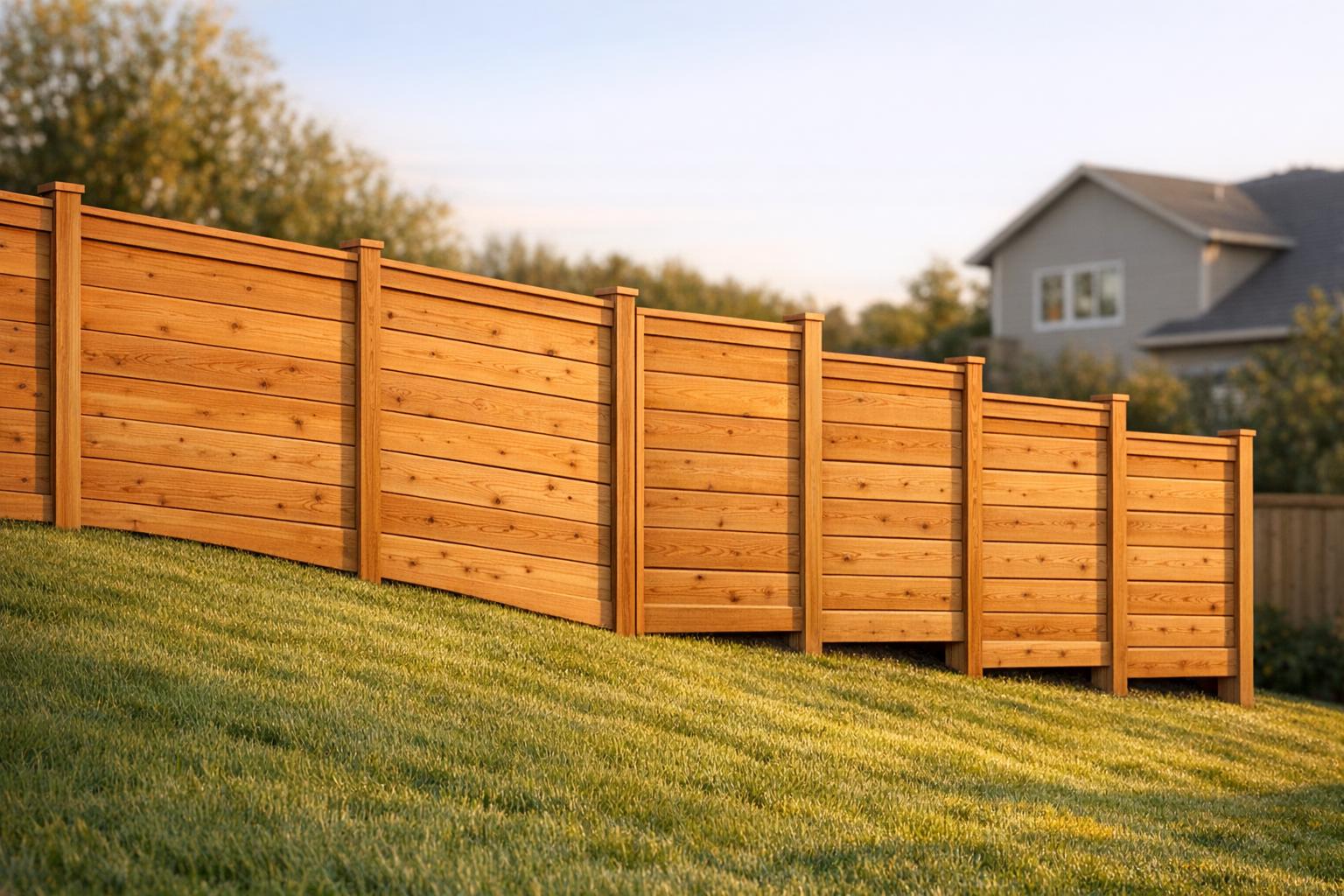
When fencing a sloped yard, you have two main options: stepped fencing and raked fencing. Here’s a quick breakdown:
- Raked fencing follows the slope of the ground with angled rails, keeping the gap between the fence and the ground consistent. It’s best for gentle slopes (under 15°) and is great for pet containment.
- Stepped fencing uses horizontal panels that "step down" the slope in sections, creating a clean, level top line. It’s ideal for steeper slopes (over 15°) but leaves gaps at the base, which may need to be filled.
Quick Comparison
| Feature | Raked Fencing | Stepped Fencing |
|---|---|---|
| Design | Rails follow the slope | Panels stay horizontal, step down |
| Best Slope Range | Gradual slopes (<15°) | Steep slopes (>15°) |
| Ground Clearance | Consistent | Gaps at the base |
| Top Appearance | Diagonal, follows terrain | Horizontal and level |
| Materials | Works with flexible materials | Works with rigid panels , such as ornamental steel fences |
| Pet Containment | High | Requires gap fillers |
Choose raked fencing for smoother slopes and better ground coverage. Opt for stepped fencing on steeper or uneven ground for a uniform top. Costs average $3,233, depending on materials and slope complexity.
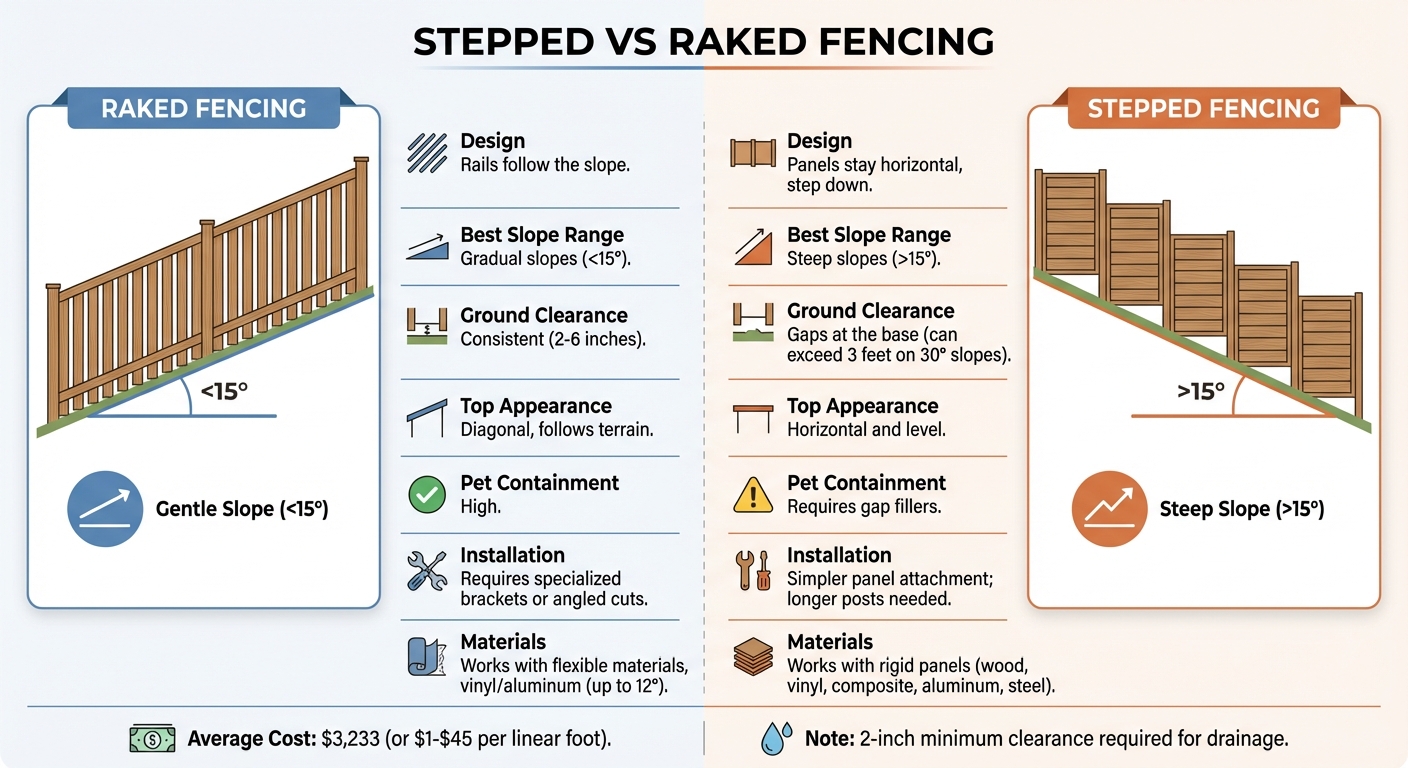
Stepped vs Raked Fencing Comparison Chart for Sloped Yards
Stepped vs Racked vs Custom Fences for Uneven Ground | Which One’s Best?
sbb-itb-d1d0a96
What is Stepped Fencing?
Stepped fencing, also known as stair-step fencing, uses horizontal panels that descend along a slope. Picture it like a staircase: each flat panel "steps down" to a lower level at each post. This creates a clean, uniform look with a level top rail. However, as the panels step down, the gap between the bottom of the fence and the ground increases at the lower posts.
How Stepped Fencing is Installed
The installation process starts with some math. To determine the vertical "step" for each panel, you divide the total grade drop of your fence line by the number of sections (e.g., 4 inches per section). Transition posts need deeper footings to handle uneven loads, and a minimum 2-inch clearance at the base is essential for drainage. Each panel is installed level, rather than angled to follow the slope, ensuring a straight top rail.
Preconstructed rigid panels – whether made of wood, vinyl, or composite – make installation easier, especially on steep slopes. To address the triangular gaps left at the bottom, you can use gravel beds, masonry infill, or filler boards. These adjustments improve security and help keep pets from slipping through. Thanks to these features, stepped fencing is a great choice for uneven or challenging landscapes.
When to Use Stepped Fencing
Stepped fencing shines on steep or irregular slopes, particularly those with a grade exceeding 15°. Many racking systems for vinyl or aluminum panels are only designed to handle slopes up to 12–15°, making stepped fencing a better option when the incline is more dramatic. It’s also a solution for areas with sudden grade changes where continuous rails aren’t practical. Additionally, some Homeowners Associations require fences with a horizontal top rail for aesthetic reasons, making stepped fencing an ideal choice in such neighborhoods.
Materials for Stepped Fencing
Stepped fencing works with a wide range of materials. Here’s a breakdown of popular options:
- Wood: Materials like cedar, redwood, and treated pine provide a natural, classic look. However, they usually require annual maintenance, such as staining or sealing, to prevent rot and moisture damage.
- Vinyl (PVC): A low-maintenance choice that resists pests and rot. Keep in mind, though, that vinyl can become brittle in extreme cold or warp in intense heat.
- Composite: Made from a mix of wood fibers and plastic, composite fencing mimics the appearance of wood but resists rot, warping, and fading. Many brands offer warranties of up to 30 years.
- Aluminum: Lightweight and naturally rust-proof, aluminum provides a sleek, modern look.
- Steel: Offers maximum security but may need anti-rust coatings over time to maintain durability.
Each material has its pros and cons, so your choice will depend on your priorities, whether it’s aesthetics, durability, or maintenance.
What is Raked Fencing?
Raked fencing (also called racked, contour, or parallel fencing) is designed to follow the natural slope of your yard, creating a smooth, diagonal line along the ground. During installation, the posts are kept perfectly vertical – using tools like a level or plumb bob – while the rails are angled to match the slope. This method ensures consistent clearance, which is especially important for keeping pets safely contained.
How Raked Fencing Works
In a raked fence, the posts and pickets remain upright, while the horizontal rails are angled to align with the slope. Many vinyl and aluminum fencing systems come pre-engineered with slotted brackets on the posts, making it easier to rake the rails. These systems generally accommodate slopes up to 12° without requiring extra modifications. For steeper slopes, or when using wood, a board-by-board approach is often used. This allows each picket to stay vertical as the rails adjust to the slope.
One important note: gates in raked fencing need custom sizing. They’re typically built as parallelograms to fit the angled opening. This seamless design is both functional and visually appealing, making raked fencing a smart choice for certain landscapes.
When to Use Raked Fencing
Raked fencing is ideal for gentle, uniform slopes – typically those with a grade of 15° or less. Its design ensures consistent ground clearance, which is great for security and pet containment, as it minimizes gaps that can occur with other fencing styles like stepped designs. If your yard has a gradual slope and you need the fence to stay close to the ground, raked fencing is a strong option.
For proper installation, leave a gap of 2 to 6 inches under the pickets to allow water to drain effectively, especially on sloped terrain.
Before choosing raked fencing, measure your slope using two stakes and a mason line. If the slope is steeper than 15°, raked fencing may strain the joints where rails meet posts, making stepped fencing a better choice.
Material Options for Raked Fencing
Your choice of material plays a big role in the success of a raked fence. Here’s a breakdown of popular options:
- Vinyl and Aluminum: These materials are common because many systems include slotted post brackets, making it easier to angle the rails. Most vinyl and aluminum panels are rated for slopes up to 12°.
- Wood: Wood offers more flexibility. With board-by-board construction, you can keep each picket vertical while the rails follow the slope. This method also works better for steeper slopes.
- Chain-Link: Chain-link fencing is very adaptable. The mesh can be tensioned to follow the slope, eliminating the need for formal racking.
- Composite: Composite materials can be tricky to work with. Systems using U-channel posts may require precise cuts to fit boards at an angle. As Natures Composites explains:
If you try to rack boards inside the U-channel, they may not stay seated properly. If you’re committed to racking, you’ll need to carefully cut the boards to the slope’s angle. This takes precision and planning.
No matter the material, measuring your slope accurately is essential. Check the manufacturer’s "racking rating" before purchasing any prefabricated panels to ensure the system can handle your yard’s slope.
Stepped vs Raked Fencing: Main Differences
The key difference between these two fencing methods lies in how they handle sloped terrain. Raked fencing follows the natural slope of the land, with rails angled to match the ground while the posts and pickets remain vertical. On the other hand, stepped fencing uses level panels that descend in a stair-step pattern, creating a horizontal top line. Raked fencing is better suited for gradual, uniform slopes of less than 15°, while stepped fencing works well on steeper slopes over 15°, as it keeps panels level despite the incline.
Another major distinction is ground clearance. Raked fencing maintains a consistent gap – usually between 2 to 6 inches – between the fence and the ground, making it a good choice for keeping pets contained. Stepped fencing, however, creates large triangular gaps on the downhill side of each panel, especially on steep slopes where gaps can exceed 3 feet. These gaps often require additional materials like gravel, masonry, or custom boards to close them off effectively for pet containment.
Installation needs also vary. Raked fencing often requires specialized hardware, such as slotted post brackets or precisely angled rail cuts, to ensure flush connections. Vinyl and aluminum panels designed for raking can typically adjust up to 12° without the need for custom modifications. Stepped fencing, by contrast, involves simpler panel attachment but usually requires longer posts at transition points to accommodate height changes. The table below offers a side-by-side comparison of these two fencing styles. For more fencing trends and installation tips, explore our latest guides.
Comparison Table: Stepped vs Raked Fencing
| Feature | Raked Fencing | Stepped Fencing |
|---|---|---|
| Design | Rails follow the slope; pickets stay vertical | Panels stay horizontal; descends in steps |
| Best Slope Range | Gradual slopes (<15°) | Steep or uneven slopes (>15°) |
| Top Rail Appearance | Matches the slope line | Horizontal and level |
| Ground Clearance | Consistent, minimal gap | Large gaps on downhill side |
| Material Requirements | Adjustable panels or custom cuts | Standard rigid panels |
| Installation Complexity | Requires specialized brackets or angled cuts | Easier panel attachment; longer posts needed |
| Pet Containment | Excellent – small gaps | Requires materials to fill large gaps |
Combining Stepped and Raked Fencing
Sometimes, the best solution is a mix of both methods. For instance, an installer might use a stepped top rail for a clean, horizontal appearance while raking the bottom rail or custom-cutting pickets to follow the ground. This hybrid approach reduces gaps while maintaining a uniform top rail.
This combination is especially useful in situations where homeowners’ associations require a consistent top-rail height, but effective pet containment is also a priority. While this method demands more time and precision during installation, it creates a fence that balances functionality with aesthetics. By blending these techniques, you can achieve a design that works well across varied terrain while meeting practical needs.
Advantages and Disadvantages of Each Type
This section dives deeper into the strengths and weaknesses of stepped and raked fencing, with a focus on wind resistance and pet containment.
Each fencing style has its own set of trade-offs in terms of appearance, functionality, and upkeep. Stepped fencing is ideal for steep or uneven terrain with slopes exceeding 15°, where racking isn’t an option. It works well with materials like wood, vinyl, and composite, and it creates a clean, level top line. However, one downside is the triangular gaps at the base of the panels. For example, on a 30° slope using 6-foot-wide panels, these gaps can be over 3 feet wide.
On the other hand, raked fencing is better suited for gradual slopes under 15°. It maintains a consistent clearance of 2 to 6 inches along the fence line and follows the natural contours of the yard, resulting in a smooth, diagonal top line. However, prefabricated vinyl and aluminum panels are generally limited to raking angles of 12–15°. Exceeding these limits can cause structural stress at the rail-to-post connections.
Pros and Cons Table
| Feature | Stepped Fencing | Raked Fencing |
|---|---|---|
| Best Use | Steep/irregular slopes (>15°) | Gradual/uniform slopes (<15°) |
| Aesthetic | Level, horizontal top line | Smooth diagonal following terrain |
| Pet Containment | Low (requires gap filling) | High (consistent clearance) |
| Material Flexibility | Works with a wide range of materials | Best with materials designed for racking |
| Installation | Simpler panel attachment | Requires angled cuts and brackets |
| Structural Concern | Asymmetric loads on transition posts | Stress at rail-to-post joints |
Wind Resistance and Pet Containment
When it comes to wind resistance, proper installation is key. In stepped fencing, transition posts face uneven lateral loads due to varying panel heights, requiring deeper concrete footings to withstand strong winds. Raked fencing, however, distributes wind loads more evenly. That said, exceeding the racking limits specified by the manufacturer can weaken rail-to-post connections.
For pet containment, raked fencing has a clear advantage with its consistent 2 to 6-inch gap, effectively keeping small pets from escaping. Stepped fencing, by contrast, often requires additional measures to secure the gaps at the bottom – such as adding gravel beds, masonry infill, or custom filler boards – especially on steep slopes.
How to Choose the Right Fence for Your Sloped Yard
What to Consider When Deciding
When deciding between raked and stepped fencing for your sloped yard, it’s important to first assess the slope itself. A simple way to measure is using the rise-over-run method: place two stakes at different elevations, stretch a level mason line between them, and measure the vertical drop at the lower stake. This measurement helps determine the most suitable fencing style.
For slopes less than 15°, raked fencing is ideal. It provides a smooth contour while maintaining consistent clearance, which is especially useful if you have pets. On the other hand, for slopes greater than 15°, stepped fencing is a better choice. However, keep in mind that on steeper slopes, such as 30°, the downhill gap can be significant – around 3.2 feet with 6-foot panels. In such cases, you may need gap fillers like gravel beds, masonry infill, or custom boards, which can add to the overall cost.
Additionally, check with your HOA for any specific guidelines. Some may require a uniform top-rail height, which could make stepped fencing necessary even on gentler slopes. Also, ensure that fence pickets are at least 2 inches off the ground to allow for proper water drainage, especially at the base of a hill. On average, professional installation costs range from professional installation costs range from $1 to $45 per linear foot to $45 per linear foot, with many projects totaling around $3,233.
If you’re unsure about the best option, consulting with a professional can help you make the right choice for your yard.
Get Expert Help from Tend Fencing
Navigating the challenges of fencing a sloped yard can be tricky, but Tend Fencing offers the expertise you need. Serving Plano, TX, and nearby areas, they specialize in custom fencing solutions tailored to uneven terrain. Whether you’re looking for wood, ornamental iron, or chainlink fencing, Tend Fencing uses durable materials to create a fence that not only enhances your yard’s appearance but also handles the demands of sloped ground.
Their commitment to sustainability is an added bonus – they plant a tree for every fence they build. Ready to get started? Visit tendfencing.com to schedule a consultation and receive a custom quote for your project.
Conclusion
Deciding between raked fencing and stepped fencing depends on your slope and specific needs. Raked fencing is ideal for gradual slopes under 15 degrees, offering a seamless look with even ground clearance – perfect for keeping pets secure and enhancing safety. On the other hand, stepped fencing works better on steeper slopes over 15 degrees, maintaining a level top rail but often leaving triangular gaps at the base that might require filling with materials like gravel or masonry.
Each option has its strengths, but the right choice depends on accurate slope measurements, HOA requirements, and drainage considerations. Use the rise-over-run method to measure your slope, confirm HOA rules, and ensure a proper 2-inch gap under pickets to prevent water buildup. For slopes steeper than 45 degrees, retaining walls or terracing may be necessary instead of standard fencing.
For those in Plano, TX, navigating these decisions is easier with Tend Fencing. They specialize in evaluating sloped properties and providing tailored solutions, whether you need wood, ornamental iron, or chainlink fencing. Their expertise ensures a balance of style, durability, and functionality.
Whether you’re enclosing a gently sloped yard or managing a steep incline, the right fencing approach can turn challenging terrain into a secure and visually appealing boundary. With professional advice, you can achieve a fence that meets your needs and stands strong over time.
FAQs
How do I measure my yard’s slope angle?
To figure out the slope angle of your yard, start by driving two stakes into the ground where you plan to install the fence. Tie a mason line tightly between the stakes. Next, measure the vertical distance from the ground up to the line at each stake. Subtract the lower measurement from the higher one. Then, divide this difference by the length of the mason line. This calculation will give you the slope as either a ratio or a percentage, which you can use to understand the grade of your yard.
How can I close the gaps under a stepped fence?
To close the gaps under a stepped fence, try these approaches:
- Add horizontal trim or lattice along the bottom to cover the open space.
- Attach a skirt or barrier made from wood, vinyl, or similar materials to the lower edge of the fence.
- Adjust the bottom rail’s height or ensure each panel is securely fastened at the base.
These solutions can help keep debris out and stop animals from sneaking underneath.
Will I need a custom gate on a sloped fence?
When it comes to gates for sloped yards, the choice depends heavily on your fencing style. If you’re using raked fencing, which adjusts to the slope, you’ll likely need a custom gate. Standard gates often don’t align well with this type of fencing. On the other hand, stepped fencing, which consists of level sections, can accommodate standard gates or custom gates tailored to each step. For sloped yards, it’s essential to think about how well the gate will fit and function with your chosen fencing style.