
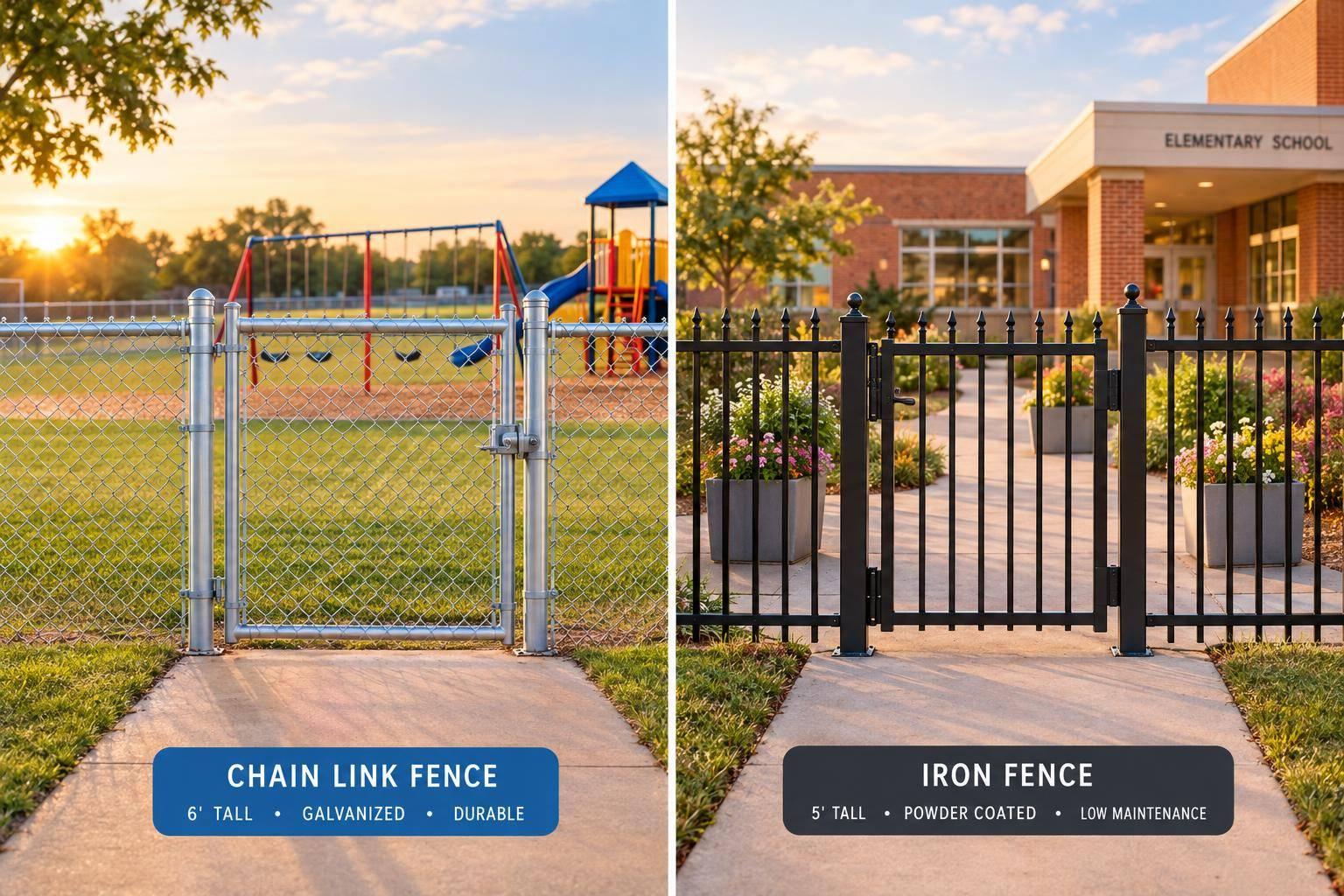
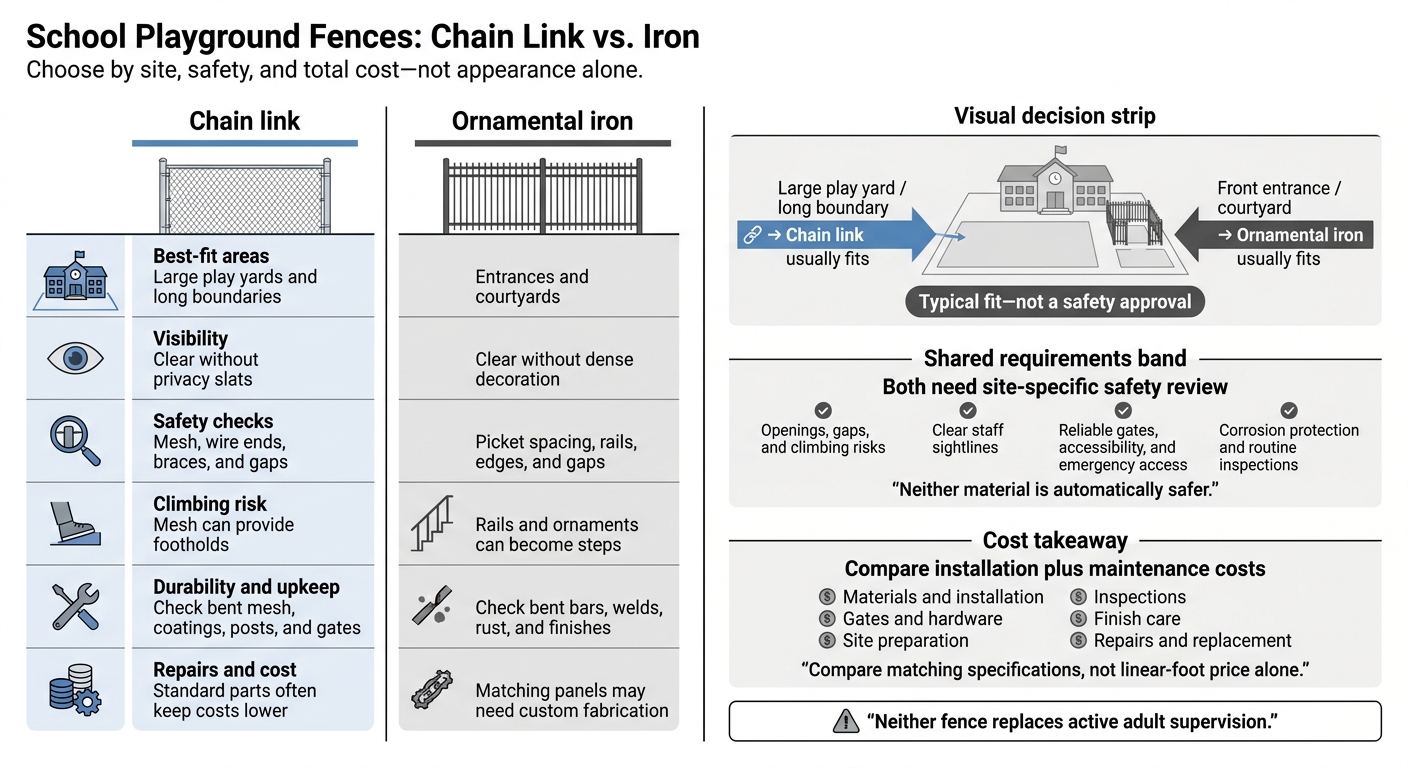
I’d choose chain link for a large school play yard and ornamental iron for a front-facing courtyard – after checking safety and gate access. Chain link usually costs less and is easier to repair. Iron offers a more formal look, but custom parts and finish work can cost more.
Neither material is automatically safer. I’d compare sightlines, climbing risks, openings, corrosion protection, and gate hardware before choosing. For example, CPSC guidance identifies 1¼-inch nominal chain-link mesh, but mesh size alone doesn’t make a fence safe.
Quick Comparison
| What I’d compare | Chain link | Ornamental iron |
|---|---|---|
| Best fit | Large play yards and long boundaries | Entrances and courtyards |
| Visibility | Clear without privacy slats | Clear without dense decoration |
| Safety checks | Mesh, wire ends, braces, and gaps | Picket spacing, rails, edges, and gaps |
| Climbing risk | Mesh can provide footholds | Rails and ornaments can become steps |
| Durability and upkeep | Check bent mesh, coatings, posts, and gates | Check bent bars, welds, rust, and finishes |
| Repairs and cost | Standard parts often keep costs lower | Matching panels may need custom fabrication |
Before requesting a quote in Plano, I’d confirm district rules, permits, accessibility, and emergency access. Then I’d give each bidder the same scope and compare installation plus maintenance costs. <u>Neither fence replaces active adult supervision.</u>
School Playground Fences: Chain Link vs. Iron
Chain Link for School Playgrounds
Once safety basics are in place, chain link is often a practical choice for schoolyards. It keeps large, open play areas visible, uses less material, and is easy to repair. Specify fencing designed for school use, with the right height and gate controls for each area.
Mesh Size and Visibility
CPSC guidance identifies 1¼-inch nominal mesh openings between parallel wires, with a maximum 1¾-inch horizontal opening between installed mesh corners. Check views from staff positions, since posts, landscaping, and coatings can block sightlines.
Smaller mesh doesn’t make a fence safe on its own. Specify neatly finished wire ends and safe fence tops. Check rails, diagonal braces, and transitions at gates, walls, and grade changes for footholds and hazardous gaps. CPSC specifically cautions against bracing that creates a ladder effect.
Rust Protection and Repairs
Galvanized steel resists corrosion and keeps costs down. Vinyl or powder coatings improve appearance and add protection, but exposed steel still needs repair.
Inspect fencing after storms, impacts, vandalism, and landscaping work. Look for bent mesh, sharp wires, loose fittings, damaged posts, bottom gaps caused by erosion, and failing gate hardware. Replace sharp or damaged wire rather than bending it aside. After repairs, recheck clearances and make sure gates work properly.
What Affects Chain-Link Installation Cost
Ask for pricing that spells out height, wire gauge, mesh opening, coating, post and framework sizes, and hardware for each gate. Demolition, hauling, difficult access, grading, concrete, drainage, and utility conflicts also affect the total.
Compare matching specifications, not linear-foot price alone. Smaller mesh, heavier components, controlled-access gates, temporary barriers, and phased work can increase school installation costs.
Chain link suits open, high-traffic play yards where visibility and fast repairs matter most. More formal spaces may call for a different look.
sbb-itb-d1d0a96
Ornamental Iron for School Playgrounds
Chain link offers a practical look; ornamental iron gives front-facing play areas a more formal finish. Usually made from ornamental steel, this fencing creates a rigid boundary while keeping sightlines clear. Request product data sheets that list the base metal, member dimensions, weld construction, corrosion protection, finish, and warranty.
Bar Spacing and Child Safety
Measure clear openings between rigid pickets, panels, rails, and decorative elements at both their narrowest and widest points. Check each opening for pass-through, entrapment, and head/neck hazards. Diagonal and lattice openings need a separate review. CPSC guidance flags openings greater than 3.5 inches and less than 9 inches as potential entrapment hazards that need further assessment. It also sets a maximum opening of 1¾ inches for openings formed by diagonal fence members.
Specify mostly vertical members, flush or securely capped connections, and smooth, rounded edges. Keep accessible horizontal rails from becoming footholds or handholds. Avoid spear-like finials, exposed bolts, sharp ornaments, and projections that could snag clothing.
Require drawings that show picket spacing, decorative openings, bottom gaps, and transitions at slopes and gates. Move the finished gate through its full range of motion to check for changing gaps and pinch points. Pay close attention where students and visitors walk near the fence.
Impact Damage and Finish Care
Rigid doesn’t mean damage-proof. Impacts from maintenance or service equipment can bend steel or iron, crack welds, loosen posts, or transfer force into footings.
Inspect the fence after impacts. During routine checks, look for bent bars, loose hardware, damaged caps, coating blisters, exposed metal, and corrosion at welds and post bases. Specify the finish system and compatible touch-up materials.
Minor scratches may only need touch-up work. Rust across large areas, failed coating adhesion, cracked welds, or bent members may call for professional repair, recoating, or component replacement.
What Affects Iron Installation Cost
Installed cost depends on metal type, bar and post dimensions, fence height and length, decoration, custom fabrication, slopes and corners, footings, site access, demolition, and gate size and quantity. Larger gates may need heavier frames and hardware, which adds expense.
Request itemized pricing for materials, fabrication, finish, delivery, installation, permits, concrete, restoration, and testing. Ask for unit prices for replacement components and finish repairs, too.
Include long-term maintenance costs: inspections, hardware adjustments, corrosion treatment, and recoating. These figures support a side-by-side comparison of iron and chain link based on total cost and site fit.
Chain Link vs. Iron: Side-by-Side Comparison
With the material basics covered, compare how each fence performs in the same school setting.
Performance depends on site conditions and specification details. CPSC guidance favors visibility while limiting climbing, entrapment, and protrusion hazards.
| Feature | Chain link | Ornamental iron |
|---|---|---|
| Openings | Specify mesh openings and bottom clearance. | Specify picket spacing and any decorative openings. |
| Climbing risk | Mesh and framework can provide footholds. | Horizontal rails and scrollwork can become steps. |
| Repair method | Standard parts often allow repairs to individual sections. | Matching custom sections may require fabrication. |
| Maintenance burden | Check tension, ties, corrosion protection, and gate hardware. | Check connections, corrosion protection, finishes, and gate hardware. |
| Best-fit areas | Large perimeters, recreation areas, and service boundaries. | Entrances, courtyards, and front-facing boundaries. |
Match openings to the age group and how the area is used. Those needs – not the finish alone – should shape the bid scope.
Installation and Long-Term Costs
Compare the full installed cost, not just the unit price.
| Cost category | Chain link | Ornamental iron |
|---|---|---|
| Initial installation | Simpler components and less fabrication usually help keep costs down. | Weight, panel fabrication, decoration, and finishes add cost. |
| Gates and access control | Gate width, reinforcement, closers, and controls affect pricing. | Heavier gates may need stronger hardware and foundations. |
| Inspections | Budget for checks of mesh, tension components, posts, and gates. | Budget for checks of connections, coatings, posts, and gates. |
| Finish maintenance | Repair damaged protective coatings as needed. | Allow for touch-ups and eventual recoating. |
| Localized repairs and replacement | Standard parts usually simplify repairs. | Matching iron sections may require fabrication. |
Ask each bidder to explain replacement-part availability and who handles maintenance. A small repair makes sense only when the adjoining sections, posts, and footings remain sound. Otherwise, a low repair price may leave damage unaddressed.
Which Fence Fits Each Play Area?
| School area | Chain-link fit | Ornamental-iron fit | Key decision factor |
|---|---|---|---|
| Large perimeters | Usually the budget-conscious choice. | Use selectively where appearance justifies the cost. | Continuous containment, sightlines, and repair access. |
| Front-facing courtyards | Works where a simple boundary is acceptable. | Fits well with architectural features. | Clear sightlines without climbable decoration. |
| High-impact recreation zones | Often a good fit because individual components can be repaired. | Review fabrication and repair needs before selecting. | Setbacks from equipment and access for repairs. |
| Early-childhood areas | Suitable with carefully specified mesh and edges. | Suitable with controlled openings and smooth detailing. | Age-appropriate openings, limited climbing, and reliable gate closure. |
| Roads, water, or steep drops | May offer lower-cost, continuous containment after a hazard-specific review. | May suit prominent boundaries after a hazard-specific review. | Hazard-specific height, openings, footing stability, and emergency access; neither material should be assumed to stop a vehicle. |
| Campuses with multiple fence types | Useful along long or active boundaries. | Useful at entrances and courtyards. | Transitions without gaps, sharp edges, or climbable height changes. |
Include these site-specific requirements in the bid scope, fence specifications, and quote request.
School Fence Specifications and Quotes
After checking how the fence fits the site and choosing a type, turn the project into a clear bid package. Give every bidder the same scope, site plan, and bid format so you can compare quotes line by line. Require a price for the same base scope, with upgrades priced separately.
The site plan should show property lines, play areas, equipment, fence locations, sidewalks, slopes, drainage, buildings, utilities, and emergency-access routes.
Checklist for Comparing Proposals
Compare every proposal against the same requirements.
- Dimensions and openings: Specify total fence length, height, mesh or picket openings, post spacing, gate widths, and bottom clearance. Include drawings that show slopes and grade changes.
- Finishes and structure: Define coatings, posts, footings, concrete, and reinforcement. State assumptions about soil, rock, groundwater, buried concrete, and excavation.
- Gates and access: List each gate’s clear width, swing, self-closing and self-latching hardware, lock, emergency release, and pinch guards where required. Show accessible routes and emergency access.
- Site work and scheduling: Define removal, disposal, utility locating, drainage adjustments, surface repairs, restoration, staging, truck access, temporary fencing, school-hour restrictions, and completion dates.
- Itemized pricing: Separate materials, labor, gates and hardware, permits, and site preparation. Require exclusions, allowances, quote expiration dates, concealed-condition terms, and change-order pricing.
- Quality and responsibilities: Require product data, installation details, code requirements, insurance, required credentials, inspection responsibilities, and maintenance instructions. Include written warranties for materials, workmanship, finishes, and hardware.
Make field inspection a condition of acceptance. Set inspection points before crews cover the footings. Before closeout, check alignment, attachments, gate operation, latch engagement, finish damage, and cleanup. Require contractors to correct deficiencies and provide as-built drawings before closing out the project.
Planning a Fence Project in Plano, TX
For projects in Plano, pair the written scope with a site walk-through before bidding. Tend Fencing installs chain-link and ornamental iron fencing in Plano, TX, and nearby areas.
Confirm district approvals, permit needs, accessibility, emergency access, and school-hour restrictions. Have the school’s design professional or the appropriate authority confirm the requirements. Before signing a contract, independently verify insurance, required credentials, and references from comparable projects.
Conclusion: Choose by Site, Safety, and Budget
Chain link usually suits large, open play yards; ornamental iron suits front entrances and formal boundaries. The right choice depends on how people use the play area. Both allow clear views, but chain-link mesh can provide footholds, while iron rails or openings can pose climbing or entrapment risks. Neither material is automatically safer.
Match the fence to the site and compare commercial fence installation bids for the same scope of work. Look at total installed cost, gate reliability, corrosion protection, and repair needs. Factor in maintenance, too: chain-link repairs often involve individual sections, while iron repairs usually require more prep work and repainting.
Follow a documented inspection schedule, with extra checks after storms, vandalism, or impacts. Close unsafe sections until repairs are complete. After installation, routine checks matter as much as the fence you choose. Neither fence replaces active supervision.
FAQs
How tall should our school playground fence be?
Fence height should match the area’s security needs:
- 4 to 5 feet: Enough for basic boundary marking along secondary edges.
- 6 feet: The standard baseline for a secure school perimeter, balancing protection with visibility.
- 7 to 8 feet: Recommended for high-security zones, loading areas, or street-facing edges that need tighter control.
Before choosing the final height, check local building codes, fire safety regulations, and district policies.
How often should we inspect playground fences?
Inspect playground fences at least once a year and immediately after severe weather, flooding, construction activity, or physical impact. Check more often in wet areas or places where corrosion is a concern.
Site managers should look for loose hardware, leaning posts, and damaged fence fabric. Wash ornamental iron with soapy water twice a year, and check the joints for rust. Keep a record of inspection and repair dates, locations, and details.
Can we combine chain link and iron safely?
Yes. Schools often use chain link and ornamental iron together to balance safety, appearance, and cost. Ornamental iron works well for front-facing areas and main entrances. Chain link provides durability and impact resistance at a lower cost for playgrounds and sports fields.
Professional installers like Tend Fencing in Plano, TX, can help plan layouts for each site, address local regulations, and make sure connections between the two materials are secure and meet district safety standards.