
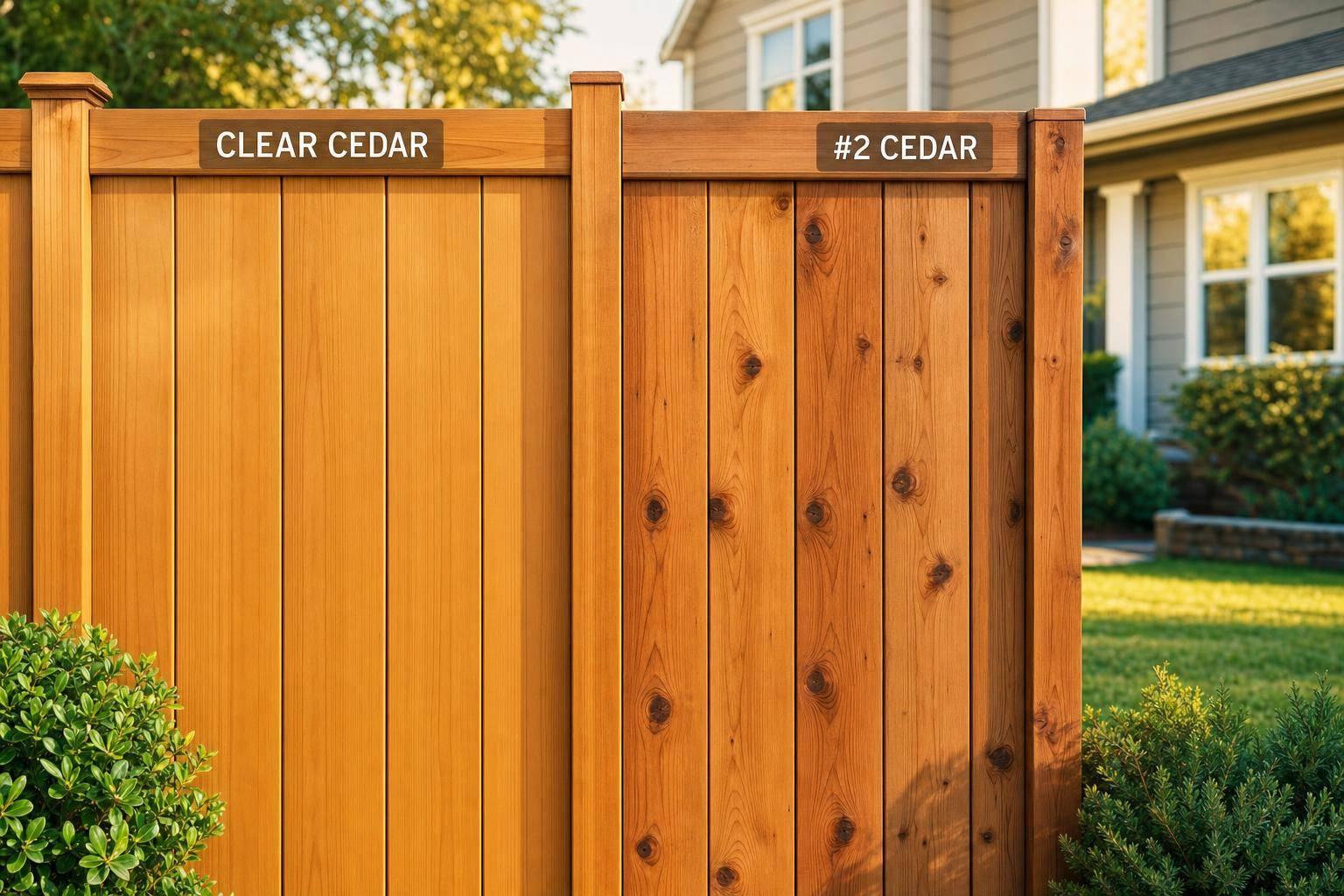
If I want the best-looking fence with less waste and fewer board problems, I’d choose clear cedar. If I need to keep the upfront cost down, I’d look at #2 cedar and plan for more rejects.
Here’s the short version:
- Clear cedar is the higher grade, with few or no knots
- #2 cedar costs less, but it often has more knots, more bowing, and more waste
- Waste matters: clear cedar is often 1%–3%, while #2 cedar is often 10%–15%
- Service life can differ: clear cedar is often a better fit for 20+ years with care, while #2 cedar is more often in the 15–20 year range
- Looks are a big factor: clear cedar fits front-yard and high-visibility fences; #2 cedar fits backyard and lower-cost jobs
- Both grades still need sealing or staining every 2 to 3 years
If you’re comparing fence boards, I’d keep my eye on four things: appearance, waste, repair risk, and total installed cost. A lower price per board can lose its edge fast when loose knots, cracks, and bowed pickets lead to more throwaways.
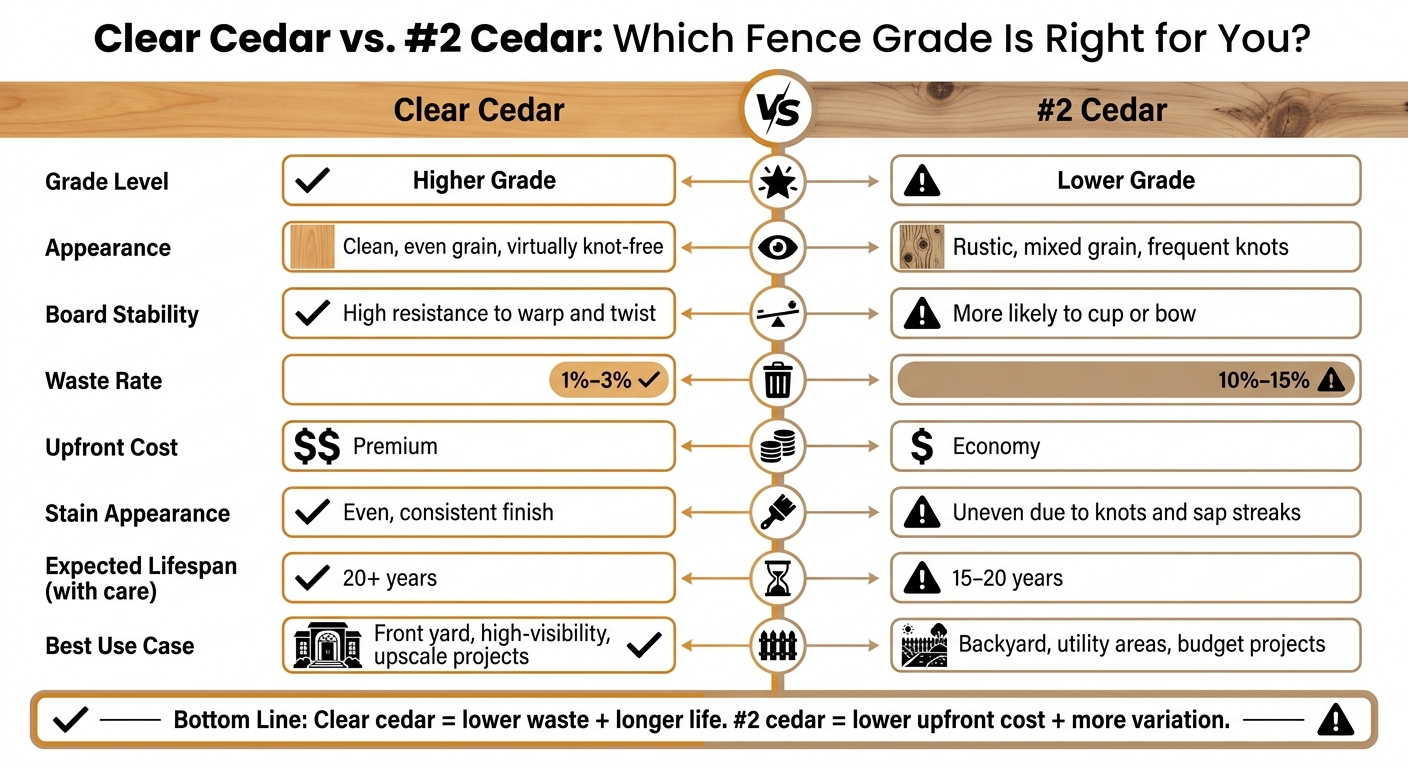
Clear Cedar vs. #2 Cedar: Side-by-Side Fence Grade Comparison
What type of cedar board should I use for my fence? Part one of How to Build a Fence
sbb-itb-d1d0a96
Quick Comparison
| Criteria | Clear Cedar | #2 Cedar |
|---|---|---|
| Grade level | Higher grade | Lower grade |
| Look | Clean, even, few knots | Rustic, mixed, more knots |
| Knot count | Very low | Higher, including loose knots |
| Board stability | Better resistance to warp and twist | More likely to cup or bow |
| Waste rate | 1%–3% | 10%–15% |
| Upfront cost | Higher | Lower |
| Stain appearance | More even | Less even |
| Best fit | Front yard, visible areas, higher-end jobs | Backyard, utility areas, tighter budgets |
| Expected lifespan with care | 20+ years or more | 15–20 years |
So when I compare clear cedar vs. #2 cedar, the choice is simple: pay more now for a cleaner fence and lower waste, or pay less now and accept more variation, more sorting, and more repairs later.
Clear Cedar: Appearance, Performance, and Best Uses
Grading and Visual Qualities
Clear cedar is the cleanest, highest-grade cedar used for fencing. It has a tight grain and a surface that is almost knot-free. That clean grain is a big reason people choose it for fences where looks and long-term stability matter most.
For fencing, CVG gives the most even look and the best stability. A & Better still looks very clean, but it can include a few small knots.
Fence Performance and Long-Term Wear
The lack of knots helps with more than appearance. Knots tend to shrink, crack, and weaken faster than clear wood. Once that happens, they can create weak points where moisture gets in.
Because of that, clear cedar boards usually stay sound longer. CVG boards are the most resistant to warping, cupping, and twisting as a fence gets older. That makes CVG a smart pick in places with intense heat or fast swings in moisture.
Clear cedar still needs some upkeep. Cedar’s natural phenol oils help protect the wood fibers from rot and decay, but good installation and periodic sealing still matter. Apply a UV-protective stain or sealant every 2 to 3 years to help hold the color and slow graying.
Cost and Best-Fit Applications
Clear cedar costs more. It’s harder to find and is often sold through specialty lumber yards or contractors instead of standard retail hardware stores.
That higher upfront price can pay off over time. When it’s maintained the right way, clear cedar can last more than 40 years. It’s a strong fit for upscale residential fences, front-yard enclosures, and decorative privacy screens. It also takes stain more evenly than knotty cedar. If the fence will be seen up close and needs to keep a polished look for years, clear cedar is often the better pick.
#2 cedar takes a different approach: more character, lower cost, and less uniformity.
#2 Cedar: Appearance, Performance, and Best Uses
Grading and Rustic Appearance
#2 cedar is the budget-first grade. You pay less, but you also get a rougher, more rustic look. Compared with clear cedar, #2 cedar has more knots, more color shifts, sap streaks, and occasional wane. Wane means part of the board has a rounded or uneven edge because it was not fully cut.
That look works for some fences. But it also hints at how the material may age over time.
Fence Performance and Common Trade-Offs
The same knots and pith that give #2 cedar its rustic style can also shorten how long it lasts. The main issues are loose knots and weaker board structure. As the wood dries, knots can shrink, crack, and even fall out, which leaves holes behind. Boards with pith are also more likely to cup or bow early.
"No. 2 cedar is functional but shows visible variation. Knots are more likely to fall out over time as the wood dries, creating holes in the board." – Picket Pros
Cost and Practical Applications
#2 cedar usually costs less up front and is easy to find at many hardware stores and high-volume fence suppliers. On a big job, though, that lower sticker price can shrink fast if you don’t plan for waste. Bundles of #2 cedar often come with a 10% to 15% waste factor, so it’s smart to order extra boards for rejects.
"While #2 Grade is cheaper per picket, once you throw away the ‘bad’ boards, the price-per-installed-picket is often nearly identical to #1 Grade." – Fence Supply Inc.
You can slow some of that wear with regular care. A penetrating stain or sealant every 2 to 3 years helps the wood dry more slowly and can keep knots tighter for longer.
Those trade-offs stand out even more in the side-by-side comparison below.
Clear Cedar vs. #2 Cedar: A Direct Comparison
With the grade definitions out of the way, the next step is simple: which one makes more sense for the fence itself?
Appearance, Curb Appeal, and Style Fit
The biggest visual difference is pretty easy to spot. Clear cedar looks smooth and even. #2 cedar looks more rustic and mixed. Clear cedar gives you a more consistent reddish-brown face with almost no knots, while #2 cedar often shows color shifts, sap streaks, and frequent large knots that lean rustic.
| Feature | Clear Cedar | #2 Cedar |
|---|---|---|
| Knot Frequency | Virtually knot-free | Frequent; includes large and loose knots |
| Style Fit | Modern homes | Rustic or budget projects |
On fences people see every day, looks tend to drive the choice first. After that, durability starts to matter more.
Durability, Maintenance, and Service Life
This is where the gap gets easier to feel over time. Clear cedar has knot-free heartwood, so there are fewer weak spots. #2 cedar has loose knots that can shrink, drop out, and leave holes behind.
"Because there are no knots to fall out or create weak points, Clear Grade has the highest dimensional stability." – Fence Supply Inc.
In plain terms, clear cedar usually makes more sense if you’re aiming for 20+ years of service life with proper care. #2 cedar is more often estimated at 15–20 years under similar conditions.
And once durability enters the picture, cost stops being just about the sticker price.
Budget, Long-Term Value, and Project Fit
At first glance, #2 cedar looks like the cheaper pick because it costs less per board. But that doesn’t tell the whole story. The built-in waste factor matters more than many buyers expect.
With #2 cedar, 10%–15% of a bundle may end up unusable because of cracks, holes, or heavy bowing. Clear cedar usually has a much lower waste factor of 1%–3%, which means more of what you order can actually go on the fence.
| Feature | Clear Cedar | #2 Cedar |
|---|---|---|
| Upfront Cost | Premium | Economy |
| Waste Factor | 1%–3% | 10%–15% |
| Best Use Case | High-visibility, front-yard projects | Backyard, low-visibility, or budget repairs |
| Long-Term Value | High; lower replacement frequency | Lower; higher labor and material costs over time |
So yes, #2 cedar can save money up front. But when more boards get tossed aside, and when repairs show up sooner, that gap can shrink fast.
How to Choose the Right Cedar Grade
After looking at performance, the choice usually comes down to where the fence will be seen and how much upkeep you’re willing to deal with. In plain terms, pick based on visibility, budget, how much natural variation you’re okay with, and maintenance.
Guidance for Homeowners and Property Managers
A simple way to narrow it down is to think about visibility first. Clear cedar makes more sense for street-facing fences, front yards, and higher-end landscape designs where looks matter right away. #2 cedar is often the better fit for back property lines, utility areas, and projects where budget is a big factor.
One more thing: if the contract just says "cedar" and doesn’t name the grade, get that cleared up in writing. Boards that aren’t labeled #1 or Clear are likely #2 or lower.
Why Professional Installation Matters in Plano, TX
In North Texas, grade choice matters even more when a fence will sit in strong sun and heat day after day. In Plano, proper post spacing, rail layout, and board selection can help limit early warping and keep the fence straight.
Tend Fencing installs custom cedar fences for residential and commercial properties across Plano, TX, and nearby areas, using a process shaped around local conditions and long-term structural performance.
Conclusion: Clear Cedar vs. #2 Cedar
Clear cedar leans toward appearance and long-term stability. #2 cedar leans toward a lower upfront cost and a more rustic look.
FAQs
Is clear cedar worth the higher price?
That comes down to what you want from the project. Clear cedar is the top grade. It has few, if any, knots, which gives it better stability and a cleaner, more even, premium look.
It also costs more, and you won’t see it used often for standard fencing. Still, it can make sense for high-end or architectural designs where appearance and maximum lifespan matter most. For most residential privacy fences, high-quality #1 cedar is usually the better pick for the money.
How much extra #2 cedar should I order?
Order about 10% to 15% extra to cover waste from unusable boards.
#2 cedar often comes with defects like cracks, large loose knots, heavy bowing, and wane. In plain English, that means some boards just won’t make the cut.
A good rule of thumb: plan for about 10 out of every 100 boards to be tossed out.
Which cedar grade is better for my climate?
In places with intense heat or big seasonal weather swings, #1 Grade cedar is usually the better pick than #2 Grade. It has stronger structural integrity and is less likely to warp, bow, or cup.
By comparison, #2 Grade boards often include heart-center or pith, which can make them more prone to failure in harsh conditions. That said, high-quality Western Red Cedar naturally resists decay, rot, and moisture no matter the grade.