

When choosing a privacy fence, cost, durability, privacy level, and maintenance are key factors. Below is a quick summary of the most affordable options, including their costs, lifespan, and upkeep needs:
- Chain Link with Privacy Slats: Costs $10–$25 per linear foot installed, lasts 15–30 years, and requires minimal maintenance.
- Pressure-Treated Pine: Costs $15–$25 per linear foot installed, lasts 10–20 years with regular staining and sealing every 2–3 years.
- Hog Wire with Privacy Mesh: Costs $6–$38 per linear foot depending on style, lasts 15–30 years with low upkeep.
- Split Rail with Infill Panels: Costs $12–$30 per linear foot installed, lasts 10–20 years, but offers limited privacy unless paired with infill.
- Pallet or Recycled Wood: Costs $2–$12 per linear foot, lasts 5–10 years, and requires frequent maintenance.
- Picket or Dog-Ear Pine Fence: Costs $13–$45 per linear foot installed, lasts 10–12 years, and requires regular staining or sealing.
- Corrugated Metal Panels: Costs $15–$50 per linear foot installed, lasts 20–75 years, and requires very little maintenance.
- Bamboo Screening: Costs $6–$12 per linear foot, lasts 10–20 years, and needs weatherproofing every few years.
Quick Comparison
| Material | Cost (per linear foot) | Lifespan (years) | Maintenance Level | Privacy Level |
|---|---|---|---|---|
| Chain Link + Privacy Slats | $10–$25 | 15–30 | Low | Moderate (75–85%) |
| Pressure-Treated Pine | $15–$25 | 10–20 | High (stain every 2–3 yrs) | High (95–100%) |
| Hog Wire + Privacy Mesh | $6–$38 | 15–30 | Low | Moderate |
| Split Rail + Infill Panels | $12–$30 | 10–20 | Moderate | Low to Moderate |
| Pallet/Recycled Wood | $2–$12 | 5–10 | High | Moderate to High |
| Picket/Dog-Ear Pine | $13–$45 | 10–12 | High | Moderate to High |
| Corrugated Metal Panels | $15–$50 | 20–75 | Very Low | High (100%) |
| Bamboo Screening | $6–$12 | 10–20 | Moderate (weatherproofing) | Moderate to High |
Each material has its pros and cons. For long-term durability and low upkeep, corrugated metal panels stand out. For tight budgets, pallet wood or chain link with slats are solid choices. If you prefer a natural look, pressure-treated pine or bamboo screening may suit your needs. Always weigh upfront costs against maintenance and lifespan to find the best fit for your property.
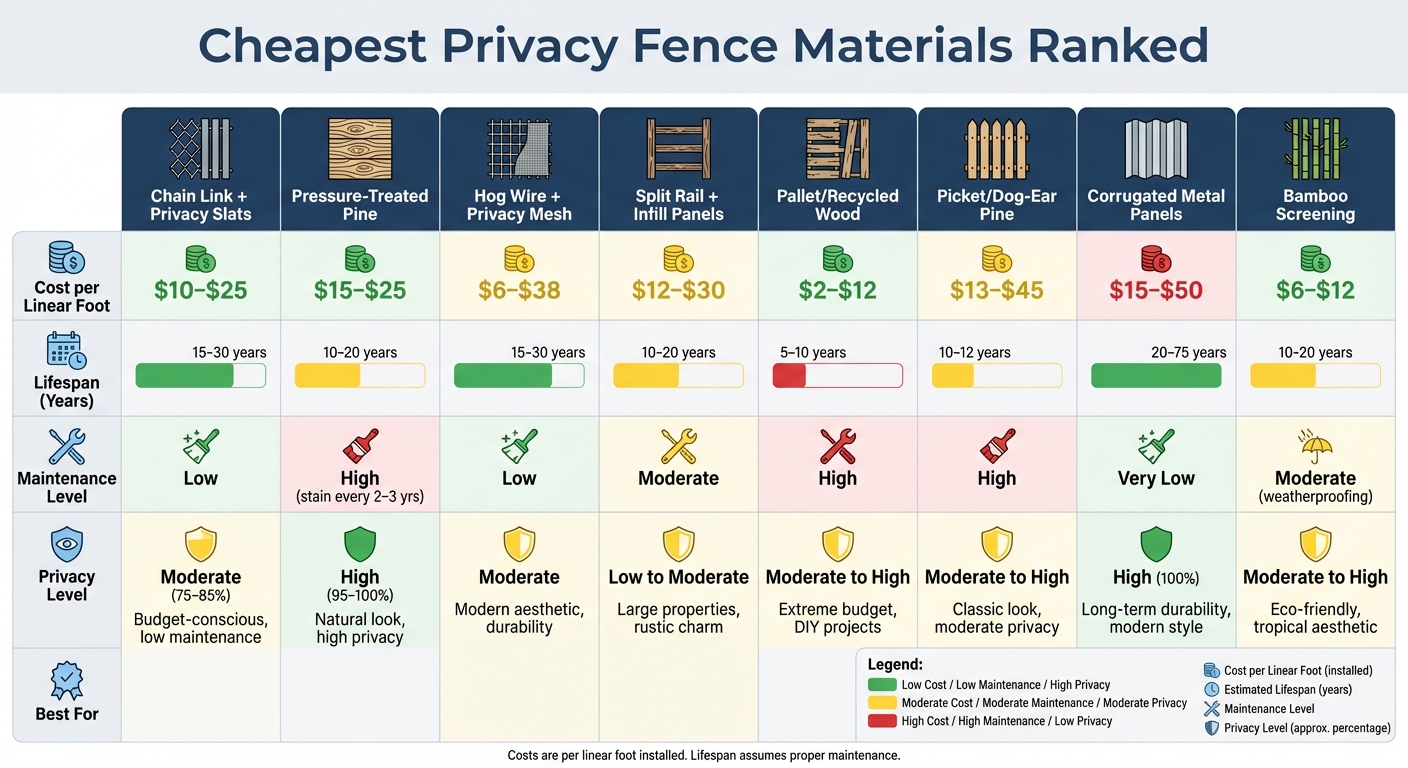
Privacy Fence Materials Cost and Durability Comparison Chart
10 Low Cost Privacy Fence Ideas for Any Backyard
sbb-itb-d1d0a96
1. Chain Link with Privacy Slats
Chain link fences with privacy slats are a wallet-friendly choice, costing about half as much as solid wood or vinyl options. These slats – made from materials like vinyl, polyethylene, aluminum, or redwood – are woven into the chain link mesh. While they provide a good level of privacy, they don’t completely block visibility like solid board fences. Here’s a closer look at what you can expect.
Cost (USD per Linear Foot)
For a fully installed chain link fence with privacy slats, prices range between $10 and $25 per linear foot. If you’re adding slats to an existing fence, the cost is lower, around $3 to $10 per linear foot. Standard galvanized mesh typically costs $5–$8 per linear foot, with labor adding another $10–$15 per linear foot. Opting for powder-coated wire adds $6–$8 per linear foot but increases the fence’s lifespan significantly.
Privacy Level
Privacy slats offer about 75% to 85% visual coverage. While this doesn’t match the near-total coverage of wooden panels (95% to 100%), it’s still sufficient for most residential needs. Plus, the chain link design allows airflow, making it more resistant to strong winds compared to solid fences.
Durability (Lifespan in Years)
A standard chain link fence with privacy slats lasts around 15 to 20 years. If you upgrade to galvanized, powder-coated, or vinyl-coated wire, the lifespan can stretch to 25 or even 30 years. The slats themselves may become brittle in harsh freeze/thaw climates, but they’re easy and inexpensive to replace individually.
Maintenance Requirements
Maintenance is straightforward – just clean the fence occasionally with soapy water. Regularly inspect the mesh and hardware to catch and tighten loose ties before they cause sagging, as repairs can cost anywhere from $300 to $800. Be sure to remove climbing vines that could weigh down the mesh and cause damage. For those who enjoy DIY projects, you can save money by installing the privacy slats yourself after professionals set up the metal framework. With minimal upkeep and a solid lifespan, chain link fences with privacy slats are a reliable, cost-effective option for homeowners on a budget.
2. Pressure-Treated Pine
Pressure-treated pine is a popular, cost-effective choice for privacy fencing. The wood is treated with preservatives like ACQ, MCA, or CCA to help it resist rot, termites, and decay. When installed in styles such as solid board, stockade, or board-on-board, it offers privacy levels on par with much more expensive materials. Here’s a detailed look at its cost, performance, and upkeep.
Cost (USD per Linear Foot)
The cost of an installed pressure-treated pine fence ranges from $15 to $25 per linear foot. Of this, raw materials typically account for $5–$10, with labor making up the rest. For a standard 6-foot wood privacy fence, the average installed cost is around $25 per linear foot. If you’re up for some DIY, you could cut costs by 30% to 50%, but keep in mind that you’ll need tools like a post-hole digger or a motorized auger.
Privacy Level
Styles like solid board and stockade provide high to maximum privacy, effectively blocking visibility when installed correctly. These fences also offer better noise reduction compared to chain link options, making them a practical choice for both privacy and sound insulation.
Durability (Lifespan in Years)
A pressure-treated pine fence generally lasts 10 to 15 years, but with proper care, its lifespan can extend to 18–20 years or more. Ground-contact-rated posts are particularly durable, lasting 20 to 30 years or longer if treated properly. Installation quality is key – posts should be set 24 to 30 inches deep (or about one-third of their above-ground height) with concrete footings to prevent leaning.
Maintenance Requirements
Pressure-treated pine requires regular maintenance to keep it in good condition. Without protection, the wood is susceptible to UV damage, which can lead to graying, cracking, and surface erosion. To extend its life, apply a UV-protective stain or sealant every 2 to 3 years. Allow new pressure-treated wood 3 to 6 months to dry before staining to ensure the wood absorbs the treatment properly. Annual power washing is recommended to remove dirt and mold before sealing. It’s also important to use hot-dipped galvanized or stainless steel fasteners, as standard hardware can corrode due to the chemicals in treated wood. Over a 10-year period, expect to spend around $1,200 on maintenance.
For those looking to ensure long-lasting performance, Tend Fencing in Plano, TX specializes in building durable pressure-treated pine fences designed to stand the test of time.
3. Hog Wire or Welded Wire with Privacy Mesh
Hog wire fencing, often called stock panels, is made up of horizontal and vertical wires welded at their intersections, typically forming 4×4 inch openings. On its own, this type of fencing prioritizes containment rather than privacy. However, adding privacy mesh or slats can turn it into a cost-effective option for those seeking both functionality and a bit more seclusion. Here’s a breakdown of its cost, privacy potential, durability, and maintenance.
Cost (USD per Linear Foot)
The cost of installing hog wire with privacy mesh varies based on whether you choose framed or frameless panels and the quality of materials:
- Frameless panels: The most economical choice, costing $6 to $13 per linear foot.
- Framed panels: Prices range from $6.50 to $38 per linear foot, depending on the frame type.
- Privacy mesh or slats: Adding these for increased seclusion will add approximately $5 to $18 per linear foot for materials and labor.
- Labor costs: Expect an additional $3–$8 per linear foot for installation.
Privacy Level
Hog wire fencing alone provides minimal privacy due to its open grid design. However, when paired with privacy mesh or slats, it can achieve moderate to good privacy, similar to chain link fences outfitted with privacy slats. The level of privacy largely depends on the density of the mesh used.
Durability (Lifespan in Years)
The longevity of hog wire fencing is influenced by the type of wire coating and materials used:
- Untreated steel wire: Lasts about 8 to 15 years.
- Galvanized wire: Extends the lifespan to 15 to 25 years.
- Powder-coated panels: Offer the longest lifespan, lasting 20 to 30 years.
- Wood frames: With proper maintenance, these can last 25 to 50 years .
For residential use, 12.5-gauge wire is standard, but a sturdier 9-gauge wire is better suited for areas prone to high impact .
Maintenance Requirements
Metal components of hog wire fencing require little upkeep, but wood frames need more attention. To prevent rot and warping, wood frames should be stained or painted every 2 to 3 years. Using galvanized or powder-coated wire can extend the fence’s lifespan by an additional 10–15 years compared to untreated steel.
4. Split Rail with Infill Panels
Split rail (or post-and-rail) fences feature horizontal timber logs mounted between vertical posts. This simple design keeps material costs low, making it a popular choice for large properties. On their own, these fences provide very little privacy. However, adding infill panels – like welded wire, hog wire, or privacy mesh – turns them into a more secure option, especially for keeping pets and children safe. Many homeowners choose this style for its balance of cost and function, as seen in our customer reviews. Below, we break down the key aspects of split rail fences with infill, including cost, privacy, durability, and upkeep.
Cost (USD per Linear Foot)
The total cost depends on the materials and installation:
- Split rail wood only: $7–$15 per linear foot for materials, or $12–$30 installed
- Infill (hog or welded wire): $7–$15 installed
- Chicken wire infill: $5–$10 installed
For a 100-foot fence, expect to spend roughly $1,200–$3,000 over a 10-year period. This makes it a more budget-friendly option compared to solid wood privacy fences, such as pressure-treated pine ($15–$25 per linear foot) or cedar ($20–$40 per linear foot).
Privacy Level
On its own, a split rail fence offers minimal privacy. Adding infill panels like hog wire, welded wire, lattice, or privacy mesh improves privacy to a low-to-moderate level. Pairing the fence with climbing plants or shrubs can further enhance privacy.
Durability (Lifespan in Years)
Split rail fences generally last between 10 and 20 years. Cedar and redwood are naturally resistant to decay, making them longer-lasting options. Pine or spruce, on the other hand, need pressure treatment to extend their lifespan. The open design of these fences also helps reduce damage from wind and weather.
Maintenance Requirements
To keep wood rails in good condition, periodic staining or sealing is essential. This prevents rot, insect damage, and weathering. Opting for cedar, which is naturally resistant to rot, can lower the frequency of maintenance compared to untreated pine.
5. Pallet or Recycled Wood
Using pallets for fencing is one of the most budget-friendly options out there since pallets are often available for free from retail stores or businesses. While the wood panels themselves might not cost you anything, you’ll still need to purchase structural components like pressure-treated posts, concrete for footings, and hardware. By going the DIY route, you could save 30% to 50% on labor costs compared to hiring professionals.
When selecting pallets, look for ones stamped with the IPPC "HT" mark, which indicates they’ve been heat-treated and are safe to use. Avoid pallets marked "MB", as these have been treated with chemicals that can be harmful. You can arrange the pallets vertically for a solid barrier or stagger them to achieve a rustic shadowbox look.
Cost (USD per Linear Foot)
Since pallets are typically free, the main expenses include materials like pressure-treated posts, concrete, and hardware, bringing the total cost to $2 to $12 per linear foot. For comparison, traditional pressure-treated pine fences cost around $15–$25 per linear foot, and cedar fences range from $20–$35 per linear foot. A 100-foot pallet fence might cost between $200 and $1,200, making it a much cheaper alternative to standard wood fencing.
Privacy Level
The amount of privacy you’ll get from a pallet fence depends on how the boards are arranged. Placing boards edge-to-edge creates a solid, gap-free barrier, while a staggered shadowbox design allows for some visibility. Even with the shadowbox style, a pallet fence generally offers more privacy than chain-link or hog wire options.
Durability (Lifespan in Years)
With proper maintenance, a pallet fence can last 5–10 years. Without regular upkeep, the lifespan may drop to just 2–5 years. Since untreated pallet wood is thinner and more prone to splitting and decay than commercial-grade lumber, it’s crucial to use new pressure-treated 4×4 posts for structural stability instead of relying solely on the pallet wood.
Maintenance Requirements
Pallet fences require consistent upkeep to prevent deterioration. Apply a UV-resistant exterior sealer or stain right after construction, and reapply it every 1–2 years to protect against moisture, rot, and warping. Sand down any rough edges before sealing to avoid splinters. Over time, individual boards may decay and need replacing, so regular maintenance is key. While this option is highly affordable, it does demand a bit more effort to keep it in good shape, offering a distinctive and economical choice among privacy fence materials.
6. Picket or Dog-Ear Pine Fence
Pine fencing comes in two main styles: picket fences and dog-ear fences. Picket fences are decorative, standing 3 to 4 feet tall with spaced boards, while dog-ear fences are solid, 6-foot structures with trimmed top corners, offering full privacy. Thanks to its affordability, pine is a popular choice for homeowners looking for cost-effective fencing solutions. Depending on the design, pine fences can balance aesthetics with functionality.
When choosing a pine fence, it’s important to weigh the cost, privacy level, and durability to find the best fit for your needs.
Cost (USD per Linear Foot)
The price of a pine fence depends on its style and installation:
- 6-foot dog-ear privacy fences: Installed costs range from $13 to $45 per linear foot, with an average of about $25. Materials alone are priced between $6 and $18 per linear foot, while labor adds approximately $10 to $30 per linear foot.
- 3- to 4-foot picket fences: Installed costs fall between $10 and $36 per linear foot.
- For DIY projects, individual pressure-treated pine pickets cost $1 to $4 each.
Sarah Noel from HomeGuide highlights:
Wood is the cheapest material for building a privacy fence but also requires the most maintenance.
Privacy Level
The level of privacy depends on the fence style:
- Dog-ear fences: With tightly placed boards, a 6-foot dog-ear fence offers full privacy. Opting for a board-on-board design – with overlapping slats – eliminates gaps, even as the wood naturally shrinks over time.
- Picket fences: These shorter, 3- to 4-foot fences provide limited privacy due to their spaced boards and lower height.
Durability (Lifespan in Years)
Pressure-treated pine fences typically last 10 to 12 years, but without proper care, their lifespan can drop to 5 to 10 years. John Smucker, Owner of Smucker Fencing, explains:
While a wood fence is a good low-maintenance fence in a financial pinch, the boards and rails are only expected to last for 10-12 years.
Pine’s durability is limited by its tendency to warp, rot, and attract insect damage, making it less resilient than other wood types.
Maintenance Requirements
To extend the life of a pine fence, regular upkeep is essential:
- Restain or reseal: Every 3 to 5 years to protect against moisture, UV rays, and decay.
- Annual cleaning: Helps prevent damage from dirt and moisture.
- Professional maintenance services cost an additional $2 to $14 per linear foot.
Without consistent care, pine deteriorates faster than woods with natural resistance to rot and decay.
7. Corrugated Metal Panels
Corrugated metal panels are a modern choice for privacy fencing, combining a sleek industrial aesthetic with impressive durability. Among budget-friendly options, these panels stand out for their strength and lightweight design, thanks to their ribbed structure. They’re particularly popular for ranch-style properties or contemporary homes, where their clean lines complement the architecture seamlessly.
Made from materials like galvanized steel, aluminum, or copper, these panels often include 30% to 40% recycled content. They resist rot, decay, insect damage, and won’t crack, warp, or split – even in extreme weather conditions.
Cost (USD per Linear Foot)
Corrugated metal fencing costs between $15 and $50 per linear foot installed, with an average of $25. Pricing depends on the type of metal and fence height:
- Steel panels: $15–$55 per linear foot
- Aluminum panels: $35–$75 per linear foot
- Copper panels: $22–$105 per linear foot
Fence height also plays a role. A 5- to 6-foot fence costs $20 to $45 per linear foot, while taller fences (8 feet or more) can reach $30 to $100+ per linear foot. Professional labor typically adds $10 to $25 per linear foot to the total cost. Most homeowners spend around $2,500 for installation, with project costs ranging from $1,600 to $6,250.
For those who prefer DIY, individual 36-inch-wide panels are available at approximately $6.65 per linear foot for a 4-foot height, $9.98 for 6 feet, and $13.30 for 8 feet. Installing the panels yourself can save 30% to 50% on labor costs, though professional post-setting is recommended for stability.
Privacy Level
Corrugated metal panels offer complete privacy, blocking 100% of visibility with their solid, gap-free design. A 6-foot-tall fence is highly effective at shielding your yard from neighbors and passersby. This level of privacy far exceeds open-style fences like chain link or hog wire, which require additional materials to achieve similar coverage.
However, while these panels excel in visual privacy, they are less effective at sound dampening. In fact, their reflective surface can create an echo effect in enclosed areas.
Durability (Lifespan in Years)
Corrugated metal fences are built to last. Standard panels have a lifespan of 20–30 years, mid-range options last 30–40 years, and premium panels with thicker gauges and quality coatings can endure for 50–75 years. Galvanized steel, in particular, resists rust and corrosion, typically lasting 25 to 30 years before requiring major repairs.
Alec Pow, Economic & Pricing Investigator, emphasizes:
With minimal maintenance, a corrugated steel fence can last over 25 years for a cost-effective investment.
The durability of these fences depends on the metal’s thickness (gauge) and the quality of its protective coating, such as galvanization or powder coating. For areas prone to high winds, 26-gauge steel is recommended over thinner 29-gauge. Uncoated steel, however, may start to rust within 5 to 7 years.
Maintenance Requirements
Corrugated metal fences require very little upkeep compared to wood. Cleaning involves a simple rinse with water and mild detergent once a month to remove dirt and debris. After storms, it’s a good idea to check for loose fasteners and tighten them if needed.
To extend the fence’s lifespan, inspect it periodically for scratches and treat any rust spots immediately with rust-preventative spray paint. Using galvanized or stainless steel screws and bolts prevents rust at attachment points. Additionally, light-colored powder coatings or galvanized finishes can reflect sunlight, reducing heat buildup on the panels.
8. Bamboo Screening
Bamboo screening is a natural and environmentally friendly way to create privacy fencing. It comes in two main forms: bamboo screening rolls, which are slats tied together with galvanized steel wire, and living bamboo plants, which grow into dense privacy barriers over time. Both options are cost-effective alternatives to traditional fencing, but they differ in terms of installation and long-term performance.
Cost (USD per Linear Foot)
Bamboo screening rolls are an affordable choice, costing between $6 and $12 per linear foot when installed. This makes them comparable to basic chain-link fencing, which ranges from $5 to $20 per foot, and much cheaper than vinyl ($19–$40) or composite options ($23–$40).
Living bamboo is slightly pricier, with materials costing $10–$15 per linear foot, or $12–$23 per foot installed. This includes the cost of a root barrier, often referred to as a "Bamboo Shield", which helps control the plant’s spread.
Privacy Level
Bamboo screening rolls offer immediate privacy upon installation, though they may not block visibility entirely. For better coverage, you can add a dark backing material, like tarpaulin, to close any gaps.
Living bamboo, on the other hand, provides a more dynamic privacy solution. It can grow to heights of 20 feet or more, far exceeding the typical 8-foot height restrictions imposed by many local ordinances or homeowners’ associations. However, it takes 2 to 5 years for the plants to grow dense enough to form a solid barrier. Once established, living bamboo offers year-round privacy due to its evergreen nature, making it a long-term solution for those willing to wait.
Durability (Lifespan in Years)
Living bamboo screens are incredibly long-lasting, with a lifespan of over 75 years when properly maintained. This far outperforms wood fences, which typically last 10–15 years, and even vinyl, which can last 25+ years. Living bamboo is also naturally resistant to pests, fungi, and diseases.
In contrast, bamboo screening rolls have a shorter lifespan, generally lasting 10 to 20 years with regular maintenance. Without proper care, their durability may drop significantly, especially in harsher climates. According to Forever Bamboo:
When you clean, seal and stain it as needed, it’s likely to last 20 years and beyond.
Bamboo is also known for its strength, resisting splitting and breaking under tension better than steel.
Maintenance Requirements
Bamboo screening rolls require periodic cleaning with water and a mild detergent or bleach, using a nylon brush. To protect against fading and moisture damage, apply an oil-based stain with UV protection every few years. Some exterior paints can extend durability for up to 15 years. Be sure to let the bamboo air-dry for at least two days before staining, and install it with a gap at the bottom to prevent direct contact with the ground, which can lead to rot.
Living bamboo requires less intensive maintenance but does need proper containment. Installing a root barrier at the time of planting helps prevent the bamboo from spreading uncontrollably. Occasional trimming is necessary to maintain a neat appearance and keep the screen from becoming invasive. With these practices, bamboo screening remains a practical and eco-conscious choice for privacy fencing.
Advantages and Disadvantages
Each privacy fence material comes with its own benefits and challenges. Understanding these trade-offs can help you pick the right option for your budget, maintenance needs, and aesthetic preferences.
Chain link with privacy slats is a cost-efficient choice, running only $0.40–$0.75 per foot annually due to its 20–30 year lifespan and minimal upkeep. That said, its industrial look often doesn’t appeal to homeowners seeking a more polished style.
Pressure-treated pine offers a natural wood appearance at a reasonable cost of $12–$25 per linear foot. When properly maintained, it provides a good balance between affordability and durability.
Corrugated metal panels are highly durable, lasting 20–25 years with little maintenance. However, they can be noisy during rain and may clash with traditional home designs.
Bamboo screening is an environmentally friendly option with a tropical vibe. However, it requires periodic weatherproofing and has a shorter lifespan of 10–15 years.
Pallet or recycled wood is the least expensive material, often costing nothing if you salvage the wood yourself. However, it has a limited lifespan of 2–5 years and requires a lot of prep work to make it usable.
Other options, such as hog wire with privacy mesh, split rail with infill panels, and picket or dog-ear pine fences, each bring their own mix of affordability, privacy, and upkeep considerations. Below is a table summarizing the pros and cons of these materials for easy comparison.
| Material | Pros | Cons |
|---|---|---|
| Chain Link + Slats | Low cost; 20–30 year lifespan; minimal maintenance | Industrial look; slats may fade or break |
| Pressure-Treated Pine | Affordable wood option; natural look; widely available | High maintenance; prone to rot and warping |
| Hog Wire + Mesh | Inexpensive; durable; easy DIY installation | Requires additional materials for privacy; utilitarian appearance |
| Split Rail + Infill | Budget-friendly; rustic charm; simple to install | Limited privacy unless panels are added; shorter lifespan (10–15 years) |
| Pallet Wood | Virtually free; eco-friendly; allows for creative designs | Extremely short lifespan (2–5 years); labor-intensive preparation |
| Picket / Dog-Ear Pine | Classic look; moderate privacy; affordable | Needs regular painting or staining; gaps may reduce privacy |
| Corrugated Metal Panels | Modern style; durable (20–25 years); fire-resistant; low upkeep | Noisy during rain; industrial look may not fit all homes |
| Bamboo Screening | Lightweight; tropical aesthetic; sustainable | Requires weatherproofing; shorter lifespan (10–15 years) |
Conclusion
When deciding on the best fencing material, consider key factors like upfront costs, maintenance needs, and expected lifespan. For example, chain-link with privacy slats typically costs $8–$15 per linear foot, while pressure-treated pine ranges from $12–$25 per linear foot. If you’re working with an extremely tight budget, recycled or pallet wood might seem appealing since they can be virtually free upfront. However, keep in mind that these materials often require replacement within 2–5 years.
Labor costs can significantly impact your overall budget, accounting for 30% to 50% of the total and averaging about $10 to $20 per linear foot. Opting for DIY installation could save you around $10 per linear foot in labor, but professional installation ensures proper post depth and alignment, which are crucial for long-lasting durability. In fact, professional installation can boost property value by 50% to 75% of the installation cost.
For homeowners in Plano, TX, working with local experts can make a big difference. Professionals familiar with regional soil conditions and HOA guidelines can help you avoid costly errors. Tend Fencing specializes in wood, chain-link, and custom fence designs, offering services that include handling permits, precise post-setting, and even planting a tree for every fence they install.
Whether you’re drawn to the practicality of chain-link, the timeless appeal of pressure-treated pine, or the sleek look of corrugated metal panels, the right choice depends on balancing your budget with your property’s long-term needs. Reach out to Tend Fencing for a personalized consultation and custom quote tailored to your unique preferences and property requirements.
FAQs
What’s the cheapest fence that still feels private?
When it comes to affordable privacy fence options, two stand out. First, chain link fences with privacy slats are a practical choice, costing around $10–$20 per linear foot. They provide a good mix of durability and privacy. Second, for those on a tighter budget, DIY fences made from pallets or reclaimed materials can be an excellent solution, with costs ranging from $2–$5 per linear foot. These options offer flexibility, allowing you to balance cost, privacy, and style to suit your needs.
Which low-cost privacy fence lasts the longest?
Vinyl fencing stands out as a highly durable and affordable option for privacy. With proper care, it can last anywhere from 20 to 30 years. Its long lifespan and low maintenance needs make it an economical and practical choice for homeowners looking for a reliable, long-term fencing solution.
How much can I save by installing a privacy fence myself?
Installing a privacy fence on your own can cut costs by about 50% or more. For a typical project, this means reducing expenses from roughly $4,300–$8,000 to around $1,500–$4,000. The exact savings will depend on the length of the fence and the materials you select.