
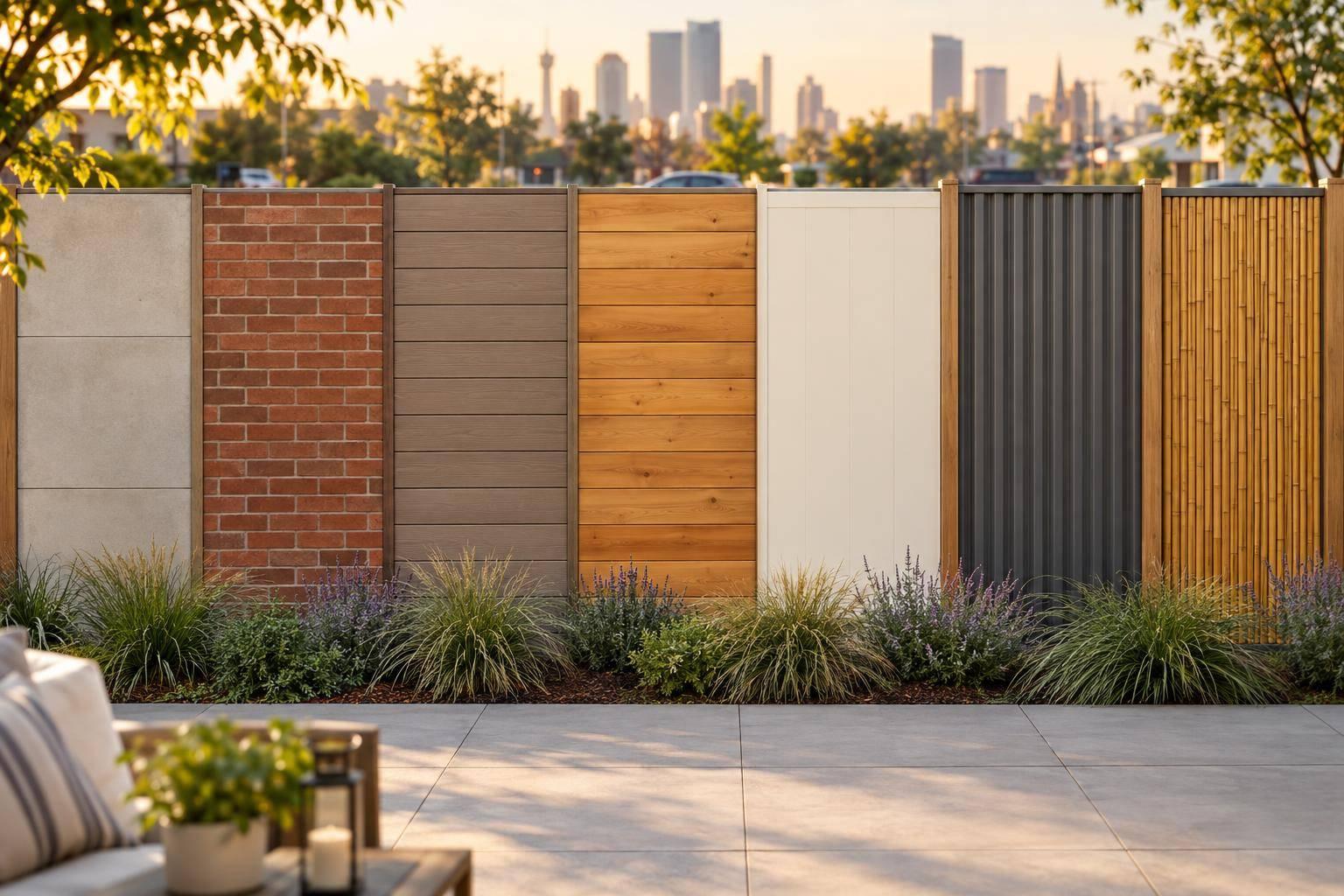
For traffic noise, I’d start with a tall, solid fence that blocks the direct sound path – not just the view. Effective traffic barriers commonly reduce noise by about 5–10 decibels, but no fence eliminates it.
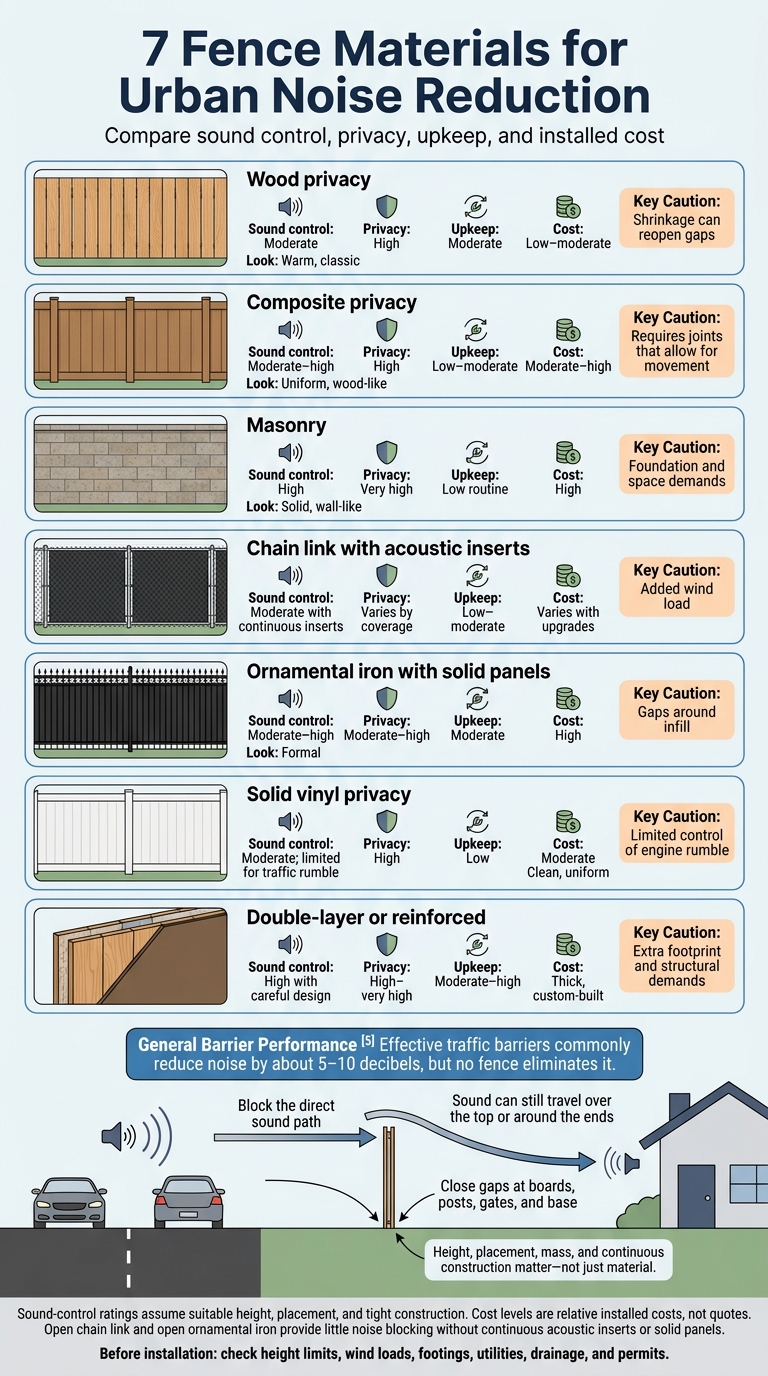
I compare seven options below by sound control, privacy, upkeep, appearance, and installed cost. Masonry and layered systems offer strong sound blocking; wood fence installation, composite, and vinyl balance privacy with other needs. Open metal fencing needs solid panels or acoustic inserts to help with noise.
Quick Comparison
Sound-control ratings assume suitable height, placement, and tight construction. Cost levels are relative installed costs, not quotes.
| Fence system | Sound control | Privacy | Upkeep | Look | Cost |
|---|---|---|---|---|---|
| Wood privacy | Moderate | High | Moderate | Warm, classic | Low–moderate |
| Composite privacy | Moderate–high | High | Low–moderate | Uniform, wood-like | Moderate–high |
| Masonry | High | Very high | Low routine | Solid, wall-like | High |
| Chain link with acoustic inserts | Moderate with continuous inserts | Varies by coverage | Low–moderate | Functional | Varies with upgrades |
| Ornamental iron with solid panels | Moderate–high | Moderate–high | Moderate | Formal | High |
| Solid vinyl privacy | Moderate; limited for traffic rumble | High | Low | Clean, uniform | Moderate |
| Double-layer or reinforced | High with careful design | High–very high | Moderate–high | Thick, custom-built | High |
My starting checklist: <u>check height limits, close sound gaps, and confirm wind-load and footing needs</u>. Then compare quotes for the same fence height and length, including gates, grading, permits, and removal.
7 Fence Materials for Urban Noise Reduction
15 Most Effective Noise Barrier Designs
sbb-itb-d1d0a96
1. Wood Privacy Fences
Wood is a familiar, affordable choice for a privacy fence. Built with tightly fitted boards, it blocks views and helps reduce noise.
Sound Control
Construction matters more than wood species. Tight boards, overlapping boards, or tongue-and-groove joints block more sound than open pickets. A 6-foot wood fence helps, though traffic rumble can still travel over the top.
Privacy and Appearance
The same solid construction keeps your yard out of view. Cedar offers warm grain and natural resistance to decay. You can let it weather gray or apply stain. Pressure-treated pine usually costs less and accepts stain or paint once it has dried enough. Cap-and-trim details give either wood a more finished look.
Maintenance
Wood can shrink or warp, leaving gaps that let sound through. Check after the first wet-dry cycle and once a year after that. Replace warped boards, tighten fasteners, and close gaps with new boards – not sealant.
Installed Cost and Site Fit
An installed 6-foot pressure-treated wood fence typically costs $18–$38 per linear foot, compared with $25–$55 for cedar. Pine works well for budget-focused boundaries, while cedar suits visible yards and patios.
Composite panels offer the same privacy goal with less upkeep.
2. Composite Privacy Panels
Composite offers wood-like privacy with less maintenance.
Sound Control
Choose dense, solid panels with tight joints and no gaps beneath or between sections. Ask for product-specific acoustic data. The main sound-control benefit comes from closing gaps that let traffic noise through.
On slopes, allow for drainage without leaving open gaps under the panels. Joints also need the manufacturer’s required expansion spacing to prevent buckling.
Privacy and Appearance
Interlocking panels provide strong privacy for patios, courtyards, and small commercial properties. Wood-grain textures and stain colors give the fence a uniform finish without regular staining. Before choosing, compare actual samples, panel thickness, and warranty coverage for fading.
Maintenance
Wash panels twice a year with mild soap and a soft brush. Follow the manufacturer’s directions for pressure washing and chemicals. Check joints, rails, fasteners, posts, and gate alignment seasonally and after storms.
Installed Cost and Site Fit
Standard 5- to 6-foot composite privacy fences often cost $75–$95 per linear foot installed. Treat that as a planning range, not a quote. Ask for itemized pricing for gates, removal, grading, and permits.
Composite suits residential homeowners and small business owners who put privacy and less routine upkeep ahead of the lowest upfront price. Steep or windy sites need tighter post spacing, stronger reinforcement, and higher wind ratings.
For more noise blocking, the next option adds much more mass.
3. Masonry Walls
Masonry has the most mass of any option on this list, so it usually provides the strongest noise reduction.
Sound Control
Brick, CMU, and poured concrete block more sound than lighter fences because their mass reduces noise transfer. Results still depend on the wall’s height, length, placement, and how well gaps are sealed.
Privacy and Appearance
A masonry wall gives you full visual privacy when built without openings. Brick comes in classic colors and patterns. CMU can be smooth, split-face, textured, or coated, while poured concrete can take stucco, veneer, paint, or form-liner finishes. Keep openings off the noise-facing side, and choose a cap or coping that sheds water.
Maintenance
Check masonry annually and after storms for loose caps, open joints, and cracks. Brick and block may need repointing. Check poured concrete for cracks and movement, too.
Before patching widening or stair-step cracks, have a structural professional assess them. They may point to foundation settlement.
Installed Cost and Site Fit
Installed masonry often costs about $34.37–$47.11 per square foot. Treat this as a planning range, not a quote.
Masonry suits sites where long-term privacy, durability, security, fire resistance, and strong sound blocking justify a large upfront investment.
Examples include a home beside a busy arterial, a townhouse courtyard, or a small business bordering a parking or service area.
Hire a qualified contractor. Before construction, confirm drainage, property lines, utilities, easements, and local height limits.
Next, compare lower-cost metal systems that need acoustic inserts or added panels to work well.
4. Chain Link With Acoustic Inserts
Chain link with acoustic inserts offers a lower-cost way to update an existing fence. Added density and coverage can help reduce some urban noise without replacing the whole fence.
Sound Control
Ordinary chain link blocks almost no sound. Privacy slats improve screening, but lightweight slats and mesh screens mainly hide the view – not the noise.
For noise control, choose a dense, continuous acoustic insert or curtain backed by documented test data. Just keep in mind that lab results won’t match every site.
Privacy and Appearance
Privacy slats screen about 75%–95% of views, depending on the product and spacing. They can improve the look of side yards and service edges. Acoustic curtains have a more industrial look but work well for hiding equipment.
Added screening also limits visibility. Keep driveway sightlines, camera views, and service access clear.
Maintenance
Inspect the fence after storms and once a year. Look for loose ties, torn membranes, open seams, corrosion, and leaning posts. Check slats for brittleness or movement, and inspect curtains for torn grommets or loose fasteners.
Follow the manufacturer’s instructions when repairing acoustic coverings. Clear debris from lower edges without blocking drainage.
Installed Cost and Site Fit
An existing chain-link fence in good condition can suit side yards and small-business service areas when you need noise reduction sooner without a full replacement.
Standard 6-foot chain link costs about $15–$29 per linear foot installed, before acoustic add-ons. Privacy-slat retrofits cost about $3–$10 per linear foot, but mainly screen views. Ask for separate prices for the acoustic insert, repairs, structural upgrades, gates, and installation.
Dense inserts add wind load. Before adding them, have a qualified installer check the posts, spacing, rails, attachments, and footings. ASTM F3000 addresses chain-link privacy-screen systems, and the Chain Link Fence Manufacturers Institute publishes framework wind-load guidance. Close acoustic gaps where possible while keeping gates working and drainage and emergency access clear.
If a screened retrofit won’t block enough noise, the next option adds solid panels to an ornamental steel frame.
5. Ornamental Iron With Solid Panels
When screened chain link lets through too much noise, ornamental iron with solid infill adds mass and a more formal look.
Sound Control
Open ornamental iron bars do little to reduce noise. The solid infill – steel, aluminum, wood, composite boards, or masonry panels – blocks sound, not the decorative frame.
Keep the infill continuous, with no gaps at the rails, posts, or gate. Perforated metal and lattice let sound through. Solid panels offer more privacy than open iron, but noise control still depends on a tight fit.
Privacy and Appearance
Opaque backing keeps iron’s formal outline while screening patios, courtyards, and service areas. Rigid framing and secure gates improve security; solid infill adds privacy and noise control.
Check local visibility rules near driveways and intersections. Opaque fencing can block sightlines.
Maintenance
Inspect coatings, welds, and attachment points annually. Touch up exposed metal promptly, and use compatible fasteners and isolation washers to limit corrosion and rattling.
Installed Cost and Site Fit
Installed ornamental iron with solid panels often costs about $30–$100 per linear foot. Panel choices, hardware, gates, and structural upgrades can increase the total.
This system suits urban homes and small business sites where appearance, privacy, and access control all matter. Don’t assume an existing frame can support solid infill. Have the installer request a quote to check rail strength, post spacing, footing size, and wind-load requirements. Heavier rails, larger footings, or new foundations may be needed.
6. Solid Vinyl Privacy Fences
Solid vinyl provides privacy with little upkeep, but its low mass limits how much noise it can block.
Sound Control
Solid vinyl blocks views, but thin PVC panels lack the mass needed to stop low-frequency traffic noise. Tightly interlocking panels and a carefully graded base help reduce sound leaks. Avoid gaps beneath panels, especially on slopes. Don’t count on a specific decibel reduction without testing.
Privacy and Appearance
Full-privacy vinyl screens neighboring yards, parking areas, and equipment. White, tan, gray, and wood-look finishes keep a uniform appearance without painting or staining. Where screening matters, full-height panels provide more continuous coverage than lattice tops.
Maintenance
Vinyl usually needs periodic cleaning, not painting or staining. Rinse off dust and pollen with a garden hose, then tackle dirt with mild soap and water. Areas prone to mildew may need a manufacturer-approved cleaner. After severe weather, check rails, caps, panels, and footings. Cracked parts usually need replacement.
Installed Cost and Site Fit
Budget $25–$60 per linear foot installed for many 6-foot vinyl privacy projects. Check whether the price includes gates, removal, grading, permits, and reinforcement.
Vinyl suits yards and small business sites where privacy and low upkeep matter more than noise control. It provides more privacy than open fencing, but blocks less sound than masonry and reinforced systems. Exposed sites need larger footings, stiffer posts, and stronger rail anchoring to withstand wind loads.
For stronger sound blocking, the next option uses layered construction.
7. Double-Layer or Reinforced Fences
For the noisiest sites, a layered fence offers the strongest custom option.
Sound Control
Mass, a sealed air gap, and tight joints help layered fences reduce vibration and sound leaks. Add an acoustic membrane or sound-absorbing fill between the layers. FHWA guidance links effective barrier material weighing about 4.1 pounds per square foot (20 kg/m²) to about 20 dB(A) of transmission loss.
Privacy and Appearance
Opaque layers provide strong privacy, though the added thickness can make the fence look like a wall. To soften that look, recess the inner layer or match the outer finish to the structure behind it. Use the second layer only on the noise-facing side to limit bulk.
Maintenance
Check both faces, joints, fasteners, and the cavity for moisture, rot, corrosion, loose hardware, failed seals, pests, and settlement. A removable cap or access panel makes repairs easier. Keep vegetation out and drainage paths open.
Inspect gate seals and hinges more often than fixed panels, since gates can become weak points for sound control.
Installed Cost and Site Fit
Treat this as a custom, premium installation. Panels, sealing, framing, footings, gates, and engineering all add to the cost. Ask for separate prices for each component.
Persistent noise from roads, rail lines, HVAC equipment, deliveries, or other business activity may justify the expense. Occasional neighborhood noise usually doesn’t.
Before adding weight to an existing fence, have its posts and foundations assessed. Plan for the extra thickness, property-line clearance, utilities, and drainage. Verify height limits and permit requirements before construction.
Next, compare all seven systems by performance, upkeep, and cost.
Compare Performance, Upkeep, and Cost
Urban noise control depends on the full assembly – not just the material. Homeowners usually prioritize appearance and privacy. Small businesses tend to focus on durability, access, and wind load.
Sound Control. Height, mass, and sealed edges determine how well a barrier blocks sound. Low-frequency traffic noise is the hardest to block.
Privacy and Appearance. A fence that blocks the view won’t always block noise. Choose finishes and cap details that provide coverage while supporting curb appeal.
Maintenance. Keep the barrier sealed and free of gaps, and inspect it after storms.
Installed Cost and Site Fit. Ask for quotes based on the same height and length. Have contractors list gates, demolition, grading, permits, and restoration separately. A basic 6-foot fence and an engineered 8-foot barrier aren’t a like-for-like comparison. Taller barriers may require engineering, stronger posts, deeper footings, or permit review.
Use the table below to compare your options. Ratings assume suitable height, placement, and continuous construction.
| System | Sound-Control Potential | Privacy Level | Maintenance Burden | Installed Cost | Best Fit | Main Limitation |
|---|---|---|---|---|---|---|
| Wood privacy | Moderate–high | High | Moderate | Low–moderate | Yards and patios seeking a warm, customizable look | Shrinkage can reopen gaps |
| Composite privacy | Moderate–high | High | Low–moderate | Moderate–high | Homes and businesses seeking a uniform finish | Requires joints that allow for movement |
| Masonry | High | High | Low routine | High | Noisy homes and businesses with room for heavy construction | Foundation and space demands |
| Chain link with acoustic inserts | Low–moderate | Moderate–high | Low–moderate | Moderate after upgrades | Existing fences and business service areas | Added wind load |
| Ornamental iron with solid panels | Moderate–high | Moderate–high | Moderate | Moderate–high | Decorative home, office, and retail frontages | Gaps around infill |
| Solid vinyl privacy | Moderate | High | Low | Moderate | Homes with moderate exposure | Limited control of engine rumble |
| Double-layer or reinforced | High | High | High | High | Homes and businesses with persistent noise | Extra footprint and structural demands |
Pros and Cons of Each Fence System
Compare the main trade-offs for each fence system below.
| System | Main Advantages | Main Drawbacks | Best Use Case |
|---|---|---|---|
| Wood privacy | Individual boards are easy to replace. | Boards can warp or shrink. | Boundaries where easy repairs matter more than low upkeep. |
| Composite privacy | Provides consistent screening without regular staining. | A higher purchase price can cancel out maintenance savings. | Homes and businesses that put low upkeep ahead of upfront savings. |
| Masonry | High mass helps block sound. | Construction takes more work, and repairs and expansions are costly. | Permanent boundaries where foundation work is feasible. |
| Chain link with acoustic inserts | Makes use of an existing fence. | Added screening puts more wind load on posts and footings. | Retrofits where the frame and footings can handle the added load. Acoustic inserts help only when they run continuously. |
| Ornamental iron with solid panels | Keeps the decorative frame. | Solid backing adds cost and wind load. | Sites where appearance matters and solid backing serves as the sound barrier. |
| Solid vinyl privacy | Needs little routine upkeep. | Lightweight, hollow panels provide limited mass. | Low-upkeep residential screening. Reinforced, sealed panels provide modest sound screening. |
| Double-layer or reinforced | Combines mass, overlap, and backing to reduce sound leaks. | Extra thickness and hidden components make space planning and repairs harder. | Use only for persistent noise that simpler fences cannot handle. |
FHWA guidance uses about 4 lb/sq ft as a density benchmark. Even so, noise can still travel over the top or around the ends.
Next, compare performance, upkeep, and cost across all seven systems.
Conclusion: Choose a Fence for Your Noise and Site
Choose wood or composite for residential privacy, solid vinyl for low upkeep, and masonry for maximum mass. For security-focused retrofits, use chain link with acoustic inserts. Ornamental iron with solid panels provides a formal look, while double-layer construction addresses persistent noise. Match your choice to your budget, maintenance capacity, available space, and local code limits.
Next, check the layout. The fence must block the direct line of sight between the noise source and the area you want to protect. For heavy traffic, truck routes, or upper-story windows, get an acoustic or structural review.
Seal joints at boards, posts, gates, and the base. Extend the barrier beyond the protected area to reduce sound traveling around the ends.
Before installation, check wind loads, foundations, property lines, utility locations, setbacks, permits, and codes. Use designed, limited drainage openings rather than a continuous gap beneath the fence. For Plano-area projects, Tend Fencing can discuss site-specific wood, ornamental iron, chain link, and gate installation needs, with noise reduction, privacy, upkeep, and site limits in mind.
FAQs
How can I measure noise reduction after installation?
Compare ambient noise levels before and after installing the fence to measure the difference. Check the material’s Sound Transmission Class (STC) rating, which indicates how well it blocks sound. Field testing requires professional acoustic equipment.
Some composite panels are rated to reduce outdoor noise by more than 75%. For best results, choose a solid, gap-free fence that’s 6 to 8 feet tall.
Can a noise barrier reflect sound toward my neighbors?
Yes. Solid noise barriers made of wood, composite, or masonry can block and dampen noise in your space. But their surfaces can also reflect sound toward neighbors or other areas.
If that’s a concern, pair your fence with thick evergreen plantings to help absorb sound rather than just reflect it.
What if local height limits prevent an effective noise fence?
If local height limits rule out a taller noise fence, focus on density, placement, and landscaping. Choose solid, dense wood, composite, or vinyl panels with no gaps. Board-on-board cedar is one option. Place the panels to block direct lines of sight and sound from streets or neighbors.
Plant a thick layer of evergreen vegetation along the fence line to help dampen noise.