
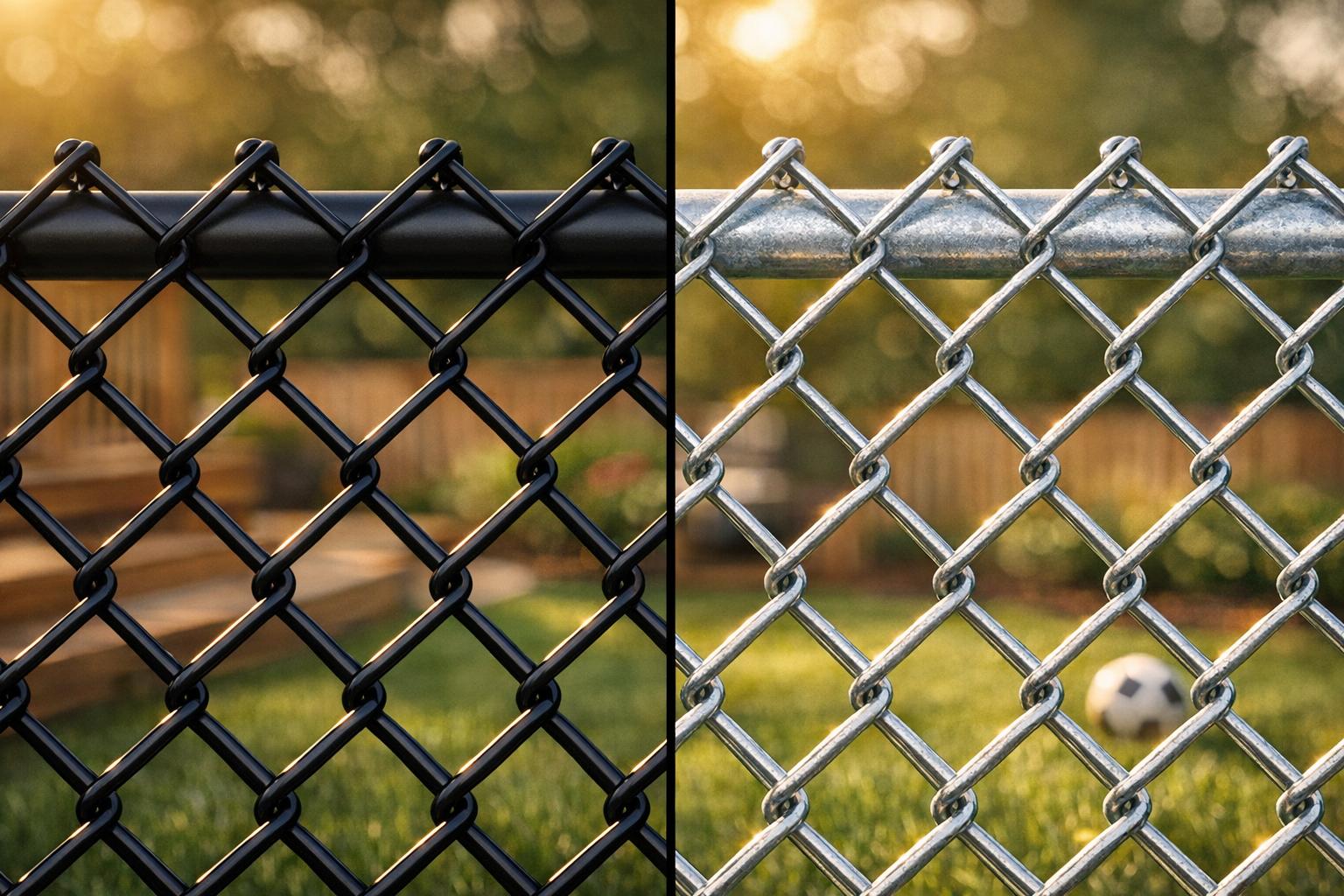
When choosing between vinyl-coated and galvanized chain link fences, the decision boils down to durability, cost, and appearance. Here’s the key takeaway:
- Galvanized fences are cheaper upfront ($15–$29 per linear foot installed) and last 15–20 years in inland areas. However, they’re prone to rust in coastal regions, requiring more maintenance and earlier replacement.
- Vinyl-coated fences cost about 30% more initially (~$26 per linear foot installed) but offer better corrosion resistance, especially in humid or coastal areas. They last 20–25 years, require less maintenance, and come in various colors like black, green, and brown for a more polished look.
Quick Comparison
| Feature | Galvanized Chain Link | Vinyl-Coated Chain Link |
|---|---|---|
| Cost (per LF) | $15–$29 | ~$26 |
| Lifespan (Inland) | 15–20 years | 20–25 years |
| Lifespan (Coastal) | 5–7 years | 15–20 years |
| Maintenance Cost | $50–$100/year | $25–$50/year |
| Appearance | Metallic silver-gray | Multiple colors |
If you’re prioritizing durability and aesthetics, vinyl-coated fencing is worth the investment. For residential projects or industrial use, galvanized fencing is a practical choice.
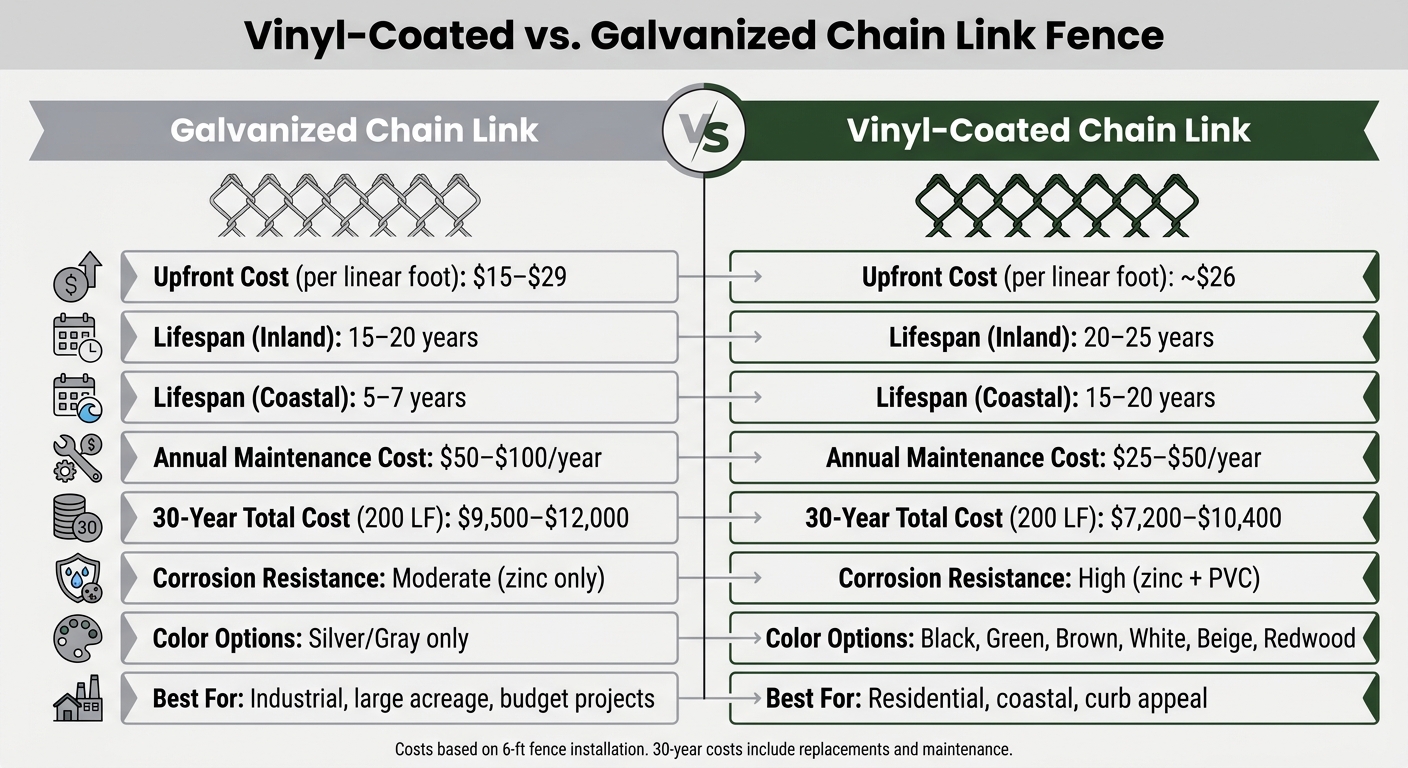
Vinyl-Coated vs. Galvanized Chain Link Fence: Cost, Lifespan & Maintenance Compared
Why Black Chain Link Is the Top Choice for Residential
sbb-itb-d1d0a96
What Is a Galvanized Chain Link Fence?
A galvanized chain link fence is made from steel mesh coated with zinc, creating a strong shield against rust. The process, known as hot-dip galvanization, involves dipping the steel in molten zinc, forming a tough barrier that withstands rain, snow, humidity, and pollutants. While aluminum is sometimes used for a lighter finish, zinc remains the standard choice.
"A galvanized chain link fence can last 20 years or more." – Duraguard Fence Ltd.
However, coastal environments can speed up corrosion. If you’re within a mile of saltwater, rust may appear in just 5–7 years. For those in humid or coastal regions, this is an important consideration.
Key Features of Galvanized Chain Link Fences
When function and affordability matter more than looks, galvanized chain link fences are a solid option. Their open mesh design allows wind to pass through, offering only about 35% solid surface area, which is a big plus in windy conditions. Additionally, they stand up to cold weather better than materials like vinyl or PVC, which can crack when temperatures drop below 20°F.
| Feature | Galvanized Chain Link |
|---|---|
| Primary Material | Steel |
| Protective Coating | Molten Zinc (standard) or Aluminum |
| Expected Lifespan | 15–20+ years |
| Maintenance | Low – rust treatment every 3–5 years |
| Wind Resistance | Excellent (open mesh design) |
| Best For | Security, large acreage, commercial/industrial use |
While maintenance is relatively low, it’s not entirely hands-free. Regular checks for rust, tightening sagging mesh, and replacing damaged tie wires are necessary. Annual upkeep typically costs between $50 and $100. For large properties, construction sites, sports fields, or industrial areas, galvanized chain link fences strike a practical balance between cost and functionality.
This breakdown highlights the key attributes of galvanized chain link fencing, laying the groundwork for comparing it with vinyl-coated alternatives in terms of durability, cost, and appearance.
What Is a Vinyl-Coated Chain Link Fence?
A vinyl-coated chain link fence combines a galvanized steel core with a PVC (polyvinyl chloride) coating. This outer layer not only improves the fence’s appearance but also protects it from moisture and salt air, helping to prevent rust and corrosion. The PVC coating acts as the first line of defense, while the galvanized steel underneath provides backup protection if the coating chips. This dual-layer design makes vinyl-coated fences more durable than standard galvanized ones, especially in wet or coastal areas. Vinyl-coated fences typically last 15–20 years in such environments, compared to just 5–7 years for their galvanized counterparts.
The type of vinyl coating also affects durability. Class 2B coatings, which are thermally bonded, are more resistant to cracking and fading than Class 1 extruded coatings. Class 1 coatings are simply applied over the wire and are more prone to peeling over time. For long-term use or high-traffic areas, opting for a Class 2B coating is a better choice.
"If the fence will be in a prominent place and you want it to look attractive, use a vinyl coated mesh. If the fence will be less visible and you don’t mind a utilitarian appearance, use a GBW mesh." – Duncan Page, Louis Page
Key Features of Vinyl-Coated Chain Link Fences
What sets vinyl-coated chain link fences apart is their combination of durability and visual appeal. Unlike standard galvanized fences, which are only available in a metallic silver-gray finish, vinyl-coated options come in a variety of colors, including black, green, brown, white, gray, beige, and redwood. Black is especially popular for residential properties because it blends into the background, making the fence less noticeable. As Duncan Page of Louis Page explains, "black mesh tends to disappear into the background, becoming virtually invisible. You can see whatever is on the other side of the fence more clearly". This makes black vinyl-coated fences a great choice for those who prioritize security but want to avoid an industrial look.
| Feature | Vinyl-Coated Chain Link |
|---|---|
| Primary Material | Galvanized steel core + PVC coating |
| Expected Lifespan | 20–25 years |
| Coastal Lifespan | 15–20 years |
| Annual Maintenance | $25–$50 |
| Color Options | Black, Green, Brown, White, Gray, Beige, Redwood |
| Warranty (Coating) | 15–20 years (most manufacturers) |
| Best For | Residential yards, coastal properties, visibility-sensitive areas |
These fences also offer practical benefits, like pairing well with color-matched privacy slats. These slats can be inserted directly into the mesh, providing 70–85% visual screening in colors like green, black, brown, or white. This is an excellent option for homeowners who want more privacy without changing the overall fence style.
With their extended lifespan, lower maintenance needs, and aesthetic versatility, vinyl-coated chain link fences stand out as a premium option compared to standard galvanized fences. They’re a smart investment for anyone looking to combine durability with a polished, modern look.
Durability and Lifespan: Vinyl-Coated vs. Galvanized
When it comes to how long a fence lasts, the environment plays just as big a role as the materials used. In dry, inland areas, a standard galvanized fence usually holds up for about 15–20 years, while vinyl-coated fences often last 20–25 years under similar conditions.
However, the story changes dramatically in coastal regions. Saltwater exposure can cause a galvanized fence to start rusting in as little as 5–7 years. On the other hand, vinyl-coated fences in the same environment can last 15–20 years, making them two to three times more durable. For anyone living near the Gulf Coast, the Atlantic, or the Pacific, this is a major consideration.
The difference comes down to how these fences are protected. Galvanized fences rely on a zinc coating to keep moisture at bay. Vinyl-coated fences, however, go a step further by adding a PVC outer layer on top of the zinc, which prevents moisture and salt from ever reaching the steel. As long as the PVC coating remains intact, the steel underneath stays protected. These differences not only affect how long the fences last but also how much maintenance they require.
Galvanized fences need rust treatment every 3–5 years, with upkeep costs averaging $50–$100 per year. By contrast, vinyl-coated fences require only occasional cleaning, which costs about $25–$50 annually. It’s also worth noting that the tie wires on both types of fences tend to corrode faster than the main fabric, so regular inspections are key to preventing issues like sagging.
Comparison Table: Durability and Lifespan
Here’s a side-by-side look at how galvanized and vinyl-coated fences stack up:
| Metric | Galvanized Chain Link | Vinyl-Coated Chain Link |
|---|---|---|
| Expected Lifespan (Inland) | 15–20 years | 20–25 years |
| Expected Lifespan (Coastal) | 5–7 years | 15–20 years |
| Corrosion Resistance | Moderate (zinc coating only) | High (zinc + PVC barrier) |
| Performance in Humidity | Prone to early red rust | Excellent; PVC blocks moisture contact |
| Coating Warranty | 10–15 years | 15–20 years |
| Annual Maintenance Cost | $50–$100 | $25–$50 |
| Maintenance Frequency | Rust treatment every 3–5 years | Minimal cleaning/inspection |
Cost Comparison: Vinyl-Coated vs. Galvanized Chain Link Fences
Vinyl-coated chain link fences come with a higher upfront cost – about 30% more than galvanized options. For a 6-foot galvanized chain link fence, installation typically costs between $15 and $29 per linear foot, while vinyl-coated fences average around $26 per linear foot. For a 200-linear-foot project, this translates to $4,000 for galvanized and $5,200 for vinyl-coated options. Additional features like walk gates cost $175–$350 installed, and double drive gates range from $350–$700, regardless of the fence type.
When looking at long-term costs over 30 years, the difference becomes more apparent. Galvanized fencing, which may require one or two replacements during this time, can total $9,500 to $12,000 for the same 200-linear-foot project. In contrast, vinyl-coated fencing, with its longer lifespan, costs around $7,200 to $10,400. On an annual basis, this breaks down to $267–$400 for galvanized fencing compared to $264–$347 for vinyl-coated. If you’re replacing an old fence, expect to add $3 to $5 per linear foot for removal and disposal costs.
Comparison Table: Cost Breakdown
| Cost Factor (6 ft Height) | Galvanized Chain Link | Vinyl-Coated Chain Link |
|---|---|---|
| Installed Cost (per LF) | $15–$29 | ~$26 |
| Total Cost (200 LF) | ~$4,000 | ~$5,200 |
| Annual Maintenance | $50–$100 | $25–$50 |
| Expected Lifespan | 15–20 years | 20–25 years |
| 30‑Year Total Cost | $9,500–$12,000 | $7,200–$10,400 |
| Annual Cost | $267–$400 | $264–$347 |
| Wire/Coating Specification | Class 1 Zinc (1.2 oz/sq ft) | 9‑ or 11‑gauge steel with PVC |
While the annual cost difference is relatively small, vinyl-coated fencing offers better long-term value due to its durability and reduced maintenance. For projects with a $5,000 budget, galvanized fencing is a solid choice, but stretching the budget slightly for vinyl-coated fencing could lead to meaningful savings over time. That said, cost isn’t the only factor – appearance and personal aesthetic preferences should also weigh into the decision.
Appearance and Aesthetic Differences
When choosing between fence types, appearance can play a major role, especially if you’re considering curb appeal. Galvanized fences come with a metallic finish – shiny at first but eventually fading to a dull, matte gray as the zinc coating oxidizes. This creates a functional, no-frills look that often feels industrial. You’ll usually find galvanized fences around construction sites, sports fields, or utility areas where practicality outweighs visual appeal. This reflective, metallic finish makes them stand out, which can affect how they complement – or clash with – the surrounding environment.
Vinyl-coated fencing, on the other hand, offers a more polished and versatile aesthetic. Its smooth, plastic-polymer coating is available in colors like Black, Forest Green, and Woodland Brown, making it easier to blend with your property’s surroundings. The added color options allow for a more tailored look, whether you’re enclosing a backyard or enhancing a commercial property.
Color selection matters because it influences how your fence interacts with its environment. Black vinyl-coated fences are a favorite for residential properties because their dark tone absorbs light, making the mesh nearly invisible from a distance. Similarly, green vinyl-coated fences work well in landscaped areas, blending naturally with grass and trees. In contrast, galvanized fences, with their reflective surface, create a more noticeable visual boundary.
Another advantage of vinyl-coated systems is the availability of color-matched hardware. Posts, caps, tension bars, gate clips, and hinges can all be coordinated with the fence color, creating a seamless appearance. This long-term investment is often backed by a comprehensive warranty. Galvanized fences lack this option, as their hardware is limited to the same silver-gray steel finish.
Here’s a quick side-by-side comparison to help visualize the differences:
| Feature | Galvanized Chain Link | Vinyl-Coated Chain Link |
|---|---|---|
| Finish | Metallic silver-gray | Smooth PVC over zinc |
| Standard Colors | Silver/Gray only | Black, Forest Green, Woodland Brown |
| Visibility | High (reflective, stands out) | Low (blends with surroundings) |
| Hardware | Standard metallic fittings | Coordinated, color-matched hardware |
| Best Fit | Construction sites, sports fields | Residential yards, commercial properties |
If appearance and curb appeal are important – whether for a backyard, a multi-family housing complex, or a commercial property – vinyl-coated fencing is the way to go. However, galvanized fences remain a practical choice for projects where aesthetics are less of a concern, like industrial or utility-focused applications.
How to Choose Between Vinyl-Coated and Galvanized Chain Link Fences
When deciding between vinyl-coated and galvanized chain link fences, focus on four key factors: budget, location, maintenance, and appearance. These considerations build on the earlier comparisons of durability, cost, and aesthetics to help you make the best choice.
Budget often takes center stage. Galvanized fencing is cheaper upfront, but its shorter lifespan can make it more expensive over time. Over a 30-year period, galvanized fences typically cost more due to earlier and more frequent replacements. In contrast, vinyl-coated fencing, though pricier initially, requires fewer replacements and ends up being more cost-effective. As NMI Fence explains:
"Standard galvanized chain link is the most expensive option on a 30-year basis because it needs replacement sooner."
Location plays a significant role too. If you live near the coast or in a humid area, vinyl-coated fencing is better because it resists corrosion more effectively. However, for inland, rural, or large properties where corrosion isn’t a major concern and upfront cost is key, galvanized fencing is a solid option.
Think about how much maintenance you’re willing to handle. Galvanized fences need rust treatment every 3 to 5 years, costing around $50 to $100 annually. On the other hand, vinyl-coated fences require minimal upkeep – just an occasional rinse, which costs about $25 to $50 per year. If you prefer a low-maintenance option, vinyl-coated fencing is the way to go.
Finally, appearance and local regulations can sway your decision. Many HOAs ban standard galvanized chain link but allow vinyl-coated versions. Additionally, a 2024 survey showed that 68% of real estate agents view standard chain link as a negative for curb appeal in homes priced above $300,000. A smart compromise? Use vinyl-coated fencing for visible front and side yards to enhance curb appeal, and opt for galvanized fencing in less noticeable areas like the rear perimeter to save on costs.
Tend Fencing‘s Chain Link Fence Installation Services
When it comes to chain link fences, the quality of installation plays a huge role in ensuring durability and long-term value. No matter which material you select, a properly installed fence is essential to protect your investment. Tend Fencing serves both homeowners and businesses in Plano, TX, and nearby areas, handling residential and commercial projects with a strong emphasis on precision and detail.
Chain link fencing is particularly useful for properties with uneven terrain, especially those with slopes greater than 15%. Its flexible mesh design can be angled to match the landscape, eliminating the gaps often seen with vinyl panels on sloped ground. On flat surfaces, installation is impressively efficient – a two-person crew can install 200 linear feet of 6-foot chain link fencing in just 1 to 1.5 days, which is about 25–35% faster than vinyl fence installations. Tend Fencing adheres to strict industry standards: galvanized chain link fences feature a Class 1 zinc coating at 1.2 oz/sq ft, offering a lifespan of 15–20 years, while vinyl-coated fences use UV-stabilized PVC, lasting 20–25 years. For added functionality, you can customize your fence with security features like barbed wire or razor ribbon toppers (an additional $2–$4 per linear foot) or enhance privacy with slats ($3–$7 per linear foot), which provide 70–85% screening.
Why Choose Tend Fencing?
Tend Fencing takes a personalized approach, offering consultations to help you choose the best material and design for your property, budget, and specific needs. Fully licensed and insured, they are dedicated to delivering exceptional craftsmanship and ensuring customer satisfaction. As an added touch, for every fence they install, Tend Fencing plants a tree – an effort to contribute to environmental responsibility.
Conclusion
Deciding between vinyl-coated and galvanized chain link fencing comes down to three key factors: budget, environment, and appearance – each playing a role in durability and long-term costs. Galvanized fencing runs about $15–$29 per linear foot installed. While it’s cheaper upfront, it tends to rack up higher maintenance and replacement expenses over time. On the other hand, vinyl-coated fencing, which costs roughly 30% more initially, offers a longer lifespan and lower annual upkeep.
The environment is another major consideration. In coastal areas within a mile of saltwater, galvanized steel can start showing rust in as little as 5–7 years, while vinyl-coated fencing holds up much better under these conditions.
For residential properties, aesthetics often take center stage. Galvanized fencing has a more industrial look that might not suit a front yard, whereas vinyl-coated options – particularly in black – blend seamlessly into landscaping and are generally preferred for curb appeal. By weighing these factors, you can choose a fence that aligns with both your budget and style preferences.
If you’re unsure, reach out to Tend Fencing. Based in Plano, TX, their team specializes in both residential and commercial projects. They can even design a hybrid layout – using vinyl-coated fencing for visible areas and galvanized fencing for less prominent sections – to strike the perfect balance between style and cost. Make your choice with confidence, keeping your environment and property’s character in mind.
FAQs
How do I know if my area counts as ‘coastal’ for rust risk?
Coastal areas are commonly defined as regions near saltwater bodies such as oceans, seas, or salt lakes. The combination of salty air and high humidity in these locations significantly raises the risk of rust and corrosion. If your property is within a few miles of the coast, it’s wise to explore protective measures like vinyl coatings or other rust-resistant treatments to safeguard your chain link fence from damage.
What happens if the vinyl coating chips or cracks?
If the vinyl coating gets chipped or cracked, it can impact the fence’s look and leave the metal underneath exposed. Once exposed, the metal becomes more vulnerable to corrosion, especially in damp or harsh weather conditions, which can lead to further deterioration over time.
Which fence type is best for a sloped yard?
Vinyl-coated chain link fences work well for sloped yards because they can be adjusted to fit the slope seamlessly. By modifying the fabric and posts, these fences create a smoother, more cohesive appearance. On the other hand, galvanized chain link fences are less flexible and often need additional adjustments to handle slopes, which can make installation more complicated and expensive. If you’re dealing with uneven terrain, vinyl-coated fencing offers a more adaptable and visually appealing solution.