

Acoustic fencing can cut traffic noise – not silence a school. Traffic-noise barriers typically reduce noise by 5–10 decibels, but placement, height, and gaps affect results. I’d start by mapping road noise during drop-off and pickup, then checking where a fence could help without blocking staff views or emergency access.
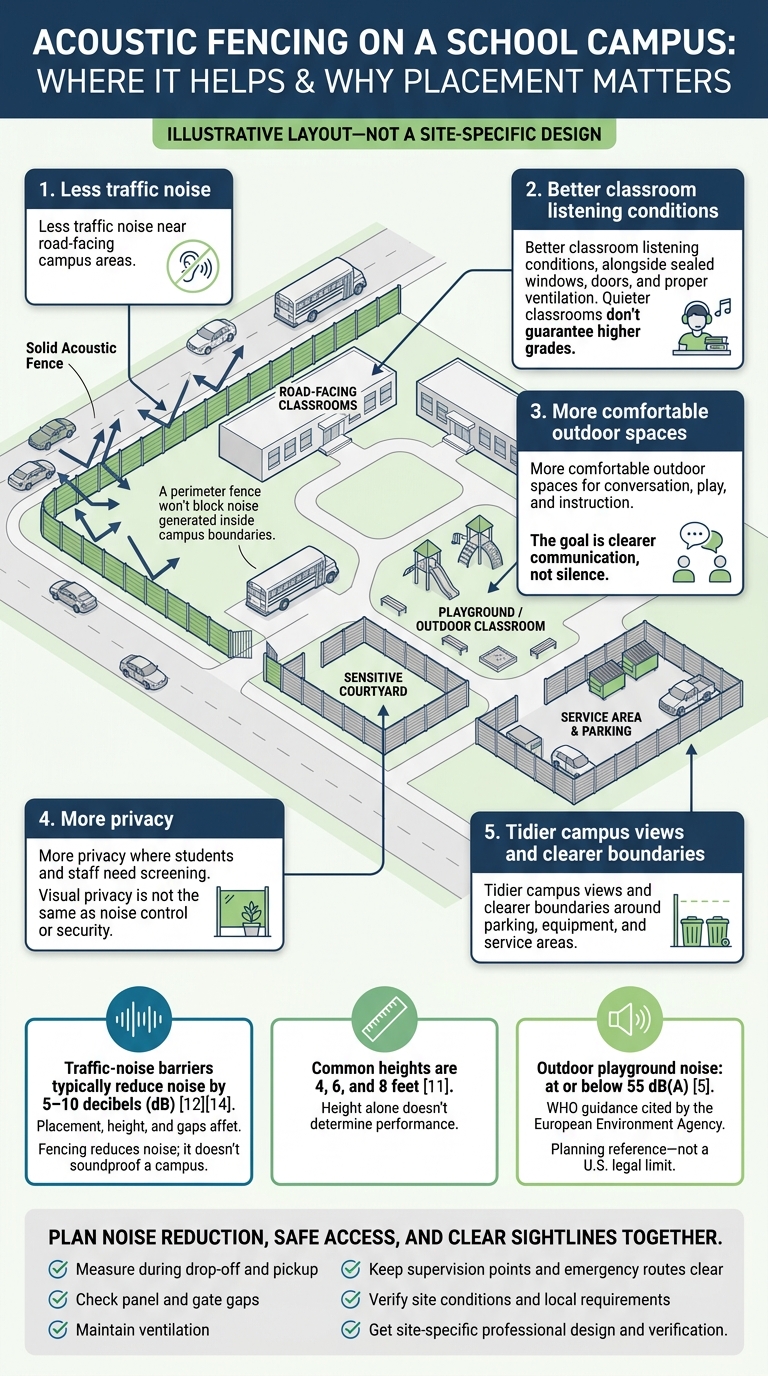
For your school, a well-planned fence can offer five gains:
- Less traffic noise near road-facing campus areas.
- Better classroom listening conditions, alongside sealed windows, doors, and proper ventilation.
- More comfortable outdoor spaces for conversation, play, and instruction.
- More privacy where students and staff need screening.
- Tidier campus views and clearer boundaries around parking, equipment, and service areas.
My advice: plan for <u>noise reduction, safe access, and clear sightlines together</u>. A fence is one part of the solution – not a replacement for building repairs, supervision, or site-specific noise checks. If you’re ready to improve your campus environment, you can request a free quote for your project.
5 Benefits of Acoustic Fencing for Schools
Acoustic Effectiveness of Vinyl Fence Noise Walls
sbb-itb-d1d0a96
How Acoustic Fencing Works at Schools
A solid acoustic fence reduces sound transmission between a noise source and the area it protects. Placement, height, and site conditions all affect how well it works. Common heights are 4, 6, and 8 feet, but height alone doesn’t determine performance.
Gaps let sound through, whether they’re under panels, between boards, or around gates. Board-on-board construction uses overlapping pickets to reduce those gaps. On slopes, carefully planned stepped and level transitions help maintain coverage without leaving large openings underneath.
Acoustic fencing should be part of a complete noise-control plan that also addresses windows, doors, and insulation. This matters most along roads, bus lanes, and parking areas that border the campus.
1. Less Traffic Noise Around Campus
With that barrier effect in mind, one clear benefit for schools is less traffic noise around campus. Acoustic fencing can reduce roadside noise at the campus edge, but it won’t eliminate it. Traffic-noise barriers typically reduce noise by 5–10 decibels (dB). Sound can still travel around the ends and through open gates. Plan for the barrier to extend beyond road-facing school areas instead of fencing only the busiest stretch.
The reduction matters most during busy arrival and dismissal periods, especially when vehicle queues sit outside the barrier. A perimeter fence won’t block noise generated inside campus boundaries, such as buses idling in an on-campus loop. Assess noise during morning drop-off and afternoon pickup, when campus traffic is highest.
2. Better Conditions for Classroom Focus
The same noise reduction can help nearby classrooms stay quieter, making instructions easier to hear during lessons, discussions, and testing. Noise from traffic, construction, playground activity, and lawn equipment can disrupt speech, learning, attention, and memory.
Quieter classrooms don’t guarantee higher grades. Studies link chronic transportation noise to weaker reading outcomes, but findings on attention and working memory are less consistent.
Results also depend on classroom location, window and door seals, ventilation openings, and wall insulation – not just the fence. Start with road-facing classrooms and measure indoor noise before and after installation under similar conditions. Check seals, too, without reducing ventilation.
3. More Comfortable Outdoor School Spaces
The same noise reduction can make outdoor learning and recreation areas more comfortable. Less noise at the campus edge makes conversation and play easier in playgrounds and courtyards. It can also help students hear coaching on athletic fields and directions in outdoor classrooms. The goal is clearer communication, not silence.
World Health Organization guidance cited by the European Environment Agency recommends keeping outdoor playground noise at or below 55 dB(A). Use that as a planning reference, not a U.S. legal limit.
Less noise may reduce annoyance, but fencing is not a treatment for anxiety or behavior problems.
Place commercial fencing where students spend time outside. Focus on playground edges beside roads, outdoor classrooms, courtyards used for instruction, and athletic spaces near highways or commercial areas.
Compare daytime sound measurements before and after installation, along with staff observations, student feedback, and complaints. Can students in the farthest seats hear normal speech? Can staff hear student calls, whistles, and emergency instructions?
Keep accessible paths, gates, and emergency routes clear. Avoid hidden corners, maintain clear staff sightlines, and leave enough space for equipment access and ordinary play.
4. More Privacy for Students and Staff
Acoustic fencing does more than improve comfort. It can also shield sensitive outdoor spaces from views along roads and from nearby properties.
Examples include playgrounds, counseling courtyards, special education outdoor spaces, and staff break areas.
Place screening where visual separation is needed, rather than around the whole campus by default. Where you put the panels matters as much as which panels you choose.
Visual privacy is not the same as noise control or security. Blocking a view doesn’t automatically reduce traffic noise or stop people from entering without permission.
Map views from streets, homes, and public paths. Then check the layout from reception areas, gates, and staff observation points. Keep entrances and supervision points visible. Set panels back where needed so drivers can see pedestrians at driveways and crosswalks.
Use solid panels beside sensitive spaces and open fencing near entrances and supervision points. Before approval, require a scaled site plan that shows this mix, gate locations, and sightlines.
5. Tidier Campus Views and Boundaries
Acoustic fencing does more than add privacy. It can give the campus edge a cleaner, more orderly look by screening parked vehicles, dumpsters, utility equipment, loading areas, and street activity – all while keeping key sightlines open.
Match fence colors and materials to the school buildings and landscape so the screen looks like a planned part of the campus.
After installation, regular upkeep helps the boundary look complete. Keep vines, weeds, and branches clear of the fence, gates, lighting, and drainage. Leave enough room for mowing and panel inspections.
Remove graffiti promptly with panel-approved cleaners. Harsh solvents and high-pressure cleaning can damage the finish.
Keep gates aligned, clearly marked, and working properly so the boundary looks continuous. Check for damage after severe weather, vehicle impacts, and landscaping work, and make repairs promptly to prevent gaps in the visual boundary.
Conclusion: Plan Fencing for Your School
Plan acoustic fencing around your school’s site and needs. A well-planned fence can improve noise control, learning conditions, outdoor comfort, privacy, and campus appearance.
These results aren’t automatic. Fencing reduces noise; it doesn’t soundproof a campus. Get site-specific professional design and verification before relying on it for noise reduction.
Match the layout to the campus’s busiest and most exposed areas. Walk the site during arrival, dismissal, lunch, and after-school periods. Map the noisiest and most-used areas, including traffic routes. Before placing solid fence sections, check pedestrian routes and make sure staff can still see the areas they need to supervise.
Before finalizing the layout, check drainage, underground utilities, and property lines. Confirm gate access with first responders, and verify permits, height limits, accessibility rules, and district requirements with local officials.
FAQs
How can we tell if acoustic fencing will help our school?
Check for a direct line of sight between the noise source and the area you want to protect. To block that sound path, the fence needs to be tall, solid, and free of gaps.
Compare noise levels before and after installation, or check the material’s Sound Transmission Class (STC) rating. If you’re dealing with heavy traffic noise or noise reaching upper floors, get a professional acoustic or structural review to assess how much noise reduction your site could achieve.
What should our school budget for acoustic fencing?
Costs vary based on materials, engineering, grading, and permits. Installed wood privacy fencing typically starts at $18–$38 per linear foot, while composite systems range from $75–$95 per linear foot. Masonry can cost $34.37–$47.11 per square foot. High-performance layered acoustic barriers are custom installations with premium pricing.
Sound reduction depends on height, mass, and sealed edges – not just the material. Ask for itemized quotes that include gates, demolition, grading, permits, and structural reinforcement.
Can acoustic fencing be added without disrupting classes?
Yes. Tend Fencing schedules installation around the school’s needs to limit disruptions to classes and daily routines. Serving Plano, TX, and surrounding areas, its licensed and insured crews work efficiently, with a focus on safety and clear communication. This helps keep the campus running smoothly while improving noise reduction, privacy, and security.